 APTF
APTFEmotions in forex trading
Controlling emotions in forex trading is usually understood as the ability to feel nothing. That is unattainable and unnecessary: without emotions a person makes no decisions at all. The manageable part is different — at which moment of a trade an emotion gets access to the button, and how many decisions you left for that moment.
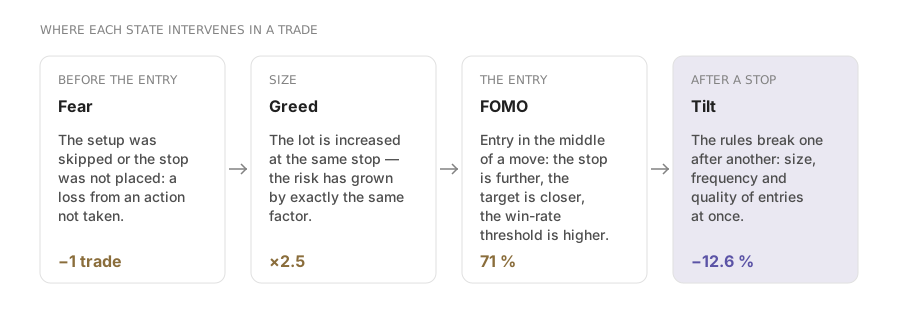
Six states and the point where each one interferes
It is useful to look not at the name of a feeling but at its place in the chain of a trade. The same nerves before an entry and after an entry produce different mistakes and are treated by different rules.
| State | Where it interferes | What the hands do | Price |
|---|---|---|---|
| Fear | Before entry and in position | Skips the setup, does not place the stop | Edge not collected |
| Greed | When calculating size | Increases the lot without changing the stop | Risk above plan |
| FOMO | At the sight of someone else's move | Enters after most of the move | A poor entry price |
| Tilt | After a heavy loss | Breaks rules one after another | A run of violations |
| Gambling urge | In the absence of a setup | Looks for a trade for the process | Overtrading |
| Euphoria | After a good run | Raises size «on the wave» | The largest loss |
Note the last row: the biggest loss most often comes not after a run of failures but right after the best run. This is a stable observation from journals, and the explanation is simple — control weakens after success, not after failure.
Working nerves against dangerous gambling urges
They cannot be told apart by the strength of the sensation: the pulse is the same. They differ by what the attention is directed at and by what happens to the rules.
A one-question check. «If I close the terminal for two hours right now, will I feel relief or loss?» Relief means you are in a working state and simply tired. A sense of loss, that «the move will get away», is already a gambling urge, and in that state a trade will cost more than the average.
Controlling emotions on forex: why «pulling yourself together» does not work
Self-control is a consumable resource. It is high in the morning, in a calm state and on a flat account, and it is at its minimum exactly when it is needed: after the second stop, late in the evening, in the fourth hour at the chart. Building a system on it means designing for the best case.
Two approaches to one task
Hence the order that runs through the whole site: first a limit, then measurement, and only then work on the state itself. The reverse order is the most common reason «psychology does not help».
What to do with each state
- Fear prevents entering and placing the stop
- Reduce position size to a sum whose loss does not change the evening. The breakdown is in fear in trading.
- You want to add size on an «obvious» signal
- Size is calculated by a formula from risk and is not revised in the moment. The breakdown is in greed.
- Price left without you and you want to catch it
- The rule «after X points of the move the entry is cancelled» solves this mechanically. The breakdown is in FOMO.
- After a big loss everything went off the rails
- A stop-day introduced in advance. The breakdown is in tilt.
- A trade is needed even when there is no setup
- A limit on the number of trades per day and a list of permitted pairs. The breakdown is in gambling and addiction.
- After a good week the size grew by itself
- A constant-risk rule and a ban on changing it more often than once a month. The breakdown is in euphoria.
Bodily signs: how to recognise a state before it reaches the button
An emotion becomes expensive not at the moment it arises but at the moment it reaches an action. Between those two points there is a window of several minutes, and it is recognised by the body rather than by thoughts — by then the thoughts have already been selected to fit the desire.
| Sign | What usually stands behind it | What to do in those minutes |
|---|---|---|
| A pulse in the ears, heat in the face | Tilt or a gambling urge after a strong move | Get up from the desk without closing positions that are running to plan |
| Holding your breath before the click | Fear of entering on a completed setup | Check the size: almost always it is bigger than calculated |
| The sense of time has gone | A gambling urge and overtrading | Look at the number of trades this session and compare it with the limit |
| Tension in the shoulders and jaw | Accumulated stress rather than the current trade | Close the session: the quality of decisions has already fallen |
| Lightness and «everything is clear» | Euphoria after a run of profits | Check the current size against the recorded base risk |
| An urge to open the terminal outside the window | A gambling urge or postponed revenge trading | Do not open it: a trade outside the schedule is statistically the worst |
Notice that in almost every row the action is the same — look at a number, not at the chart. That is not a coincidence: your own state is judged unreliably, whereas size, the number of trades and what is left of the daily limit are verifiable quantities.
What happens to expectancy when a state decides
A conversation about emotions becomes concrete when they acquire a sign in a formula. Take a system with an edge and look at what each state does to it separately — with the entry rules unchanged.
| State | What changes in the trade | Win rate | Average R | Expectancy |
|---|---|---|---|---|
| Working to plan | nothing | 45 % | +2.00 / −1.00 | +0.350 R |
| Fear at the exit | profit cut to 1R | 45 % | +1.00 / −1.00 | −0.100 R |
| Greed in size | risk ×2.5 on some trades | 45 % | +2.00 / −2.50 | −0.475 R |
| FOMO at the entry | stop further away, target closer | 45 % | +0.40 / −1.00 | −0.370 R |
| Overtrading | extra trades at a 30 % win rate | 38.6 % | +2.00 / −1.00 | +0.157 R |
| Tilt | size ×3, entries outside the setup | 30 % | +2.00 / −3.00 | −1.500 R |
plan: 0.45 × 2.00 − 0.55 × 1.00 = +0.350 R
fear at the exit: 0.45 × 1.00 − 0.55 × 1.00 = −0.100 R
The main conclusion of the table is in the second row. Early profit-taking alone, without a single violation of the entry rules and without any growth in size, flips the sign of the system. That is the answer to why a strategy that «works on history» does not work on an account: on history a robot closes the trade, on an account a human does.
Frequently asked questions
Can you learn to trade without emotions?
Without emotions, no; without emotional decisions, yes. The difference is that the feeling stays but the action is not tied to it: the stop is already placed as an order, the size is calculated by a formula, the daily limit is set. The sensation does not go anywhere, it simply no longer affects anything.
Is it true that experienced traders feel nothing?
No. What changes is not the strength of the feeling but its consequences: an experienced trader has closed in advance every point where a feeling could have interfered. On top of that comes the habit of recognising a state by bodily signs before it reaches the button.
Do breathing practices and meditation help?
As a way to lower the general level of arousal, yes — this is supported both by experience and by research on stress resilience. As a replacement for rules, no: a calm person without a stop loses exactly as much as an agitated one without a stop.
Which emotion do I start with if all of them get in the way at once?
None of them. When it feels like «everything gets in the way», what works is not analysing states but introducing a hard external limit for a couple of weeks: one trade a day, a fixed size, a stop-day after the first loss. Once the flow of decisions narrows, it becomes visible which state is the leading one — the breakdown map shows the same thing.
Read next
