 APTF
APTFForex addiction and gambling disorder
Forex addiction is a question asked in two opposite senses: to dismiss the activity entirely, and to avoid an honest answer about oneself. Both extremes get in the way. Trading by a system and gambling addiction differ not by the market and not by the sum, but by what the action is done for.
How trading by a system differs from gambling
The difference is not the presence of risk — there is risk in running a business too. The difference lies in three verifiable properties.
| Trading by a system | Gambling | |
|---|---|---|
| What the action is for | For the expected result over a distance | For the process itself and the arousal |
| Is the expectancy known | Yes, calculated from statistics | No, and the question does not come up |
| What happens without a signal | There is no trade, the day is closed | A trade is found in any case |
| Reaction to a win | An entry in the journal, size unchanged | The stake grows |
| Reaction to a loss | Stop-day | The stake grows |
| What a pause does | Nothing, it is a normal mode | Causes irritation and craving |
The key row is the second to last. In gambling both a win and a loss lead to the same thing: a bigger stake. If your behaviour after a plus and after a minus is identical and both times it is «more size», the question is worth asking seriously.
Why forex is a convenient environment for gambling
It is not about the market being «unfair» but about the currency market accidentally reproducing every condition that research on addictive behaviour calls reinforcing.
It does not follow that one must not trade. It follows that the environment does not help you by itself, and external limits are needed here more than in most other occupations.
Trading addiction: eight signs that mean you should stop
This is not a diagnostic questionnaire and not a substitute for a consultation. It is a list of observable facts; each of them separately occurs with ordinary traders too, but their combination is already another story.
What to do if three or more match. Do not try to solve it with trading rules: a daily limit and a stop-day are powerless here, because the very mechanisms that were supposed to hold them are the ones being broken. The working steps are different: close off access to topping up the account, tell one person close to you, and go to a specialist in addictive behaviour. This is the territory of medicine, not of trading, and the site cannot help here.
The in-between case: gambling urges without addiction
Far more common than addiction is episodic gambling: a state in which a trade is needed for the process, but control is broadly preserved. It is dealt with by ordinary means.
- A limit on the number of trades per day
- A hard number, three for example. After the third the terminal closes regardless of the result.
- A list of permitted instruments
- Two or three pairs. The absence of a signal on them means there are no trades today, not that you should look elsewhere.
- Pending orders instead of manual entry
- They remove the very process of «sitting and waiting for the moment», and with it most of the arousal.
- Planned days without trading
- One or two a week, set in advance. This is a test: if a day without trades is hard to bear, the market is not the problem.
Three levels: interest, episodic gambling, addiction
Between «I find this interesting» and «I cannot stop» there is a middle, and that is where most people are. Distinguishing the levels matters because the means differ: what helps at the second level is useless at the third.
| Level | How it looks | What works | What must not be done |
|---|---|---|---|
| Interest | Interest in the task, a pause is borne calmly, size is stable | Nothing special: ordinary rules and a journal | Considering yourself addicted on the strength of one episode |
| Episodic gambling | A trade is sometimes needed for the process, the number of trades jumps around, pauses are hard | A trade limit, a short list of pairs, pending orders, planned days without trading | Increasing size «to make it more interesting» |
| Addiction | Borrowed money, concealment, failed attempts to stop, growing sums for the same old sensation | Stopping trading, closing access to top-ups, help from a specialist | Trying to solve it with risk-management rules |
Why rules do not help at the third level. A daily limit, a stop-day and a trade limit work because you agree to follow them in a calm state. In addiction the very mechanisms that were supposed to hold them are the ones being broken — so an attempt to «pull yourself together through risk management» turns into a series of broken promises, deepens the guilt and changes nothing in substance.
Why variable reinforcement is so persistent
The mechanism was described in behavioural psychology long before retail forex appeared, and it is not about weak will. Reinforcement that arrives irregularly shapes behaviour more firmly than regular reinforcement and fades the most slowly — slot machines are built on exactly this.
A result for every action. Behaviour forms quickly and fades just as quickly when the result disappears.
easy to quitThe result arrives after an unpredictable number of attempts. Behaviour forms more slowly but holds for a very long time even without a result.
hard to quitA winning trade after a run of losing ones reinforces not the system but the action «try once more». The two reinforcements can be separated only by a record: was the trade by the rules or not.
hence the journalThe practical conclusion is not obvious and is worth writing down: a winning trade made outside the rules is more harmful than a losing one. A losing trade confirms the rule; a winning one outside the rules reinforces the violation, and in the most persistent mode there is. That is why such trades are marked separately in the journal rather than celebrated.
The cost of trades «for the process»: counted over a year
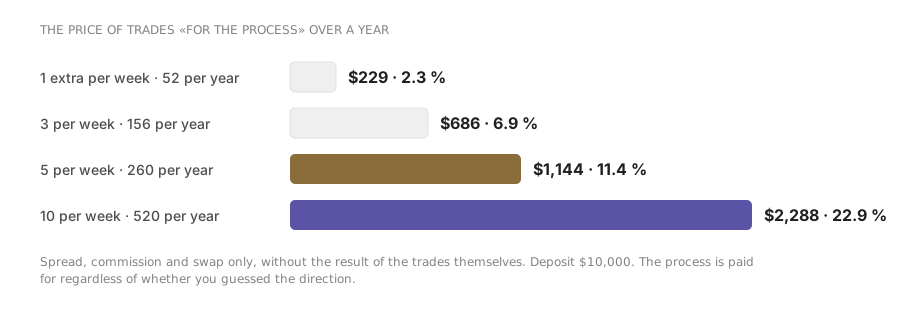
Gambling urges rarely show up as one large mistake — they show up as extra entries, each of which looks innocent on its own. A $10,000 account, costs of one trade $4.40 (spread, commission, swap).
| Extra trades per week | Per year | Costs only | That is, of the account |
|---|---|---|---|
| 1 | 52 | $229 | 2.3 % |
| 3 | 156 | $686 | 6.9 % |
| 5 | 260 | $1,144 | 11.4 % |
| 10 | 520 | $2,288 | 22.9 % |
This is only the fee for taking part: the result of the trades themselves is not in the table, and for entries «out of boredom» it is usually negative. The full calculation for your own spread and size is in the cost-of-a-trade calculator, and the number of entries a system actually requires is in the overtrading breakdown.
Frequently asked questions
Is trading gambling addiction?
Not in itself: trading by a system with positive expectancy and fixed risk is structurally no different from any other activity with an uncertain outcome. But the currency market provides every condition under which addictive behaviour forms easily, and some people genuinely fall into it — which is exactly why the question is worth asking yourself honestly rather than waving away.
What is trading addiction called?
There is no separate diagnosis of «trading addiction» in the classifications; cases are described through gambling disorder, because the mechanism is the same. For you this changes nothing in practice: the signs matter, not the name.
Can you return to trading after the signs have appeared?
Such cases exist, but that decision is not taken on your own or from an article on the internet. The general rule: a return is discussed only after a sustained break and together with the specialist who did the work.
Does switching to long-term positions help?
It sometimes reduces frequency but does not settle the question: the craving finds an outlet in bigger size or in adding instruments. Frequency is a symptom, not a cause.
Read next
