 APTF
APTFA forex trader's pre-trade checklist
A forex trader's checklist solves one task: inserting a procedure between the impulse and the button. It works not because it reminds you of the rules — you remember those anyway — but because it takes time. Thirty seconds is usually enough for a FOMO entry to stop looking sensible.
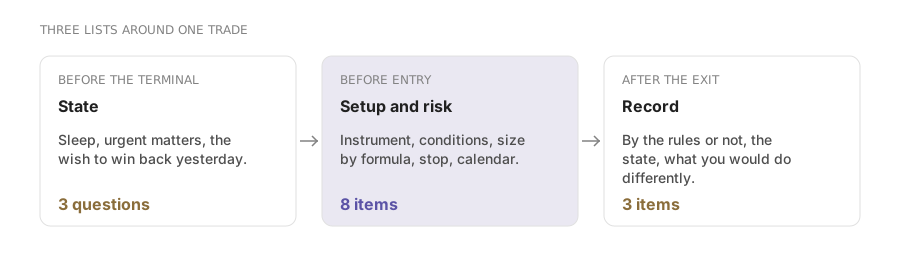
A pre-trade checklist on forex: eight points
The marks are saved in the browser, so the list can be kept open in a neighbouring tab and gone through before every trade. Nothing is sent anywhere.
Points 4 and 5 stand in that order deliberately: if you choose the size first, the stop will inevitably be fitted to it. The mark-up comes first, the size second — and that is the difference between calculation and greed.
A state checklist: three questions before opening the terminal
It is gone through once at the start of a session, not before every trade. A negative answer to any of the three means there is no trading today — and that is the cheapest trade of the day.
Lack of sleep hits the assessment of probabilities and inhibitory reactions harder than it hits attention. Subjectively it feels as though everything is fine.
physiologyIf there is a sum in your head that has to be won back, you must not trade. That is revenge trading with a delayed start.
the motiveTrading in passing produces entries without checks and exits at the doorbell. Better to skip the session entirely.
circumstancesHow to make sure the checklist does not get abandoned
- Keep it short
- Eight points are gone through in half a minute. A list of twenty is not gone through at all — it starts being ticked as a formality.
- Keep it where the terminal is
- A neighbouring tab, a sheet of paper by the keyboard, a note on the second screen. A checklist in another application does not get opened.
- Do not add points after every mistake
- Otherwise within a month the list has fifteen lines. A new point is added only at the planned review and only in place of an old one.
- Record the skips
- A trade made without the checklist is marked in the journal. Within a month you can see how its result compares with the rest — usually that is enough for the question to close itself.
Why a checklist works: the mechanics of delay
The effect of a checklist is not in reminding — you remember the rules anyway. The effect is in the delay between impulse and action. Thirty seconds is enough for the arousal to subside far enough that the decision becomes a decision again.
Three formats and how not to quit in the second week
A checklist gets abandoned not because it is useless but because it is inconveniently placed. The format matters more than the content.
| Format | Plus | Minus | Who it suits |
|---|---|---|---|
| This page in a neighbouring tab | The marks are saved, nothing needs setting up | You need a second screen or to switch | For those who trade at a computer |
| A sheet of paper by the keyboard | Always in view, requires no switching | Does not calculate statistics | For those who get distracted by tabs |
| A field in the trade journal | Immediately gives the share of trades that went through the list | Filled in after the entry rather than before | For those who already keep a journal |
| An order template in the terminal | Size and stop are calculated automatically | Does not check your state or the calendar | For those who trade often |
trades with the mark ÷ all trades for the period
a working level is from 90 %, and it grows faster than the overall rule-following share
The marks on this page are stored only in your browser and are tied to its address: a checklist on another page of the site neither sees them nor confuses them.
An exit checklist: three points after closing a trade
Many people have a list before the entry, almost nobody has one after the exit. And that is exactly where the material for a review is lost: an hour later the details have already been touched up by memory.
Not in currency: «plus two R» is comparable between trades and does not depend on the size of the account. Calculated by dividing the result by the risk of the trade.
right after the exitYes or no, naming the point broken from the closed list. A winning trade outside the rules is marked in the same way as a losing one.
right after the exitOnly if the trade was outside the rules. For a trade made by plan there are no conclusions regardless of the result — and that is the main protection against learning from noise.
the same day+$94 at a risk of $50 = +1.88 R — that number is comparable with any other trade of any month
Three points take a minute and close the most expensive loss of data — records of trades during bad periods. It is those that carry the main information, and it is those that are skipped most often.
Frequently asked questions
Does a checklist not stop you catching a fast move?
It does, and that is its function. Trades you cannot make within thirty seconds are entries in the middle of a move, whose required win rate is noticeably higher than yours. The detailed calculation is in the material on FOMO.
How does a checklist differ from a trading plan?
A plan is a document of decisions, a checklist is the procedure for verifying them at the moment of action. One plan usually yields one short checklist; it introduces no new rules.
What if a point is not met but you want to enter?
Do not enter. That is the only answer that makes a checklist work: a list that can be passed partially is no different from having no list.
Can the check be automated?
Partly: calculating size, checking the calendar and controlling the daily limit are easy to automate. The setup conditions are harder, and an attempt to formalise them fully usually runs into the fact that they were never formalised. That, incidentally, is a good test of the quality of a plan.
Read next
