 APTF
APTFTilt on forex
Tilt on forex is a state after a strong emotional blow in which decisions are taken outside the rules. The term came from poker, where it was described earlier and more precisely than on the exchanges. The key difference between tilt and ordinary upset: what changes is not your mood but your behaviour — size grows, the stop disappears, entries come one after another.
What triggers tilt
Not every loss produces tilt. What triggers it is not the size of the loss in itself but the gap between expectation and result.
The most frequent trigger. Everything was done correctly and the result is negative — and the main everyday conviction, that correct actions produce correct results, collapses.
a gap in expectationA feeling of personal injustice. Objectively this is half of all stops, but it is experienced as a targeted action by the market against you.
the illusion of intentA trade closed early that then went all the way to the target. It produces tilt no less often than a loss does, although you lost no money.
regretAn accumulation rather than a single event. Here tilt develops gradually and is therefore recognised in time less often.
accumulationThe signs: how to recognise it before it becomes expensive
The state is recognised by three groups of signs. The bodily ones appear first, the behavioural ones last — and it is the behavioural ones that cost money.
| Group | Sign | What to do at that moment |
|---|---|---|
| Bodily | A faster pulse, heat in the face, tension in the shoulders | Get up from the desk for five minutes |
| Bodily | A lost sense of time, forgetting to eat | Close the terminal, set a timer |
| Mental | «The market did it on purpose», «I have to get it back today» | Write the phrase down in the journal word for word |
| Mental | Piling up arguments in favour of an entry after the fact | Postpone the decision to the next session |
| Behavioural | Size above plan | Stop-day, trading stops |
| Behavioural | Trades not recorded in the journal | Stop-day, trading stops |
| Behavioural | An instrument outside the list is open | Stop-day, trading stops |
Note that for the behavioural group the action is one and the same. This is not a simplification: once the state has reached actions, it is too late to distinguish shades, and only a full stop works.
Why tilt costs more than it seems
In tilt it is not one variable that changes but three at once: the size of the risk, the frequency of trades and the quality of entries. Multiplied together they produce a loss out of all proportion to the original one.
1 % × 3 × 6 trades × 0.7 ≈ 12.6 % of the deposit in a single evening
The size multiplier and the share of losers are taken here as typical for the state: in tilt the share of winning trades falls below your usual win rate, because the entries happen outside the setup. The numbers are a model — what matters is the order of magnitude, not the second digit.
For comparison: the original loss that triggered the state was exactly one percent. The cost of the reaction exceeded the cost of the event by more than a factor of ten — and that is an ordinary proportion, not an extreme case.
How to get out of tilt on forex
The order of the actions matters more than their content: the first step is mandatory, and without it the rest do not work.
Not «I will not enter again» but close the terminal and put the phone away. The decision «I just will not trade» does not hold longer than ten minutes in this state.
immediatelyA walk, a shower, any exertion. The point is not rest but that physiological arousal subsides by itself in 20–40 minutes, if it is not kept up by a chart.
half an hourWhat happened, what you felt, what you wanted to do. The entry is made the same day: by tomorrow memory will have adjusted the story in your favour — that is hindsight bias.
in the eveningOne question: was it by the rules. A loss by the rules requires no conclusions at all; a loss from a breach requires one specific change to the rules, not five.
the next dayThe first five trades after tilt are taken at half size. This is not a punishment but a way to restore execution of the rules without the price of an error.
the next sessionOne change to the plan that follows from the review: the stop-day threshold, a trade limit, a ban on trading after a certain hour. Without this step the next tilt will arrive by the same script.
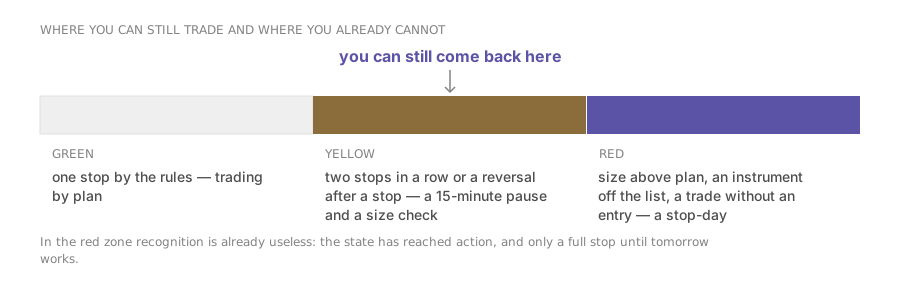
at the scheduled reviewA scale of states: where you can still trade and where you can no longer
Tilt does not switch on instantly — it builds up. It is useful to know your own markers in advance, because in the state itself your self-assessment is inflated.
Why there is one action for the red zone. Distinguishing shades of the state makes sense while decisions are still being taken. After the first action outside the rules the capacity for self-assessment falls faster than the loss grows, and any subtler scenario («I will trade a bit smaller», «just one entry») in practice returns you to the old size within half an hour.
The cost of tilt compared with the event that caused it
It is worth working out the proportion once: what the original event cost and what the reaction to it cost. For most people it turns out to be between 1:8 and 1:15.
| What happened | Price | Share of the evening |
|---|---|---|
| A stop by the rules — the event | −1.0 % | 7 % |
| Second trade at ×3 size | −3.0 % | 22 % |
| Third trade outside the setup | −3.0 % | 22 % |
| Fourth with the stop removed | −6.5 % | 49 % |
recovery needs a gain of +15.6 %, that is about 45 trades by the plan
This proportion is the main argument for the stop-day, and it is an arithmetical one rather than a moralising one. The rule «after two stops in a row the day is closed» costs you a few missed trades a month; its absence costs you one such evening a quarter. Comparing those two figures on your own statistics settles the question faster than any persuasion.
Frequently asked questions
What is tilt in trading, in plain words?
A state in which you do what you would not have done in the morning. The check is simple: if today's trade would not have passed your own checklist yesterday, you are in tilt, however calm you feel.
How do I get out of tilt quickly?
Quickly is not possible. Physiological arousal subsides over tens of minutes, and the ability to judge probabilities comes back later. The only quick action that genuinely works is to stop trading for the rest of the day.
Can I trade in tilt at a small size?
Technically yes, and it is better than trading at full size. But a reduced size usually becomes a reason to stay at the terminal, and half an hour later the size is back where it was. Closing the day is more reliable.
Does tilt happen after a profit?
It does, and it is more dangerous, because it is not perceived as a problem. The state after a large gain is covered separately — euphoria and overconfidence.
What if tilt happens almost every week?
That is no longer about a single episode but about the size of the risk not matching what you can bear. Halve your base risk and introduce a hard daily limit: the frequency of breakdowns falls along with the price of an individual stop.
Read next
