 APTF
APTFImpostor syndrome in a forex trader
Impostor syndrome in a forex trader is the persistent feeling that the result came by chance and that any moment now it will turn out you can do nothing. Here it has a peculiarity: the feeling is partly justified. An individual trade really is random, and skill cannot be told apart from luck on a short sample.
Why this state is especially persistent on forex
In most professions the feedback is accurate enough: do it well and the result is good. Here the link exists only over a distance, and that creates constant ground for doubt.
What helps: a footing in the sample rather than in the feeling
A feeling is an unreliable source here by construction, so the footing has to be something else — numbers that do not depend on your mood.
The share of trades taken by the rules is what you genuinely control. It grows from your actions and does not depend on luck.
a measurable quantityA smaller sample says nothing either way. Judging yourself by the last five trades is a guaranteed way to swing between «I am a genius» and «I am nobody».
the right scaleA plan written, a limit introduced, a month of the journal with no gaps. These items have been completed exactly, and they cannot be explained by luck.
a factual footingFixed risk closes off the main consequence of the syndrome — cutting size at exactly the moment the system is working.
the mechanismThe other side: when doubt is useful
Not every doubt is worth removing. There is a case where the feeling «I do not know what I am doing» is an accurate assessment of reality rather than a distortion.
A one-question test. Can you state your win rate and your average risk/reward ratio over the last hundred trades? If you can, and they are calculated from the journal, the doubt is probably excessive. If you cannot, this is not impostor syndrome but an absence of statistics, and it is cured not by working on confidence but by three months of records.
Why skill cannot be told from luck on a short sample
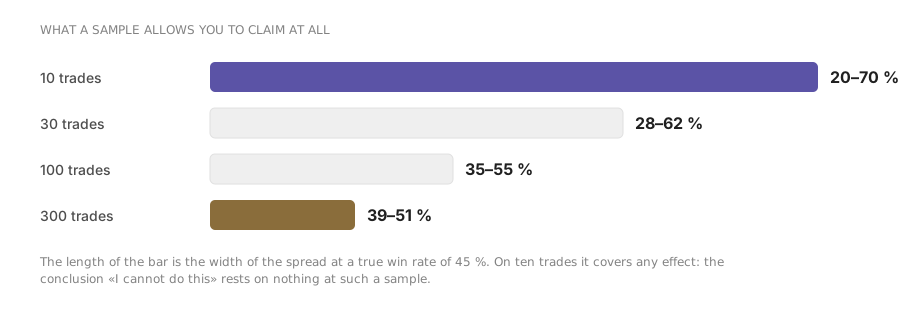
The feeling that «my result is accidental» is unpleasant partly because over a short stretch it is mathematically correct. Below is how many trades it takes for the difference between skill and luck to become distinguishable.
| Sample | Spread of the observed win rate at a true 45 % | What can be asserted |
|---|---|---|
| 10 trades | 20–70 % | Nothing: the spread covers any effect |
| 30 trades | 28–62 % | A rough estimate, the direction is visible |
| 100 trades | 35–55 % | An estimate accurate to about ten points |
| 300 trades | 39–51 % | A working estimate for decisions about position size |
Hence a practical conclusion that takes off some of the tension. If you have fewer than a hundred trades, the feeling of uncertainty is not a distortion but a correct assessment of the situation. It is cured not by working on confidence but by accumulating a sample, and that is a question of time rather than of character.
over 10 trades the observed win rate says almost nothing about the true one — and conversely, a run of 8 winners does not prove skill
A list of what has been done: a footing that does not depend on the market
What works against impostor syndrome is not persuasion but a list of what has been completed. The items below are verifiable and are not explained by luck — unlike the month's result.
- The rules are written down
- There is a document with nine sections that another person could trade from. That is a fact, not an opinion about yourself.
- The journal is kept with no gaps
- The number of trades recorded matches the number of trades in the terminal report for the period.
- The share of execution is growing
- A month-by-month comparison: 55 % → 76 % → 94 %. The quantity is under your control and does not depend on the market.
- Risk was not changed off the calendar
- Every change of base risk has a date and a reason in the journal. The absence of spontaneous changes is itself the result of work.
- The stop-day has never been breached
- The number of days on which the limit triggered equals the number of days on which trading stopped.
- You know your own numbers
- Win rate, average ratio and expectancy over the last hundred trades named from memory. That is a sign that the statistics exist.
The test that separates the syndrome from reality. If you cannot state your win rate and your average risk/reward ratio over the last hundred trades, this is not impostor syndrome but an absence of statistics. It is cured by three months of the journal, and until then the doubt is justified.
How it looks in the trades: four traces in the report
The state is subjective, but its consequences are measurable. Below is what to look for in your own export if the feeling is familiar.
below 0.9 — impostor syndrome is at work; above 1.1 — revenge trading
calculated in five minutes from the risk column of the journal
The formula above is convenient because it distinguishes two mirror-image states by a single number. Both change position size in response to the previous result, both cost money — but they are treated differently, and they should not be confused.
Frequently asked questions
Does impostor syndrome get in the way of making money?
It does, through a specific mechanism: cutting size after a good run and raising it after a bad one, «to prove the point». This is the mirror image of euphoria and costs about the same.
Does it pass with experience?
It weakens as your own statistics accumulate: the figures over a hundred and three hundred trades gradually replace the feeling. It rarely disappears entirely, but it stops affecting position size — and that is the practical goal.
What if after a profit you want to withdraw everything and stop?
That is a normal reaction, and there is no need to fight it by force. The workable option is to write the withdrawal rule down in advance: what share of profit is withdrawn and how often. Then the action stays but stops being impulsive.
Does talking to other traders help?
It helps you learn that the state is a common one — that takes off some of the tension. But the footing comes not from a conversation but from your own statistics: someone else's experience does not answer the question of whether your system has an edge.
Read next
