 APTF
APTFMyths about forex: a bucket shop, a casino and 90 %
A bucket shop, a casino, «90 % blow up» — some common claims about the currency market are true, some are false, and most are a correct observation with an incorrect conclusion. We examine the seven most frequent: what exactly is claimed, what is verifiable and what follows from it.
Myth 1. «90 % of traders blow up»
The figure circulates in versions of 70, 80, 90 and 95 % and almost never with a source. It cannot be checked in general terms: there is no single set of statistics covering all clients of all brokers.
The practical conclusion. An argument about whether it is 76 percent or 90 changes nothing in what you do. What matters is different: the share of losers is high, and falling into it is determined mainly by position size and rule-following — that is, by what is under your control.
Can you make money on forex, and five more myths in brief
- «Forex is a bucket shop, the broker trades against the client»
- The query «is forex a scam or not» usually comes from exactly here. The short answer is no, but execution models differ, and some brokers do keep client positions internally. Yet the conclusion «so you cannot win» does not follow: that is a question of choosing a broker and a jurisdiction, not of the market itself. The verifiable signs are the regulator, segregation of funds and public reporting.
- «Trading is a casino»
- In a casino the mathematical expectancy is negative by construction and cannot be changed. On the market expectancy depends on your system and costs and can be anything, including positive. What is true is something else: trading without rules is built like a game — this is covered in detail in the material on gambling urges.
- «You need huge starting capital»
- Technically no: an account can be opened for any amount. In practice a small account means costs take a large share of the result and profit in percent does not translate into meaningful money. That is an argument about timelines and expectations, not about access.
- «Professionals do not make mistakes»
- Everyone has losing trades, because an individual outcome is random. The difference is not the absence of losses but the fact that they are limited in advance and identical in size.
- «There have to be more winning trades»
- Not necessarily. At a 1:2 risk/reward ratio a system breaks even at just 36.7 % winners once costs are included — calculate it for your own parameters. Chasing a high win rate usually ends in short targets and a wide stop.
- «More indicators means a more accurate entry»
- Every tool added increases the number of signals, not their quality. In practice a rise in the number of indicators correlates with a rise in the number of trades — that is overtrading, not accuracy.
How to check claims about the market
Not a retelling and not a picture but the primary document: a broker disclosure, a regulator's report, a study with a stated method. The absence of a source is already an answer.
step 1Accounts or people, a quarter or a year, all instruments or one. Most arguments about figures are arguments about different quantities.
step 2If the answer is «nothing», the claim can be set aside. Only facts that change the rules are useful.
step 3How broker disclosures are built and what follows from them
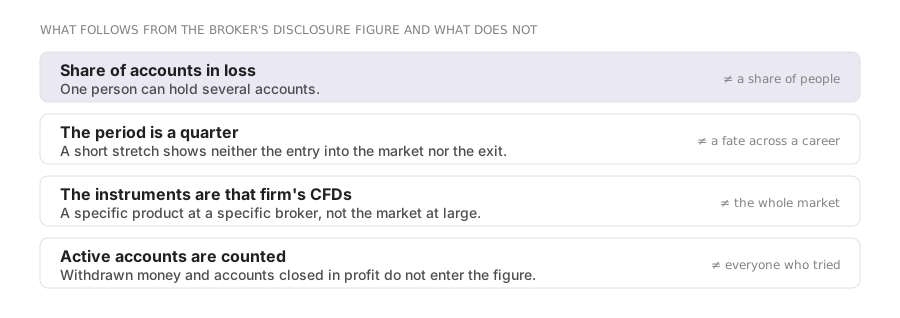
The only public figures on the share of loss-making accounts come from mandatory disclosures by regulated firms. They have to be read carefully: what is measured there is not what is usually quoted.
| What the disclosure says | What follows from it | What does not follow from it |
|---|---|---|
| The share of retail accounts with a loss over the period | Most accounts end a quarter in the red | That the same share of people «blew up»: one person may have several accounts |
| The period is usually a quarter | An estimate of a short stretch | That this is a fate over a career: a quarter shows neither entry into nor exit from the market |
| The instruments are that firm's CFDs | A picture for a specific product at a specific broker | That the figure carries over to the whole market or to other instruments |
| Active accounts are counted | It refers to those who traded during the period | That withdrawn money and accounts closed in profit are included |
Hence the site's position, stated plainly: the substance of the claim is true — most retail accounts are loss-making — while the specific figure is unverifiable and differs by twenty points between sources. The argument about it has no practical significance: falling into the loss-making share is determined by position size and rule-following, that is, by what is under your control.
Six signs of material not worth believing
The subject of trading psychology is especially cluttered with texts written for the sake of a sale. They can be told apart by formal signs, without going into the content.
«95 % lose», «80 % of success is psychology». Percentages that cannot be checked usually never were.
sign 1«You will reach a stable income in three months». The author sets the deadline; the market is supposed to meet it.
sign 2One screenshot instead of statistics. Winning trades get shown; nobody publishes the losing ones.
sign 3«Control your emotions», «be disciplined». A requirement with neither a procedure nor a price cannot be followed.
sign 4Good material says where its approach does not work. Bad material claims it always works.
sign 5A course, signals, access. It does not disqualify by itself, but it explains why the prospects are described the way they are.
sign 6It is worth checking our own materials against these six signs. The figures here are either calculated by a formula on the same page or marked as models; the limits of the method are collected on the methodology page; the rules for mentioning services are on the affiliate links page.
Frequently asked questions
Can you make money on forex at all?
Saying «yes» or «no» in general terms is incorrect: the result depends on the system, the costs, position size and execution. What is verifiable is different: most retail accounts have a negative result, and the bulk of the losses is explained by position size and rule violations rather than by a lack of knowledge about the market.
How do you tell working material from a course sale?
By the presence of verifiable claims. Working material gives formulas you can repeat and admits its limits. A sale promises a result and replaces calculation with success stories. Our rules on this are in the editorial policy.
Why does everyone talk about psychology but nobody shows the figures?
Because figures require a model, and a model requires assumptions that would have to be named. It is easier to write «control your emotions». We chose the opposite path: every assumption is stated next to the result, see the methodology.
Read next
