 APTF
APTFForex trader burnout
Forex trader burnout is not fatigue and not a bad week. Fatigue passes after sleep and a weekend; burnout does not pass after a rest. The key sign: what disappears is not strength but meaning — trading stops being interesting, and at the same time you cannot give it up either.
How burnout differs from being tired of forex trading
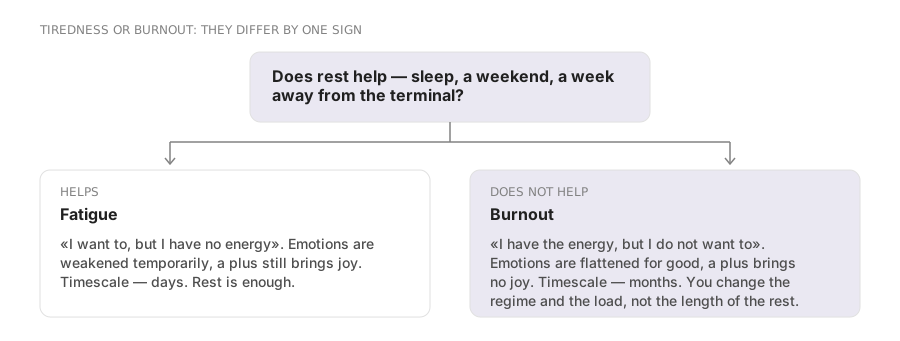
Burnout in trading is confused with fatigue because from the outside they look alike. One thing tells them apart: the reaction to rest.
| Fatigue | Burnout | |
|---|---|---|
| What helps | Sleep, a weekend | Rest does not help |
| Attitude to the work | I want to, but I have no strength | I have the strength, but I do not want to |
| Emotions | Temporarily dulled | Persistently flattened |
| Attitude to the result | There is joy at a profit | A profit brings no joy |
| Timescale | Days | Months |
| What people do | They rest | They change their routine and their load |
Three stages and the signs of each
Time at the chart grows, sleep shrinks, weekends are taken up with reviewing trades. Subjectively it is «this is an important period, I will rest later». Results are not suffering yet.
weeksIrritation with trading appears, the number of breaches of the plan grows, the journal stops being filled in. The result gets worse, and that increases the load — the circle closes.
monthsThe terminal provokes aversion, trades are made mechanically or not made at all. This is often the point at which people quit, come back six months later and repeat the cycle.
a quarter and longerThe stages are marked out conventionally; there are no boundaries between them. The practical use of the division lies elsewhere: at the first stage changing your routine is enough, at the third you need a break of months.
Four causes specific to trading
The currency market works round the clock, there is no boss, and there is no end to the working day either. Everything that limits the load has to be introduced by you.
structuralIn most occupations more work gives more result. Here it does not, and the absence of that link wears you down more than the losses themselves.
cognitiveThere is nobody to share a decision with and nobody to check your judgement against. The absence of feedback from people is a known factor in burnout in any profession.
social«I will reach an income in three months» against a real learning period of years creates a constant background of failure, even when there is progress.
motivationalThe order of getting out
- Stop completely, rather than «trade a bit less»
- At the second and third stages a half-measure pause does not work: trading continues to occupy your head. The period is two weeks or more.
- Remove the terminal from your phone
- Not a symbolic gesture: checking quotes maintains involvement and does not let the state subside.
- Restore your sleep and physical exercise
- This is not advice about a healthy lifestyle but a condition: without sleep, inhibition is not restored, and it is inhibition that breaks first.
- Come back at demo size or a minimum lot
- For the first two weeks after coming back there is one task — executing the rules, not the result.
- Change what led to the burnout
- Coming back to the same regime produces a relapse in two or three months. The hours, the number of instruments, the timescale of expectations — at least one of them changes.
- Set a date for the next check
- A month after coming back: how many hours at the chart, how much sleep, does a profit bring joy. Three questions and an entry in the journal — that is enough to notice a second approach before the third stage.
Three burnout scenarios and what distinguishes them
The causes differ, and that matters: coming back to the same configuration produces a relapse in two or three months, and what people change is usually not what needs changing.
One question helps tell the scenarios apart: what exactly disappeared — strength, meaning, or belief in the system? In the first case rest and routine work, in the second a revision of the goal, in the third a check of the edge against the statistics and a reduction in size.
Prevention: what to do before it starts
Burnout is cheaper to prevent, because getting out of the third stage takes months. Prevention means four restrictions that are introduced in advance and cost nothing while all is well.
Not «as many as it takes» but a specific number of hours at the chart per day and per week. Exceeding it is as much a breach of the plan as a trade outside the setup.
against overloadOne or two a week, set in advance. They also serve as a check: if a day without trading is hard to bear, the issue is not the schedule.
against involvement«Bring the share of execution up to 90 %» is fulfilled by your actions. «Earn N by the holidays» is fulfilled only by the market.
against a gap in expectationsAn area where the result depends on effort directly. This is not advice about balance: feedback of that kind is physically necessary, and the market does not give it.
against estrangementThe fourth point looks out of place in a text about trading, but it is precisely the one most often missing in people who reach the third stage. The market does not confirm the correctness of your actions in the moment — and a person needs to get that confirmation from somewhere.
Frequently asked questions
How do I know it is burnout and not laziness?
By the attitude to the result. With laziness a profit brings joy but you do not want to work; with burnout a profit provokes almost nothing. The second sign is that rest does not help: after a week's holiday the state is the same.
Can you burn out if you trade an hour a day?
You can. Burnout is linked not to the number of hours but to the continuity of involvement: if you spend the remaining twenty-three hours thinking about the market and checking quotes, the load is round the clock.
How long do I need not to trade?
At the first stage a week and a change of routine are enough. At the second, from two to four weeks. At the third it runs into months, and here it is sensible to discuss your state with a specialist: a persistent loss of interest in everything at once is no longer about trading.
Does changing market or strategy help?
It gives a temporary lift through novelty, but it does not remove the causes: a few months later the cycle repeats in the new place. What has to change is the routine and the expectations, not the instrument.
Read next
