 APTF
APTFForex trading sessions: times, routine and fatigue
A daily routine on a round-the-clock market is its main trap: forex does not tell you when it is time to finish. Below are the trading sessions and their times in your time zone, an account of how fatigue changes decisions, and workable schedule options for those who do not trade full time.
Which sessions are open right now
Choosing your window is not about «when the moves are better» but about the hours in which you are in working shape. A session you have no energy for will not become profitable just because it is volatile.
The bars are drawn in your time zone; the thin vertical line is where you are in the current day. The currency market has no single exchange, so the boundaries are conventional: a session is taken to be the working hours of the region's banks. UTC now: —.
What fatigue does to decisions
Lack of sleep and hours of watching the chart hit not your attentiveness — that, in fact, holds up for a long time. The first thing to suffer is inhibition: the ability not to do what you want to do.
The practical conclusion. Your own judgement of «I feel fine» does not work as a criterion: it rests on the very ability that breaks last. External signs are more reliable — how many hours of sleep, how many hours at the chart, which hour of the session this is. Those are what belong in the state checklist.
A forex trader's daily routine: three schedules alongside a job
There are not many arrangements in which trading fits alongside a job, and all of them are based on one principle: a window set in advance instead of «I'll see how it goes».
An hour to an hour and a half at the European open. Plus: a fresh head, and the window is hard-limited by an external circumstance. Minus: it does not suit every time zone.
1–1.5 hoursTwo hours after work. Plus: high activity, a stable time. Minus: the day has already spent your resources and inhibition is lowered — a trade limit is mandatory here.
1.5–2 hoursMark up in the evening, orders at the levels, check in the morning. Plus: it removes impulsive entries entirely and takes no time. Minus: it suits only setups that need no confirmation.
20 minutes a dayThe worst option is the one not on the list: «I switch on the terminal when I am free and trade while it is moving». That is exactly what produces trading until three in the morning, because with no boundary the only thing that sets one is fatigue, and fatigue, as shown above, arrives unnoticed.
Night trading on forex: when it is justified
Night on the currency market
What happens to price in different sessions
Choosing a window is not only about your own shape but also about whether your setups work in those hours. Below is a qualitative picture worth checking against your own statistics: the numbers are specific to each pair and each system.
| Session | The character of the movement | Spread | Which setups it suits |
|---|---|---|---|
| Asian | Narrow ranges, boundaries are respected | wider than usual on European pairs | Bounces from range boundaries, working inside a channel |
| The European open | A sharp rise in activity, false spikes | normal | Level breakouts, impulsive moves |
| The London and New York overlap | Maximum activity | minimal | Trend continuation, working off the news |
| Late American | Fading, pullbacks to the averages | starts to widen | Closing positions rather than opening new ones |
The practical conclusion from the table: the «best time» depends on the setup, not on trading volume. A system based on bounces from range boundaries will produce nothing but false signals in the hours of maximum activity, while a breakout system in the Asian session will produce no signals at all. This is a question not of discipline but of compatibility.
calculated with a pivot table on the «date and hour» column of the journal
Sleep and inhibition: why this is not about a healthy lifestyle
The link between lack of sleep and the quality of decisions on the market is direct and specific: what suffers is not attentiveness but the ability not to act. That is exactly the function on which execution of the rules rests.
Why self-assessment does not work here. The question «do I feel all right?» rests on the very ability that breaks last. Only external signs are reliable: how many hours of sleep, how many hours at the chart, which hour of the session this is. Those are what belong in the state checklist, as figures rather than sensations.
Hence the wording of a rule that can actually be executed: not «I do not trade in a bad state» but «I do not trade on less than six hours of sleep or after the third hour at the chart». The first requires a judgement, the second a glance at the clock.
A thin market in money: what an hour off schedule costs
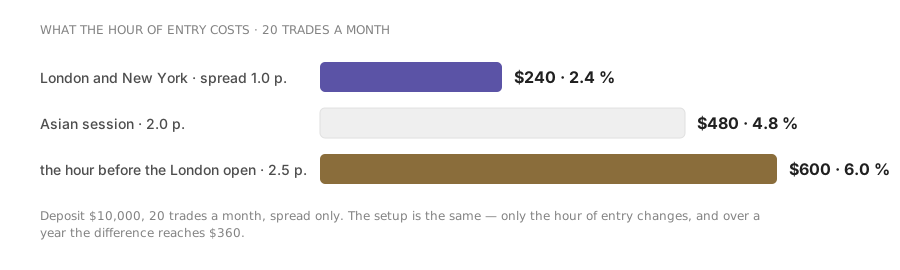
The difference between sessions is usually felt as «it goes worse at night». It can be counted: in a thin market the spread is wider, and every trade starts deeper in the red. A $10,000 account, 20 trades a month.
| When we trade | EUR/USD spread | Cost of 20 trades | Per year |
|---|---|---|---|
| London and New York | 1.0 point | $20 | $240 (2.4 %) |
| The Asian session | 2.0 points | $40 | $480 (4.8 %) |
| The hour before the London open | 2.5 points | $50 | $600 (6.0 %) |
Two or three tenths of a percent a month look like a trifle and add up to the difference between four and six percent of the account over a year — with the strategy unchanged. You can put your own spread and volume into the trade cost calculator.
Frequently asked questions
What is the best time to trade forex?
Technically, more of the movement falls in the overlap of the London and New York sessions. In practice the «best» time is the one in which you are reliably in shape and free: a setup traded in quiet hours brings more than volatility traded half asleep.
How many hours a day is it normal to trade?
For most manual strategies, one or two hours of watching plus half an hour of preparation. Beyond that what grows is not quality but the number of trades: time at the screen correlates with the number of entries, not with their result.
Do you need a day off from the market?
Yes, and preferably a planned one. It is also useful as a test: if a day without trading is hard to bear and you feel pulled to open the terminal, the issue is no longer the schedule — see gambling and compulsive play.
What do you do with a position held overnight?
The decision is taken before the entry and written into the plan: whether you hold positions overnight and over the weekend. Take the swap into account — on forex a rollover costs money every night, and a rollover through Wednesday is usually charged at triple size.
Read next
