 APTF
APTFFear in forex trading
Fear in forex trading is the one emotion that most often costs money through inaction rather than through action. The loss from it is not visible in the report: missed entries are recorded nowhere. That is why a trader's fears are habitually underestimated, although over a year they take no less than greed does.
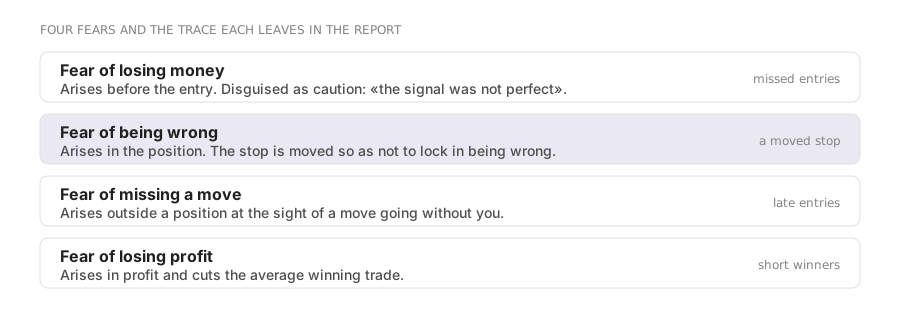
The fear of losing the deposit on forex, and three others
One word, different mechanics. Telling them apart matters, because each responds to something different, and a universal «stop being afraid» does not exist.
Arises before the entry. Shows up as endless re-checking of the conditions and in the end as a missed setup. Often disguised as caution: «the signal was not perfect».
sign: missed entriesArises once you are in the position. Shows up in moving the stop so as not to «lock in being wrong». It feeds on the stop being perceived as a personal defeat rather than as a planned cost.
sign: a moved stopArises outside a position at the sight of a move going without you. Produces an entry after the main part of the move has gone. A separate topic is FOMO.
sign: late entriesArises in a position that is in profit. Produces early closing and cuts the average winning trade. The mechanics are described in the material on loss aversion.
sign: short winnersWhy fear is stronger on forex than on other markets
The cause lies not in the character of the currency market but in position size. Leverage lets you open a size at which an ordinary daily swing in the pair amounts to a noticeable part of the deposit. The body reacts to the size of the sum, not to how well justified it is.
at 5 % risk per trade a stop feels like a catastrophe, at 0.5 % like a line in a report
Hence the first and most effective remedy: reduce size to a level at which a stop being hit does not change your evening. This is not the advice «risk less» offered on general grounds — it is a way of getting back your ability to carry out your own rules. Size can be increased afterwards, but only once the rules are being executed steadily.
How to overcome fear in trading: what helps against each kind
| Fear | What does not help | What works |
|---|---|---|
| Losing money | Convincing yourself that «the risk is justified» | Halving your size and restoring it only after 30 trades by the rules |
| Being wrong | Promising yourself not to move the stop | Placing the stop as an order immediately at entry and not keeping the terminal open |
| Missing a move | Watching a large number of pairs | A rule cancelling the entry after X points of movement and a list of 2–3 pairs |
| Losing profit | Closing «at least something» | Taking half the size off at 1R, the rest by the plan |
The left column is not a straw man: these are exactly the three methods traders themselves name most often when they describe how they fight fear. They have one thing in common: all of them require effort at the moment of the trade, that is, when the resource is at its lowest.
Fear as a useful signal
Removing fear entirely is unnecessary and harmful. In two cases it is telling the truth, and it is worth listening to.
What fear costs: counting what was not earned
Fear is the only state whose price is invisible in the report: missed entries are recorded nowhere. It can only be counted indirectly, through the number of trades not taken and the system's expectancy.
6 × 0.35 R × $50 = $105 on a $5,000 deposit that is 2.1 % a month and 25 % a year
Six missed setups a month is a moderate estimate for someone who «sometimes cannot bring themselves to». The figure is comparable with the price of revenge trading and overtrading, but unlike them it provokes neither discussion nor regret: a trade not taken leaves no trace in the account history.
Hence a practical requirement for the journal: missed setups have to be recorded alongside the ones taken. The date, the instrument and one line of reason are enough. After a month the list itself shows whether this is fear or the absence of a signal.
| Entry in the journal | What it really is | What to do |
|---|---|---|
| «There was a setup, but I could not bring myself to» | Fear of loss at too large a size | Halve the base risk for 30 trades |
| «The signal looked weak» | The entry conditions are described vaguely | Rewrite the setup as a list of checkable conditions |
| «I did not get to the terminal in time» | Not fear but the schedule | A pending order at the level instead of a manual entry |
| «There had already been two stops» | The stop rule is working | Nothing: this is not a miss but execution of the plan |
A thirty-trade programme
What works with fear is not a conversation but a sequence of actions with a verifiable result. Below is a programme whose only success criterion is the share of trades by the rules, not the profit.
Exactly to the amount at which a stop being hit does not change your evening. Often that is 0.3–0.5 % of equity, sometimes less.
day 1At the same time as the entry, with no exceptions. While the stop is «in your head», the decision belongs to fear.
from the first tradeEvery entry not taken, with one line of reason. This is the only way to see the price of the state.
every dayOnce a week: trades by the rules ÷ all trades plus misses due to fear. The goal is growth, not the absolute value.
on SaturdaysOnly after thirty trades with a share of execution of 90 % or more. If the share falls, step back.
in a month to six weeksWrite the step, the frequency and the rollback condition into the plan. After that size grows by the calendar, not by how you feel.
continuouslyWhy thirty trades exactly. On a smaller sample the share of execution jumps about at random: two breached trades out of ten give 80 %, out of thirty they give 93 %. Thirty is not a statistical threshold but a practical minimum below which growth cannot be told apart from luck.
Frequently asked questions
How do I overcome fear in trading if it stops me entering at all?
Reduce position size to one that is plainly painless and start accumulating execution statistics. The task of the first thirty trades is not to make money but to get thirty trades made by the rules. Once the share of execution reaches 90 % or higher, size can be raised in steps of 25 %, stepping back at the very first breakdown.
I am afraid to place a stop — it feels as though the price will be pushed to it deliberately
The feeling is a common one, but it is easy to check: take the last thirty trades and count in how many the price turned back in your direction within the day after the stop was hit. Usually the share turns out to be around half, that is, random. If it is consistently higher, the question is not about the broker but about the stop being too close to the entry point.
What do I do with fear after a large loss?
Do not trade the same day — that is precisely the point of the stop-day. Then go through the trade in writing: was it by the rules or not. A loss taken by the rules is lived through in a fundamentally different way from a loss caused by a breach, and the two should not be confused.
Will fear pass by itself over time?
Partly. You do get used to the swings of the account, but along with that the size you allow yourself grows too — and the fear comes back at a new level of sums. What helps steadily is not getting used to it but leaving no decisions to be taken at the moment of the trade.
Read next
