 APTF
APTFRevenge trading on forex
Revenge trading on forex is an attempt to get back what was lost with the next trade, usually at increased size. The English name is precise: the decision is not about money but about restoring justice. It is the most expensive mistake of all, because it is the only one that multiplies the loss.
Revenge on the market on forex: the mechanics of the decision
From the inside revenge trading does not look like «taking revenge on the market». It looks like a rational calculation, and that is its strength.
After a loss the goal becomes not «to be in profit over the distance» but «to get back to the morning balance». The task has changed, and with it the acceptable risk.
a new goalIt has to be recovered today. With a short deadline the only way to close the gap is to increase size: the win rate cannot be changed in a day.
deadline pressure«After two stops the third is due». The probability does not change, but the feeling that it does provides a formal argument for increasing.
a false justificationNote that all three components appear before the trade, not at the moment the button is pressed. Which means the chain has to be broken in the same place — at the level of the decision «today I must get it back».
What it costs: a step-by-step calculation
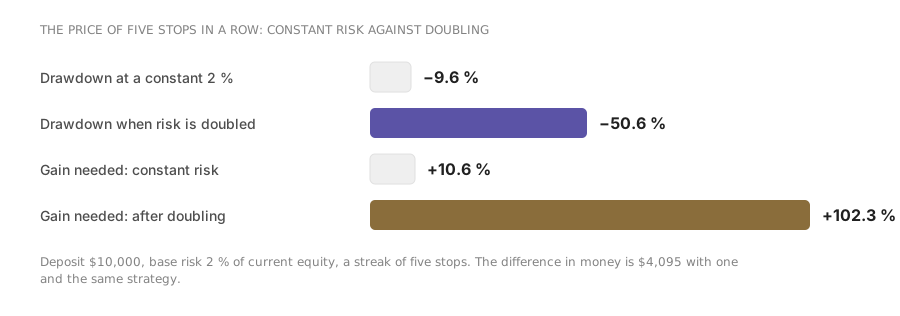
Take a deposit of $10,000, a base risk of 2 % and doubling after every loss. Risk is calculated from current equity — the way the terminal calculates it.
| Stop | Risk | Loss | Balance with revenge trading | Balance at a constant 2 % |
|---|---|---|---|---|
| 1 | 2 % | −$200 | $9,800 | $9,800 |
| 2 | 4 % | −$392 | $9,408 | $9,604 |
| 3 | 8 % | −$753 | $8,655 | $9,412 |
| 4 | 16 % | −$1,385 | $7,271 | $9,224 |
| 5 | 32 % | −$2,327 | $4,944 | $9,039 |
growth needed to recover: +102.3 % against +10.6 %
The difference in the result is $4,095, that is more than forty percent of the deposit, with one and the same run of five stops and one and the same strategy. Only the reaction to a loss changes.
And the main thing: after revenge trading more than a doubling is needed to return to the starting point. At an expectancy of +0.35 R per trade and 2 % risk that is around one hundred and ten trades — months of work. After an ordinary run of stops fifteen would have been enough.
Three rules that break the chain
The first rule is the most important and the cheapest: it closes not only revenge trading but also greed and euphoria. All three mistakes show up in one and the same thing — a changed position size.
Martingale: the same mechanism in the form of a strategy
Sometimes doubling after a loss is presented not as a breakdown but as a system: martingale. The arithmetic does not change, and the promise that «the run will break sooner or later» holds exactly until the deposit runs out.
a base of 2 % and a run of 8 stops require 510 % of the deposit
And a run of eight losses in a row at a 45 % win rate occurs over a hundred trades with a probability of about 31 % — that is, in roughly every third hundred. This is not a rare event you can leave out of your plans.
Four forms of revenge trading: one mechanism, different names
A rise in risk after a loss rarely looks like doubling the lot. More often it takes a form that has a respectable name of its own.
The most direct form. The lot grows, the distance to the stop is the same — which means risk grew by exactly the same factor.
visible in the statement at onceFormally the size did not change, but the stop is closer — and the probability of it being hit is higher. The risk in money stayed, the quality of the entry fell.
visible in the distance to the stopThe same revenge trading, distributed by quantity. Every trade is of planned size, the total daily risk is three times higher.
visible in the number of trades per dayAdding size against the move. The average price improves, the total risk grows linearly and was not calculated in advance.
visible in several entries in a row«I will make it back faster there». The number of signals grows, the share of costs in the risk grows with it, and there are no statistics for the new timeframe.
visible in a change of instrument and timeframeThe form that takes the episode beyond the evening. The risk in percent returns to plan, the absolute sum at risk grows.
visible in the balance historyWhat all six have in common is a change to a trade parameter after a loss rather than before it. There is one test: would you have taken this trade with the same settings if the previous one had closed in profit? If not, it is revenge trading, whatever it is called.
What to do in the first fifteen minutes after a stop
Revenge trading forms not at the moment the button is pressed but in the first minutes after a loss, when the statement of the task changes. Below is what actually works in that window.
Frequently asked questions
How do you stop revenge trading on the market?
Not by a decision «I will not do it again» but by two mechanisms: fixed risk and a stop-day after two stops in a row. Both are introduced away from the market and require no consent at the moment they fire — that is their only advantage over a promise.
But what if the setup after a loss really is a good one?
Then it will still be good at planned size. The test is simple: would you have taken this trade with the same lot if the previous one had closed in profit? If size depends on the result of the last trade, it is revenge trading regardless of the quality of the setup.
Is revenge trading the same as martingale?
The mechanics are the same, the difference is in the framing: martingale is declared as a system in advance, revenge trading arises along the way. For the account there is no difference; for recognising it there is: martingale is easier to spot and refuse, because it is written down.
What should you do right after you have chased a loss and lost?
Close the terminal for a day, write the episode into the journal verbatim and come back at half size for five trades. The state is examined in the material on tilt, and if the account is gone entirely, in after blowing an account.
Read next
