 APTF
APTFMoving the stop-loss on forex and averaging down
Moving the stop-loss on forex or averaging down a losing position are two actions with one outcome: after them you no longer know how much you will lose. Before them risk was a number from a formula; after them it is a quantity depending on where price goes and when your patience runs out. That, rather than the loss itself, is the main price.
Why the stop gets moved
There is one reason and it is not about the market: closing at the stop turns a paper loss into a final one. While the position is open the possibility that «it will all work out» survives, and loss aversion values that possibility far above its real probability.
What happens to the risk
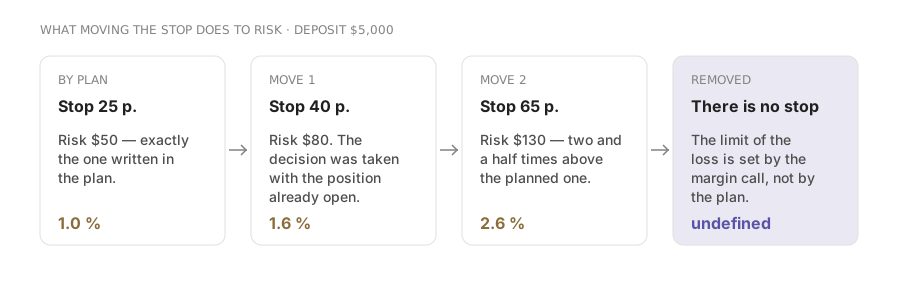
Let us count on numbers. Deposit $5,000, planned risk 1 % — $50. Stop at 25 points, size 0.20 lots.
| Action | Stop, points | Risk in money | Risk against the deposit |
|---|---|---|---|
| By plan | 25 | $50 | 1.0 % |
| Moved once | 40 | $80 | 1.6 % |
| Moved twice | 65 | $130 | 2.6 % |
| Removed entirely | not set | undefined | undefined |
Note the last row: it is not «very large risk» but precisely undefined. A position without a stop on a leveraged currency market is limited only by the broker's stop-out level, that is, by the moment of forced closure when margin runs short. You cannot plan around that.
Averaging a position on forex: the same thing but through size
Averaging down a losing position means adding size at a worse price to lower the average. The average price really does improve, and the risk grows along with it.
| Step | Size | Average price | Risk to the previous stop |
|---|---|---|---|
| Entry | 0.20 lots | 1.0850 | $50 |
| Addition at −25 pts | 0.40 lots | 1.0838 | $100 |
| Addition at −50 pts | 0.60 lots | 1.0825 | $150 |
the lower the average price, the more money every further point against the position costs
That is where the trap lies: an improvement in the average price feels like an improvement in the position, although in money the situation has become three times worse. On forex the swap is added on top: the increased size is held longer and pays for every night in proportion.
When adding size is not averaging down
What to do instead
- Place the stop as an order at entry
- Not «hold it in your head». An order executes without your participation, and that is the only way to take the decision out of the moment.
- Define the stop by the mark-up, not by a sum
- The level is found on the chart, the size is calculated from it. The reverse order — «I want this lot, I will put the stop closer» — guarantees moves.
- Close the terminal after the orders are placed
- Watching a position improves nothing but provides a constant opportunity to interfere.
- Count a stop move as a violation in the journal
- Even if the trade closed in profit. Otherwise the rule-following indicator stops meaning anything.
When the stop may be moved: three written rules
The prohibition «never move a stop» is imprecise: a move towards profit reduces risk and is therefore permissible. The difference is not in the direction but in whether the condition was written down in advance.
«On reaching a distance of 1R the stop moves to the entry point». The condition is verifiable, does not depend on your state and reduces risk.
permitted by rule«The stop is pulled up under each new local low». A mechanical rule: where exactly to put it is decided by the chart, not by your opinion of the strength of the move.
permitted by ruleIf the take-profit is moved by a written rule, the stop is pulled up along with it. Otherwise the risk/reward ratio changes against you, and it was precisely for that ratio that the target was moved.
permitted by ruleThe stop is moved away from the entry point. Risk grows, the condition is written nowhere, and the decision was taken with a position open.
violationAn argument that was not in the entry plan. If the news mattered, it should have been accounted for before the trade.
violationThe level «turned out to be lower» while already in the position. Exactly the case for which confirmation bias exists.
violationThe check is simple: either the rule for moving is in the trading plan with a specific condition, or it is not. The third option — «it exists, but I apply it as the situation requires» — does not exist in practice: it always means the second.
What happens to portfolio risk when averaging down
An individual trade is not the only place where risk grows. When averaging across several instruments the total drawdown adds up, and that is especially unpleasant on correlated pairs.
| Position | Size | Risk to the stop | Correlation with the first |
|---|---|---|---|
| EURUSD, entry | 0.20 lots | $50 | — |
| EURUSD, averaging | 0.40 lots | $100 | 1.00 |
| GBPUSD, entry in the same direction | 0.20 lots | $50 | high |
| Total risk on a move against you | 0.60 lots | $150 | in effect one trade |
0.60 × 25 × 10 = $150 = 3 % of a $5,000 deposit
with highly correlated pairs this is one trade, not three
The practical conclusion: the rule «one percent per trade» is incomplete. The working wording adds a second limit — on the total risk across open positions in one direction. Two or three percent for the portfolio at one percent per trade closes most of the cases where «every position was within the rules».
Frequently asked questions
Why is it frightening to place a stop-loss?
Because a stop fixes a loss, and a loss subjectively weighs twice as much as an equal gain. On top of that comes the widespread feeling that «they hunt the stops». The latter is easy to check: over thirty trades count in how many cases price turned back your way the same day. Usually the share is close to half, that is, random.
Can a stop be placed too close?
It can, and that is a separate problem — but it is solved in the plan, not in the position. If stops are systematically clipped and price then goes on your way, the stop level was chosen wrongly: it has to be changed in the rules for all future trades, not in the current one.
Can you trade forex without a stop?
Technically you can, if the position is so small that even a move of several hundred points creates no problem and there is a hard rule for closing by time. In practice almost nobody trades like that: the size then comes out uninterestingly small, and the rule is the first thing to be broken.
Is averaging down always bad?
What is bad is not averaging but unplanned averaging. If the grid of entries was calculated in advance and the total risk was known before the first trade, that is a strategy. If size is added because price has already gone against you, it is a decision taken at the wrong moment.
Read next
