 APTF
APTFAfter blowing a forex account
Blowing a forex account is lived through as a catastrophe and analysed as an accident — usually in the reverse order to what it should be. Below is what to do in the first days, how to break the loss down by figures and on what terms to return so as not to repeat the same cycle six months later.
How to stop blowing accounts on forex: the first rule
Blowing an account on an exchange and on the currency market is analysed in the same way, and the first step in both cases is the same. Topping up the same or the next day is a continuation of the same trade rather than a new start. The state has not changed, the rules have not changed, only the balance has.
The practical minimum is two weeks. Not because something will be understood by itself in two weeks, but because in that time the acute part of the state subsides and analysis becomes possible at all. Topping up under the pull of «getting back right now» is one of the signs from the list on the page about gambling and addiction, and it is worth checking seriously.
Analysing the loss: four questions by the figures
You need an export of trades from the terminal. The answers come out arithmetically and almost always differ from what the person thought about their loss.
Sort by result. Usually 3–5 trades produce more than half the loss. If so, the problem is not in the system but in the position size in those trades.
a question of sizeCheck whether the loss in the worst trades differs from the average by a multiple. A multiple difference means a removed or moved stop.
a question of executionPlot size in date order. A rising curve after losses is revenge trading, and it is visible on the chart without any psychology.
a question of reactionIf there are almost no trades by the rules, the question of the system's edge stays open — and that is the only honest way to put it.
a question of edgeWhat the analysis shows most often
| The picture in the export | What it means | What to change |
|---|---|---|
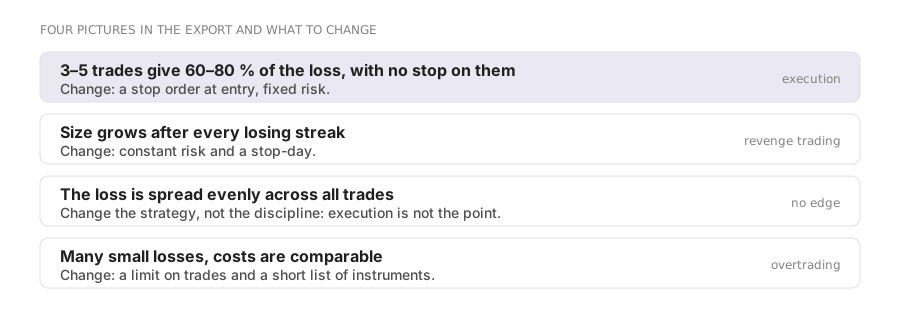
| 3–5 trades give 60–80 % of the loss, with no stop in them | The loss comes from execution, not from the strategy | The stop as an order, fixed risk |
| Size grows after every losing streak | Revenge trading | Constant risk, a stop-day |
| The loss is spread evenly across all trades | The system has no edge | The strategy, not discipline |
| Many small losses, costs comparable to the loss | Overtrading | A trade limit, a list of instruments |
The difference between the first and third rows is fundamental: in the first case the work goes into execution, in the third into the strategy, and confusing them costs months. That is exactly why the analysis starts with the export rather than with conclusions.
Terms of return
You should return not «when there is money again» but when four conditions are met. They are verifiable, and that matters more than their content.
The marks are saved in your browser and are not sent anywhere.
Six weeks after the loss: what to do week by week
The order matters more than the content here. The first two weeks are not «a pause for reflection» but the time in which the state subsides and analysis becomes possible at all.
The terminal closed, the app deleted from the phone, no top-ups. No analysis — in the first days it turns into a search for someone to blame.
do nothingDownload the trade history and derive four numbers: the share of the worst trades in the loss, whether there was a stop in them, the dynamics of size, and the result on «by the rules» trades.
one eveningDetermine which of the four scenarios is yours. Everything that follows depends on it: execution, revenge trading, the absence of an edge or overtrading.
half an hourIntroduce exactly one rule against the main cause. Not five: five do not hold, and within a month none is left.
the decisionBoth exist in writing before the first trade. Without them the next account repeats the trajectory of the previous one.
two eveningsThe first thirty trades at a risk where the stop changes nothing. The task of those trades is the rule-following share, not the result.
and onwardThe most common way to lose a second account. Skip weeks 2–4 and start straight at the sixth: reduce size and «trade more carefully». Without a diagnosis that changes only the speed — the scenario stays the same and leads to the same place, merely over a larger number of trades.
What to write in the analysis: a one-page template
An analysis that is not written down turns into a set of generalities within a week. Below is a structure that takes one page and answers every question needed for a decision about returning.
| Section of the analysis | What to write | Example |
|---|---|---|
| Numbers | Starting deposit, final figure, number of trades, period | 5,000 → $340, 214 trades, 4 months |
| Top 5 losses | The sum, its share of the total loss, whether there was a stop | −$2,890, 62 % of the loss, the stop was missing in 4 of 5 |
| Dynamics of size | Risk in money in date order, in words | Flat for the first 6 weeks, then growth after every run of stops |
| Result by the rules | Separately for the two groups | +3.1 R by the rules, −41.7 R by the violations |
| Diagnosis | One of the four scenarios, in one line | Revenge trading: size grew after losses, there was no stop in the worst trades |
| A mechanism | Exactly one rule and how it is verified | The stop as an order at entry; the check is the number of stop moves = 0 |
Note the fourth row of the example: a plus by the rules against a huge minus by the violations is the most common picture. It means the strategy does not need touching at all, and that is good news you cannot see without the analysis.
Frequently asked questions
How do you stop blowing accounts?
First find out which of the four scenarios is yours — from the export, not from memory. For three of the four the solution is mechanical: fixed risk, the stop as an order, a trade limit. For the fourth (no edge) no amount of discipline will help, and the work has to go into the strategy.
How many times do people usually lose an account before stability?
There are no verifiable statistics, and any «three times on average» is somebody's experience passed off as a regularity. What matters in practice is different: every next account must differ from the previous one by at least one mechanism introduced. If there is no difference, the same outcome repeats.
Is it worth starting with a demo account after a loss?
It is, with a caveat: a demo does not reproduce the state that lost the account. A short period on demo to check the rules and then minimum live size is more sensible — the difference is examined in the material on demo and live accounts.
What if the money lost was borrowed?
That is a situation outside the subject of trading. The first action is to stop trading entirely and not to try to win the debt back on the market: it is precisely that attempt that turns a one-off loss into a prolonged one. After that, the signs from the list on the page about gambling and addiction and, if they match, help from a specialist.
Read next
