 APTF
APTFBreak-even win rate on forex
The break-even win rate on forex answers the question «how many winning trades does a system need». «There have to be more of them than losing ones» is the most persistent misconception about trading. At a 1:2 risk/reward ratio a system breaks even at just 36.7 % winners once costs are included. The calculator works out the threshold for your parameters.
The chart shows the required win rate as a function of the risk/reward ratio at the given costs.
Formula
Let R denote the risk/reward ratio (profit in units of risk), c the costs as a share of risk and p the share of winning trades. Then the expectancy of one trade in units of risk is:
set it to zero and solve for p:
break-even win rate p = (1 + c) ÷ (1 + R)
example: (1 + 0.1) ÷ (1 + 2) = 0.367 = 36.7 %
An interesting consequence: costs enter only the numerator. That means that at large R costs raise the threshold only slightly, while at short targets they raise it a great deal. Scalping at a 1:0.5 ratio with costs of 30 % of risk requires an 86.7 % win rate — a figure that hardly ever occurs.
Table of thresholds
| Risk/reward ratio | Without costs | Costs 10 % of risk | Costs 25 % of risk |
|---|---|---|---|
| 1 : 0.5 | 66.7 % | 73.3 % | 83.3 % |
| 1 : 1 | 50.0 % | 55.0 % | 62.5 % |
| 1 : 1.5 | 40.0 % | 44.0 % | 50.0 % |
| 1 : 2 | 33.3 % | 36.7 % | 41.7 % |
| 1 : 3 | 25.0 % | 27.5 % | 31.3 % |
| 1 : 5 | 16.7 % | 18.3 % | 20.8 % |
The table shows why chasing a high win rate is usually harmful. To raise the share of winning trades you have to shorten the target and widen the stop — that is, move up the table. The required threshold then grows faster than the actual win rate.
Three mistakes in working with this number
How the threshold changes with different trading styles
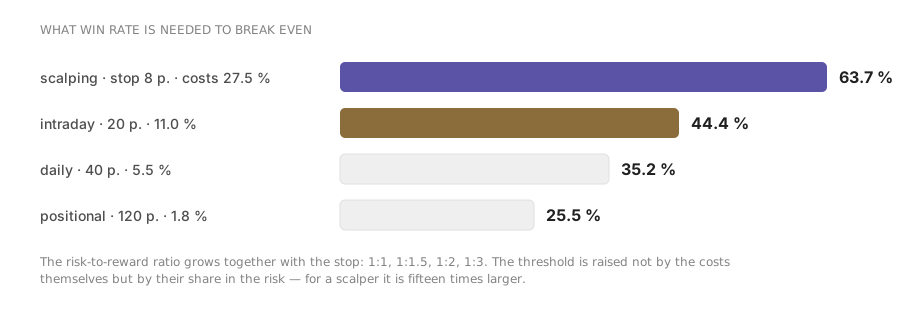
Costs enter the formula as a share of risk, and that share depends entirely on how close the stop is. Hence a non-obvious consequence: scalping and position trading have fundamentally different win-rate requirements at the same risk/reward ratio.
| Style | Stop | Costs as a share of risk | Ratio | Win rate required |
|---|---|---|---|---|
| Scalping | 8 pts | 27.5 % | 1:1 | 63.7 % |
| Intraday | 20 pts | 11.0 % | 1:1.5 | 44.4 % |
| Daily | 40 pts | 5.5 % | 1:2 | 35.2 % |
| Position | 120 pts | 1.8 % | 1:3 | 25.5 % |
The right-hand column explains why «switch to a lower timeframe, there are more signals there» almost always makes results worse. There really are more signals, but the required win rate rises from twenty-five percent to sixty-four — and the actual win rate does not grow anything like as much from a change of timeframe.
stop 8 pts: 4.40 ÷ (0.2 × 8 × 10) = 27.5 %
threshold = (1 + 0.275) ÷ (1 + 1) = 63.7 %
Margin above the threshold: how much of it there should be
An actual win rate equal to the threshold means zero, not profit. The practical question is what margin is needed for a system to survive ordinary fluctuations.
The margin has to be judged on a sample of a hundred trades or more: at thirty the spread of the observed win rate is about ±17 points, and any «margin» within that figure is indistinguishable from chance.
What to do if your win rate is below the threshold
Negative expectancy is not a death sentence for a system, but it is not a reason to work on discipline either. There are exactly four levers, and they give different gains at different prices.
| Lever | What changes | How far the threshold falls | What you pay with |
|---|---|---|---|
| Increase the risk/reward ratio | A further target or a closer stop with the same entry | from 1:1.5 to 1:2.5 — from 44.4 % to 31.4 % | The win rate falls: fewer trades reach the target |
| Reduce costs | A different account type, trading in the hours of a tight spread | from 22 % to 9 % costs — from 40.7 % to 36.3 % | Usually nothing, but the gain is small |
| Move the stop further away | Costs become a smaller share of the risk | from 8 pts to 40 pts — from 63.7 % to 35.2 % | The lot comes out smaller, although the risk in money does not change |
| Tighten the entry conditions | Fewer trades but a higher share that work out | the threshold does not change, the actual win rate grows | Rarer signals: 6 trades a month instead of 20 |
The practical sequence is usually this: the third lever first, then the first. Too close a stop is the most common cause of negative expectancy among beginners, and it also drags a high share of costs along with it. Moving the stop out to a logical level and recalculating size is worth trying before any edits to the entry rules.
stop 8 pts: 0.63 lots · stop 40 pts: 0.13 lots — the risk in money is identical, the share of costs falls fivefold
Frequently asked questions
What win rate does a trader need?
The question is posed wrongly: a win rate by itself means nothing. What matters is the pair «win rate and risk/reward ratio». A system with 35 % winners at 1:3 is more profitable than one with 60 % at 1:0.8.
What are costs as a percentage of risk?
The sum of spread, commission and swap divided by the size of the risk in money. Example: risk $50, costs $5 — that is 10 %. The closer the stop, the higher that share at the same costs.
My win rate is above the threshold but the account is not growing. Why?
Three common reasons: the sample is under thirty trades and the result is random; the actual risk/reward ratio is below the planned one; some trades are made outside the rules and do not enter the statistics. Check it by splitting the trades in the journal.
Read next
