 APTF
APTFA forex trader's glossary
A forex trader's glossary: twenty concepts of trading psychology, the ones that appear on this site most often. The definitions are short and practical: not «what the textbook says» but «what this means for your trades».
Forex trading psychology terms in alphabetical order
- Loss aversion
- Also known as aversion to losses: a loss subjectively weighs about twice as much as an equal profit. The underlying cause of the disposition effect.
- Win rate
- The share of winning trades in a sample. On its own it says nothing: meaning appears only in combination with the risk/reward ratio.
- Gate
- A rule with the right of veto: it triggers regardless of the other conditions. A stop-day is a typical gate: after it there is no trading, whatever the chart shows.
- Discipline
- Not a character trait but the share of trades made by the written rules. A measurable quantity: calculated from the journal.
- Daily loss limit
- The amount or percentage after losing which trading stops for the day. A mechanism, not an intention.
- Disposition effect
- The tendency to close winning positions earlier than losing ones. Visible in the average profit being smaller than the average loss.
- Trade expectancy
- The average result of one trade over a distance: win rate × average profit − (1 − win rate) × average loss.
- Overtrading
- Also known as excessive trading: the number of trades is markedly above plan. It costs money through the costs themselves and through the growing share of trades outside the setup.
- Revenge trading
- Also known as revenge trading: raising risk immediately after a loss with the aim of getting the loss back on the very next trade.
- Edge
- A positive mathematical expectancy of the system. Without it, discipline only slows down the loss of the account but does not change the outcome.
- Drawdown
- A fall in equity from the last high. Counted in percent, and getting out of it requires a larger gain than the depth itself.
- Slippage
- An order filled at a price worse than the one requested. On forex it happens at moments of news releases and at the weekly open.
- R
- The unit of risk: the loss when the stop is hit. Measuring the result in R is more convenient than in money — the quantity does not depend on the size of the account.
- Risk of ruin
- The probability of driving the account down to a given drawdown at your current risk size, win rate and risk/reward ratio.
- Swap
- A charge for a position left open past midnight server time; the amount follows from the interest-rate difference on the pair. Because of it, waiting while in the red stops being free.
- Impostor syndrome
- A persistent feeling that the result is undeserved. In a trader it shows up as cutting size after a successful run.
- Stop-day
- The rule of stopping trading for the day after reaching the loss limit or a set number of stops in a row.
- Tilt
- A state after a strong emotional blow in which decisions are taken outside the rules. The term came from poker.
- Trading plan
- A set of answers written down before trading: what counts as an entry, where the stop goes, what size, and when there is no trading.
- FOMO
- Fear of missing out — the fear of missing a move. It produces an entry after the main part of the move has already gone.
Terms that require calculation are covered in separate materials — the links are in the text of the relevant pages.
How the terms are connected
The concepts in the glossary are not independent: almost all of them line up in a single chain from cause to consequence.
Loss aversion: a loss weighs more than an equal profit. The point from which most of the rest grows.
the mechanismThe disposition effect: profits are cut, losses are sat out. It appears automatically, without a separate decision.
consequenceTrade expectancy goes negative with the strategy unchanged. Calculated from the averages, not from a feeling.
measuredRevenge trading and overtrading: an attempt to get the loss back quickly. Here the rate of losses grows several times over.
amplificationThe daily limit and the stop-day break the chain at the single place where it is still cheap.
exitThe journal and the share of trades by the rules show whether the chain was broken or merely moved out of sight. Without this step any improvement stays a feeling.
controlSix pairs of terms that are confused most often
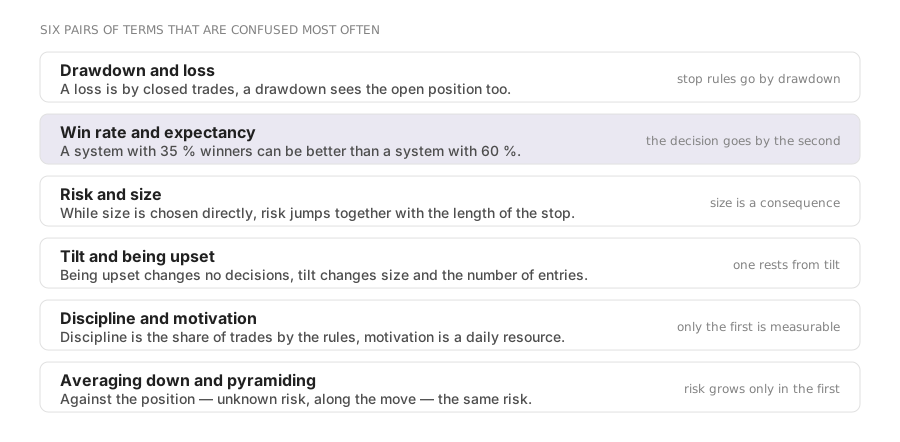
Half of the arguments about trading psychology are arguments about different things called by the same word. Below are the pairs where the substitution costs most.
| Pair | What the difference is | Why it matters in practice |
|---|---|---|
| Drawdown and loss | A loss is the result of a closed trade; a drawdown is the fall of equity from its high, including the floating result | Stop rules are set by drawdown: a loss on closed trades does not see an open position sitting in the red |
| Win rate and expectancy | Win rate is the share of winning trades; expectancy is the average result taking the sizes of profit and loss into account | A system with 35 % winners can be more profitable than one with 60 %; the decision is taken on the second figure, not the first |
| Risk and size | Risk is the amount you are prepared to risk; size is a consequence of the risk and the distance to the stop | As long as size is chosen directly, risk jumps from trade to trade along with the length of the stop |
| Tilt and being upset | Being upset does not change decisions; tilt changes size, the stop and the number of entries | You need a rest from tilt, whereas being upset after a stop taken by the rules is a normal background to the work |
| Discipline and motivation | Discipline is the share of trades by the rules, a measurable quantity; motivation is a resource with a daily cycle | Building execution on motivation means planning by the best day of the month |
| Averaging down and pyramiding | Averaging adds size against the position, pyramiding adds it with the move, moving the stop up | The first increases an unknown risk, the second leaves total risk unchanged |
The third row deserves separate mention. The wording «I trade 0.1 lots» sounds like a rule about risk, but it is not one: with a 15-point stop and with a 60-point stop these are two different amounts, differing fourfold. A rule about risk looks different — «one percent of equity per trade» — and the lot is calculated from it by formula.
0.10 × 15 × 10 = $15 against 0.10 × 60 × 10 = $60 — one and the same «fixed lot»
Terms deliberately absent from the site
Several popular words are not used in the materials, and that is a decision rather than an omission.
The full list of what we do not write and why is in the editorial policy. The formulas behind terms such as expectancy and risk of ruin are collected on the methodology page.
Frequently asked questions
How does tilt differ from ordinary upset after a loss?
Being upset does not change decisions: the rules are followed, the size is the same. Tilt changes the decisions themselves — size grows, the stop disappears, entries happen outside the setup. The practical sign: if after a loss you do something you would not have done in the morning, that is already tilt.
Why is risk more convenient to measure in R than in money?
Because R does not depend on the size of the account or on the currency. «Minus 3R for the week» reads the same on a $500 deposit and a $50,000 one, and it can be compared with your own statistics from last month.
What is an edge in plain words?
It is a positive average result per trade over a long distance. If it is negative, more discipline will stretch out the loss of the account but will not prevent it — checked in the risk-of-ruin calculation.
Read next
