 APTF
APTFFOMO on forex
FOMO (fear of missing out) is the fear of missing something. FOMO on forex is especially active: there are many pairs, the moves run around the clock, and something is always rising somewhere without you. Hence the characteristic error — an entry at the moment when most of the move is already done, with the stop having to go further away than usual.
The FOMO effect in trading: what a late entry looks like
It can be told from an ordinary entry by three signs, and all three are visible in the record of the trade, not only in the feeling.
The entry is not at the edge of the range but in the middle of the move. The distance to a logical stop has grown, which means that at the same risk the size should be reduced — but usually it is not.
sign: stop further than normalBetween the thought appearing and the button being pressed there is no check against the checklist. In a journal such trades are usually described more briefly than the rest.
sign: no record of the conditionsA pair you do not normally trade came into view by chance — through a feed, a chat or a scanner. There is no experience with it and no statistics either.
sign: somebody else's instrumentThe price of a late entry in points
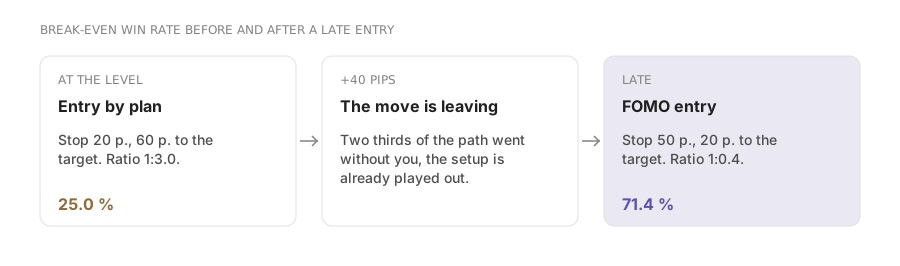
Let us work through in numbers what exactly a late entry spoils. Take a 60-point move from a level and two options: an entry at the level and an entry after 40 points of the move.
| Entry at the level | Entry after 40 points | |
|---|---|---|
| Distance to the stop | 20 pts | 50 pts |
| Left to target | 60 pts | 20 pts |
| Risk/reward ratio | 1:3.0 | 1:0.4 |
| Break-even win rate | 25.0 % | 71.4 % |
| Size at 1 % risk and a $5,000 account | 0.25 lots | 0.10 lots |
at the level: 1 ÷ (1 + 3.0) = 25.0 % · after the move: 1 ÷ (1 + 0.4) = 71.4 %
The point of the table is not that a late entry is «bad». It requires a win rate you most likely do not have: 71 % winning trades is a figure rare even for systems with a very short take-profit. That is why a FOMO entry is almost always loss-making over the distance, even when individual trades of that kind end in profit.
The rule that closes FOMO mechanically
Persuasion does not work here: the decision to enter is taken faster than it can be put into words. What works is a numerical cancellation rule written into the trading plan.
The wording of the rule. «The entry is cancelled if price has moved more than N points away from the level» — where N you take from your own statistics: it is the distance beyond which your trades stop working out. The rule is checked with a single glance at the chart and requires no judgement of the situation.
What else reduces the frequency of FOMO
- A short list of instruments
- Two or three pairs instead of the whole shop window. The fewer charts in front of you, the fewer moves «passing you by».
- Pending orders instead of manual entry
- A pending order at the level either fills or it does not. There is nothing left to chase.
- Leaving chats and feeds during the session
- Somebody else's trade in real time is the strongest FOMO trigger. This is not about «bad advice» but about the fact that another person's entry always looks timely.
- A record of missed moves
- A separate page of the journal: what you missed and what would have happened had you entered late. Within a month the list itself removes half the regret.
Why FOMO occurs more often on forex than on other markets
It is not about the character of currency traders but about the design of the environment. Four of its properties work together and produce an almost continuous stream of occasions to feel you are missing something.
Three of the four properties are removed by the settings of your workplace: a short list of instruments, pending orders instead of watching, leaving chats for the duration of the session. The fourth — overnight moves — cannot be removed at all, and the only thing that works against it is the rule cancelling an entry by distance from the level.
A worked example: two entries into one move
Take a specific day on EURUSD: the level worked and the move came to 60 points. Compare an entry at the level with an entry after two thirds of the move has passed.
| Parameter | Entry at the level | FOMO entry | Difference |
|---|---|---|---|
| Distance to the stop | 20 pts | 50 pts | ×2.5 |
| Left to target | 60 pts | 20 pts | ÷3 |
| Risk/reward ratio | 1:3.0 | 1:0.4 | ×7.5 |
| Break-even win rate | 25.0 % | 71.4 % | +46.4 pts |
| Size at $50 risk | 0.25 lots | 0.10 lots | ÷2.5 |
| Costs as a share of risk | 4.4 % | 4.4 % | equal |
The key row is the fourth. Seventy-one percent winning trades occurs with almost nobody; systems with such a win rate exist, but they have a short take and a very wide stop, that is, a fundamentally different construction. An entry in the middle of a move demands statistics you do not have — and that, rather than the «bad price», is its main problem.
at the level: 1.044 ÷ 4.0 = 26.1 % · by FOMO: 1.044 ÷ 1.4 = 74.6 % including costs
With costs included both thresholds are higher than in the table: spread and commission add about one and a half and three percentage points respectively to the required win rate. This is calculated in the costs calculator.
Frequently asked questions
How do you beat FOMO in trading if the move really is strong?
Accept that some moves happen without you — that is a built-in property of any system with a limited set of setups. The practical approach: wait for a pullback to the level and enter by plan, or do not enter at all. A trade «in the middle of the move» requires a win rate that does not exist.
Are FOMO and greed the same thing?
The mechanics are close, but the point differs. Greed changes the parameters of a trade you were going to make anyway. FOMO creates a trade that was not in the plan at all.
Does looking at the chart less often help?
Yes, and it is one of the few changes with a fast effect. Checking the market on a schedule — at the close of the hour, for example — removes most impulsive entries simply because the «right now» moment passes without you.
What to do if FOMO comes from other people's results on social media?
Remember the arithmetic of publication: winning trades get shown, not the sample. From a single screenshot you can judge neither the win rate, nor the risk per trade, nor how many accounts ended before it. A breakdown of similar claims is in myths about trading.
Read next
