 APTF
APTFA forex trader's motivation and learning
A forex trader's motivation is usually discussed in the genre of encouragement, and that is useless: the lift after a motivating text lasts a few days. Two things are practically useful — a correctly chosen goal and an honest timeline. Both change behaviour for a long time, unlike inspiration.
Two kinds of motivation in trading and why one is destructive
What drives a trader
The difference is not in the nobility of the wording but in the mechanics. A process goal is achieved by your actions. A money target with a deadline is achieved only by the market — and when it does not agree, one lever remains: position size. Hence the rise in risk at the end of the month, visible in most people's journals.
How long learning to trade forex really takes
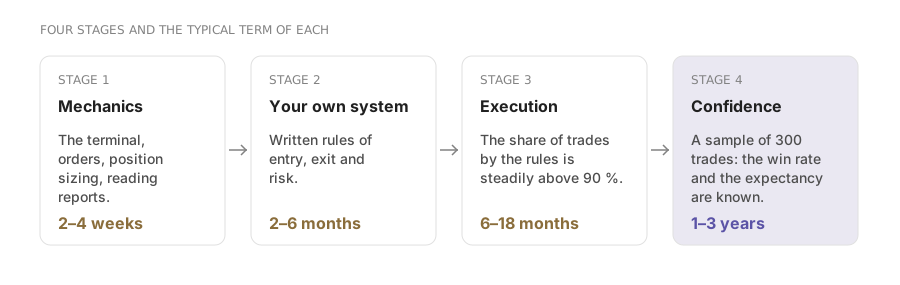
The question «how long does it take to learn trading» has no exact answer: the timeline depends on time available, a mentor, starting skills and the market. But it is useful to know the ranges from practice in advance — most disappointment comes from the gap between expectation and these timelines.
| Stage | What counts as completed | Typical duration |
|---|---|---|
| Mechanics | The terminal, orders, size calculation, statements | 2–4 weeks |
| Your own system | Written rules for entry, exit and risk | 2–6 months |
| Execution | The share of trades by the rules is steadily above 90 % | 6–18 months |
| Statistical confidence | A sample of 300 or more trades, the win rate and expectancy are known | 1–3 years |
The timelines are indicative and come from experience rather than research: no verifiable statistics on learning to trade exist. Their usefulness is not in precision but in order: the execution stage takes longer than the knowledge stage — and it is precisely that one that is usually underestimated.
What to do when motivation has gone
- Check whether it is burnout
- If rest does not help and a profit brings no joy, this is not about motivation. The signs are on the page about burnout.
- Change the goal to a process one
- If the current goal is in money and the deadline is burning, there will be no motivation by construction: every day without a result reads as a failure.
- Reduce the scale of the task
- «Thirty trades by the rules» is achievable and verifiable. «Become a profitable trader» has neither a deadline nor a criterion.
- Look at the list of what is done
- The plan is written, the limit is in place, two months of journal. These are facts, and they do not depend on what the last month looked like in money.
- Take a planned break
- A week away from the market costs nothing and often restores interest better than any technique.
- Go back to your own numbers
- Win rate, average ratio, expectancy over a hundred trades. Motivation falls partly because the result feels random; statistics restore the sense of control faster than any pep talk.
Goals that hold and goals that break you
The difference between the two kinds of goal is not the nobility of the wording but who is responsible for meeting it. A goal whose achievement depends on the market leaves one lever when you fall behind the deadline — position size.
| Goal | Who meets it | What happens when you fall behind |
|---|---|---|
| «Get the rule-following share to 90 %» | you | You keep working: the quantity grows from your actions |
| «Three months of journal without gaps» | you | You simply continue, falling behind is impossible |
| «Thirty trades on one setup» | you and the frequency of signals | You wait: a missed setup neither brings the goal closer nor pushes it away |
| «Earn 100,000 by the holiday» | the market | Size grows: there is no other way to speed up |
| «Reach an income in three months» | the market | Every month without a result reads as a failure |
| «Make back what was lost last year» | the market | A direct road to revenge trading, only stretched out in time |
You can test your own goal with one question: what will you do tomorrow if today it did not come closer? For the first group the answer is «the same thing». For the second there is no answer within the rules, and so it is found outside them.
What changes at each stage of learning
The feeling «I am not moving» most often means you are looking at the result rather than at the stage. Each stage has its own criterion, and the result in money appears at the last one.
Why the third stage is the hardest. In the first two progress is visible: yesterday I could not, today I can. In the third nothing changes outwardly, the rules have long been known, and the rule-following share grows slowly and unevenly. That is exactly the stretch where measurement helps: 55 % → 76 % → 94 % over a quarter looks like progress, while «I suppose I have become more disciplined» does not.
Frequently asked questions
How long does it take to become a trader?
It depends on what you count as the result. Mastering the mechanics takes weeks. Writing your own system takes months. Bringing execution to a stable level and gathering statistics you can lean on takes years. Short timelines in advertising refer to the first item while implying the fourth.
How do you avoid quitting at the stage where nothing works?
Change the criterion of success from the result to execution. The share of trades by the rules grows from your actions and does not depend on the market — progress is visible in it even in a losing month.
Do motivational books and videos help?
They give a lift for a few days and do not change behaviour. What proves more useful is whatever reduces the effort of the needed action: a short checklist, a five-field journal, orders placed in advance.
Is it worth setting financial goals at all?
It is — but on a horizon of a year or more and without tying them to a particular month. An annual goal creates no pressure at the end of the week, whereas a monthly one does, and it is most often what stands behind rising risk in the final days of a period.
Read next
