 APTF
APTFGreed on forex
Greed on forex rarely looks like greed. It arrives in the form of reasonable wordings: «the signal is very clear, I can take a bit more», «let it run further, the trend is strong», «one more trade, it is a good day». You can check yourself by one sign: greed always changes a number worked out in advance.
Three places where greed intervenes
Fear and greed in trading are often named as a pair, but they work at different points. Fear gets in the way of acting; greed changes the parameters of a decision already taken.
The most expensive of the three. The lot is increased while the distance to the stop is the same — which means the risk per trade has grown by exactly the same factor. This is the case the widget on the front page calculates.
price: risk × multiplierThe take-profit is moved further because «it is going well». Formally this is an increase in the risk/reward ratio; in fact it is a cancellation of the plan: the exit condition is now unknown.
price: a return to breakevenAfter two winners the feeling appears that today «it is going». The number of trades grows, and the share of trades outside the setup grows with it.
price: costs and the quality of entriesWhat an oversized lot costs
It is convenient to count not in dollars per trade but as a yearly sum: a one-off excess looks like a trifle, a habit does not.
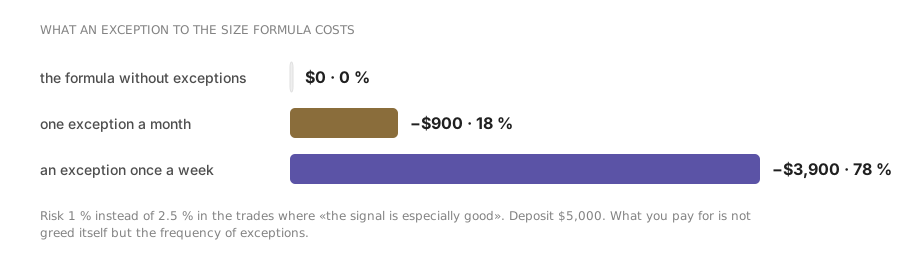
a $5,000 deposit, 1 % risk, a multiplier of 2.5, once a month: (125 − 50) × 12 = $900 = 18 % of the deposit
Eighteen percent of the deposit a year is more than most improvements to a strategy give over the same time. And the overpayment comes from exactly one decision repeated twelve times, and it is removed entirely by calculating size with a formula and not revisiting it after the calculation.
A size formula that leaves no room for editing:
(5,000 × 1 %) ÷ (25 × 10) = 50 ÷ 250 = 0.20 lots
How to overcome greed in trading: telling it from calculation
Increasing size is not always a mistake: scaling an account is normal practice. The difference is in when the decision is taken and on what grounds.
| Calculation | Greed | |
|---|---|---|
| When the decision is taken | Away from the market, before the session | In the moment, with the chart open |
| On what grounds | The statistics for a period | A feeling about the current setup |
| What changes | The base risk for all trades | One particular trade |
| How often | No more than once a month | When «the signal is especially good» |
| Is it written down | Yes, in the plan with a date | No |
The main sign. If size has been changed for one trade, that is greed, however convincing the justification sounds. A system's edge exists over a distance and is spread evenly across all trades; «especially good» trades do not exist in the statistics, only in the feeling.
A profit held too long
The second kind of greed looks like the opposite of the first and is often found in the same person. The logic of «let it run further» has a specific price on forex: holding a position is paid for with the swap every night, and the major pairs rarely move one way for longer than a few sessions.
When the target really can be moved
Six wordings behind which a forex trader's greed stands
Greed does not arrive with the word «greed». It arrives with an argument that at the moment of speaking looks professional. Below are six such arguments and a check for each.
Check: do you have statistics for the category «clear setups» over at least thirty trades? If not, this is a judgement rather than a class of trades, and it was made in a moment of arousal.
sizeCheck: where exactly is the new target and what will you do if the price comes back to the old one? If there is no answer, the exit condition no longer exists.
targetCheck: how many trades does the plan allow for the day and how many have already been made? «It is going» means two winners in a row, and two winners in a row happen at any win rate above forty percent.
frequencyCheck: what you have made sits in the same account and protects you from a drawdown exactly as the original deposit does. There is no separate «not really yours» part of the equity.
the house money effectCheck: a money target over a short period is achievable only through an increase in size — the win rate does not change over a week. That is already revenge trading.
a money targetCheck: work out the total risk after the addition. Usually it turns out to be twice the planned one, because the stop has stayed where it was.
adding to a positionWhat all six have in common is a first-person verb and the absence of a number. A rule written with a number admits no such wording: «risk 1 % of equity, size calculated by formula, review on the first of the month» cannot be applied «a bit more».
What happens to the account: three scenarios over a year
The difference between calculation and greed is visible not on one trade but over a year's horizon. Take one system and three ways of handling size.
| Scenario | Risk per trade | Overpayment per year | That is, of the account |
|---|---|---|---|
| The formula with no exceptions | 1 % always | $0 | 0 % |
| One exception a month | 1 %, occasionally 2.5 % | −$900 | 18 % |
| An exception once a week | 1 %, often 2.5 % | −$3,900 | 78 % |
once a month: (125 − 50) × 1 × 12 = $900
once a week: (125 − 50) × 4.33 × 12 = $3,900
The third row looks like an exaggeration right up to the moment it is checked against your own export. «Once a week» is one trade in five to seven, that is, under twenty percent of cases. And that is exactly the spread of risk found in most people who believe they trade a fixed percentage.
Frequently asked questions
Are greed and ambition the same thing?
No. Ambition sets a goal away from the market: «reach steady execution of the rules», «bring the deposit to such-and-such a size within a year». Greed changes a parameter inside a trade that is already open or being prepared. The first is useful, the second costs money.
What do I do if a signal really does look stronger than usual?
Nothing special — take the planned size. If you have grounds to consider some setups stronger, that has to be part of the system: a separate category of trades with a separate risk, described in the plan and checked against the statistics over at least thirty cases.
Can risk be increased at all after a good period?
It can, if this is planned scaling: a fixed step, a review no more than once a month, and a rollback to the previous risk at a drawdown of a set depth. A spontaneous increase after a good week is already euphoria, and it usually brings the largest loss of the month.
How is greed connected with overtrading?
Through the feeling that «it is going today». It produces both an increase in size and a growth in the number of trades at once, and the second part is less noticeable. The price of extra trades is worked out in the costs calculator.
Read next
