 APTF
APTFA forex trader's trading plan
A forex trader's trading plan is not a description of a strategy and not a list of wishes. It is a set of decisions taken in advance so that they do not have to be taken at the chart. There is one test of a plan's quality: another person should be able to trade from it without asking you a single question.
Nine sections of a working plan
There is no doing with fewer: any missing item turns into a decision taken in the moment. The wordings have to be checkable — «I trade with the trend» is not an item of a plan but a mood.
| Section | What has to be written | The check |
|---|---|---|
| Instruments | Specific pairs and how many | You can list them without thinking |
| Working hours | The hours of the session and the days of the week | There is an answer to whether you trade on Friday evening |
| The entry setup | The conditions, every one of them | Another person will find the same entries in the history |
| Position size | A formula, not a number | Size is calculated rather than chosen |
| Stop | The level and the rule for placing it | The stop is set by the markup, not by a loss amount |
| Target and exit | The closing condition, including partial closes | Contains no words like «as the situation requires» |
| Limits for the day | The loss limit and the number of trades | There are specific figures |
| News | What you do before and after releases | The rule works without judging how important the news is |
| Review | When and on what grounds the plan is changed | The frequency and the minimum sample are stated |
An example forex trading plan with numbers
The example is for teaching: you cannot take it as your own — the parameters have to follow from your own statistics. But the structure and the level of concreteness here are exactly what is needed.
- Instruments
- EURUSD and GBPUSD. I do not open other pairs in the terminal.
- Time
- From 10:00 to 14:00 my time, Monday to Thursday. On Friday there are no new positions after 16:00.
- The entry setup
- A bounce from a level marked on the daily chart before the session starts; confirmation is an hourly candle closing in the direction of the bounce. The levels are marked in advance and are not added to during the session.
- Position size
- Size = (deposit × 1 %) ÷ (distance to the stop in points × point value). Rounded down to 0.01 lots.
- Stop
- Beyond the level plus the average spread. Placed as an order at the same time as the entry. Not moved against the position under any circumstances.
- Target and exit
- Half the size is closed at a distance of 1R, the stop is moved to the entry point, the remainder is run to the next level.
- Limits for the day
- A maximum of three trades. A stop-day at a 3 % loss or after two stops in a row, whichever comes first.
- News
- For 15 minutes before a release from the calendar's red list I open no new entries; open positions with a partial close taken I leave, the rest I close.
- Review
- The first Saturday of the month, with a sample of no fewer than 30 trades. One parameter is changed per review.
How a bad plan differs from a working one
A bad plan is recognised not by its length but by its wordings: it consists of intentions rather than conditions.
| The wording in the plan | Why it does not work | How to rewrite it |
|---|---|---|
| «I only trade quality setups» | Quality is judged at the moment of entry, that is, under the influence of a state | List the setup conditions as a list |
| «The risk is small» | No number means the size is chosen by feel | «Risk 1 % of equity per trade» |
| «I place a sensible stop» | «Sensible» after entry means «further away» | «The stop goes beyond the level plus the average spread» |
| «I do not trade in a bad state» | A bad state is not recognised from the inside | «I do not trade on less than 6 hours of sleep» |
| «I exit when the move runs out of steam» | There is no exit condition, so the exit will be made on emotion | «Half at 1R, the remainder to level N» |
A concreteness test. Read your plan and underline every word that cannot be checked by looking at a chart: «good», «strong», «sensible», «as the situation requires», «usually». Every underlined word is a decision you left yourself to take at the moment of the trade. Those are the ones to rewrite first.
What to do when the plan and the market diverge
The situation the plan is written for: there has been no setup for a week, or there is one but it looks suspicious. The right answer depends on what exactly has changed.
How to test the plan with someone else's hands
The main criterion of a plan's quality is reproducibility. Below is a half-hour procedure that shows the gaps more accurately than any amount of reading.
An acquaintance who can open a chart is enough. Understanding of the market is not required — quite the opposite.
5 minutesAny month, your pair, your timeframe. They mark the entry points from your description of the setup.
15 minutesIf fewer than two out of three match, the entry conditions are described vaguely and admit interpretation.
5 minutesBy your formula and your deposit. A discrepancy means the formula is being held somewhere in your head rather than in the text.
3 minutesThe answer has to be unambiguous: hours, days, limits, news. «As the situation requires» means the item is missing.
2 minutesEvery discrepancy turns into a separate line of the plan. Usually there are three or four of them.
an eveningWhy someone else specifically. The author of a plan fills in what is missing from their head automatically: in their version of the text the entry conditions are complete. An outsider reads exactly what is written, and their mistakes are the very gaps through which any convenient interpretation passes in a real session.
How the plan protects you against each state
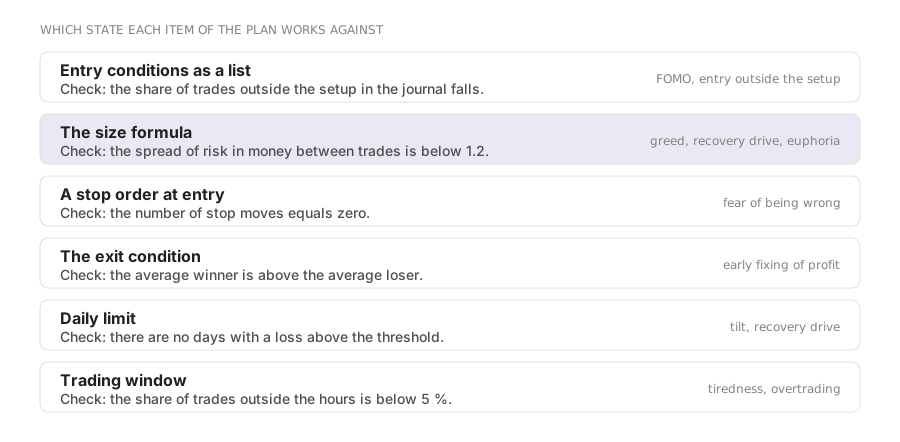
It is useful to see the correspondence: which item of the plan works against which scenario. An item with no such correspondence usually turns out to be decorative.
| Item of the plan | What it works against | How to check that it works |
|---|---|---|
| Entry conditions as a list | FOMO, an entry outside the setup | The share of trades outside the setup in the journal falls |
| The size formula | Greed, revenge trading, euphoria | The spread of risk in money between trades is below 1.2 |
| A stop order at entry | Fear of being wrong, loss aversion | The number of stop moves equals zero |
| The exit condition | Taking profit early | The average winner is above the average loser |
| Daily limit | Tilt, revenge trading | There are no days with a loss above the threshold |
| Trading window | Fatigue, overtrading | The share of trades outside your hours is below 5 % |
The table also explains why a plan is written after the first month of the journal rather than before it. While there are no statistics, it is unclear which items you actually need: for one person everything falls apart on size, for another on the number of trades, and their plans have to be different.
Frequently asked questions
How long should a trading plan be?
One or two pages. A long plan does not get read before the session, and reading it before starting work is its main function. Everything that does not fit most likely belongs to the description of the strategy rather than to the plan of action.
Do I need a plan if I trade someone else's strategy?
You need it even more: someone else's strategy describes the entries but says nothing about your time, your deposit, your acceptable risk and your behaviour after a run of stops. It is precisely that part that determines the result.
How often should a trading plan be changed?
No more than once a month and only on the basis of the statistics for the period. It is worth writing down a separate rule: the minimum number of trades that must accumulate before a review. Without it the plan gets rewritten after every bad week and never gets a chance to show what it can do.
What do I do if there is a plan but no execution?
That is a separate task, and it is not solved by rewriting the plan. The causes are examined in the material why you cannot follow your system — of the five typical causes only one is connected with motivation.
Read next
