 APTF
APTFDaily loss limit on forex and the stop-day
A daily loss limit on forex is the amount after losing which trading stops for the day. The stop-day is the rule of stopping itself. This is the first thing worth introducing and the only mechanism that halts tilt before it becomes expensive: every other tool requires you to be in a state to use it.
How to choose the number
The limit has to be large enough not to fire on an ordinary day and small enough that a bad day does not turn into a bad month. The practical method is to tie it to the size of the risk per trade.
1 % × 3 = 3 % per day — or simply: two stops in a row, whichever comes first
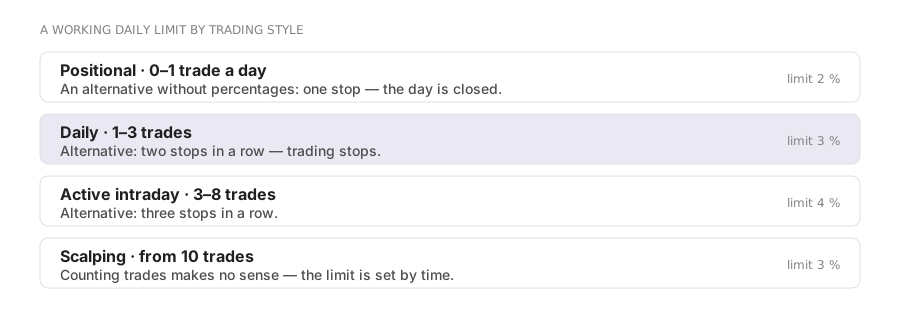
| Trading style | Trades per day | Working limit | Alternative |
|---|---|---|---|
| Position | 0–1 | 2 % | One stop — the day is closed |
| Daily | 1–3 | 3 % | Two stops in a row |
| Active intraday | 3–8 | 4 % | Three stops in a row |
| Scalping | 10+ | 3 % | A limit by time rather than by trades |
The figures are a guide, not a standard. The only hard requirement: the limit is chosen in advance and once, not adjusted on the day it gets in the way.
Two kinds of limit and why both are needed
A percentage of equity per day. It catches the case where the loss arrived fast and large — for example with size above plan.
protects against sizeA maximum of trades per day regardless of the result. It catches overtrading, where each individual loss is small and the day's sum is not.
protects against frequencyTwo or three stops in a row close the day even if the sum is still within the limit. It catches the state: a streak hits the head harder than one large loss.
protects against stateThe pair works as «whichever comes first». One money limit does not close every scenario: six small losing trades in a row formally fit inside 3 %, while the state after them is already unworkable.
The stop-day on forex: how to hold the rule technically
An agreement that «after the third stop I will close the terminal» does not hold: at the moment of the third stop you will be against it. So the mechanism has to be external to you at that moment.
- Close the terminal and log out
- The password in a password manager, logging back in requires actions. A thirty-second barrier removes most of the impulse.
- A limit on the platform side
- Some terminals and trading servers support a limit on the number of trades or on the daily loss. If such a setting exists, it is the best option, because it does not depend on you.
- A simple physical action
- Put the laptop in a bag, leave the room. It sounds naive and it works better than a promise — for the same reason a pack of cigarettes removed from the house works.
- Recording the fact in the journal
- A line saying «the stop-day fired today» with the reason. A month later the number of such lines shows whether the limit is too tight or the state too frequent.
The mirror rule: a profit limit
It is discussed less often but appears in the same plans: close the day after a result above the daily norm. The point is not to cap income but that the state after a large plus produces the same loss of control as after a large minus — this is examined on the page about euphoria.
The rule is debatable and worth introducing only on your own statistics: calculate the result of trades made after the daily target had already been reached. If it is negative on a sample of twenty or more cases, you need the rule. If not, you do not.
What the rule costs: counting what is forgone
There is always one objection to the stop-day: «what if a good move comes after the limit». The objection is fair, and it is worth calculating rather than waving away.
| What we count | How | Example at a 45 % win rate |
|---|---|---|
| Days on which the limit fires | two stops in a row over the distance | ≈ 30 % of days |
| Trades cut off per month | limit × days × trades after the limit | ≈ 6 trades |
| Their expected result by plan | 6 × 0.35 R | +2.1 R |
| Their actual result after two stops | from the journal, usually lower | −1.5 R and worse |
The key row is the last one. Trades made after two stops in a row are statistically worse than average: their win rate is lower, size is higher and the share of entries outside the setup is greater. The rule cuts off not «six ordinary trades» but the six worst trades of the month — and that has to be checked against your own journal rather than taken on faith.
price of not having the rule = the actual result of those same trades
calculated from your own export over a quarter, not from someone else's experience
Six ways to word the limit
The threshold can be defined in different ways, and the wording determines which scenarios it catches. A working combination usually consists of two or three rules of the «whichever comes first» kind.
3 % for example. It catches a large loss that arrived fast — including with size above plan.
against sizeTwo or three. It catches the state: a streak hits the head harder than one loss of the same amount.
against stateA hard number regardless of the result. It catches overtrading, where each loss is small and the sum is not.
against frequencyAn hour after which there are no new entries. It catches fatigue and «I will sit it out until London».
against fatigue6 % for example. It catches the slow slide that a daily limit does not see: a little every day.
against slidingThe mirror rule. It catches euphoria — the statistics of trades made after the target was met are worth checking separately.
against euphoriaThere is no need to introduce all six rules at once: start with two — the percentage per day and the number of stops in a row. The rest are added one at a time, when the journal shows that this particular scenario occurs with you.
Frequently asked questions
What to do if the limit fires almost every day?
That is a sign not of weak discipline but of too tight a limit or too large a risk per trade. Check it: if the limit equals two stops and the win rate is 45 %, two stops in a row will happen on roughly a third of days — calculate it for your own numbers and pick the threshold.
Can I finish the day if a perfect setup appears after the limit?
No. This exact case is what makes the rule meaningless: an exception allowed once becomes the norm within two weeks. Besides, the judgement «perfect» is issued by the same state that made the limit fire.
Should the limit be counted from the deposit or from equity?
From equity at the start of the day. That way the limit shrinks along with the account during a drawdown — and that is exactly the period when shrinking is useful.
What if a position is open and the limit has been reached?
The rule concerns opening new positions. One that is already open is managed by plan — with the stop that was placed at entry. Closing it early «since the day is closed anyway» is the same breach of the plan, only in the other direction.
Read next
