 APTF
APTFBreaking the trading plan on forex
«I know what to do and I break it anyway» is the most common complaint of a trader with more than six months' experience. Breaking the trading plan on forex is usually explained by weak motivation, and that explanation is almost always wrong. Of six typical causes motivation is only one, and the rarest.
Why a trader breaks their own rules on forex: six reasons
Before working on yourself it is worth checking whether the rule itself is workable. In half the cases the question closes at this step.
«Enter only on quality setups», «do not trade in a bad state». Compliance cannot be checked, which means it formally cannot be broken either — the rule simply does not work.
cured by rewritingTaken from a course or from an acquaintance and not matched to your time, deposit or temperament. Especially often — a requirement to sit at the chart for six hours, given to somebody with a job.
cured by adaptation«Do not miss setups» and «a maximum of three trades a day» are incompatible on an active day. In a conflict the one closer to desire wins.
cured by priorityOne increased lot looks like a trifle. While a violation has no sum attached, there are no arguments against it — and it is exactly that which the site's calculators compute.
cured by calculationThe rule demands effort exactly when no effort is left. The one cause where work on yourself is genuinely needed — and even that is solved by a mechanism rather than by motivation.
cured by a mechanismIt is written down but there are no statistics for it: it is unknown how many times it fired and how those cases ended. Following a rule for which you have not a single observation of your own is the hardest — it feels like somebody else's.
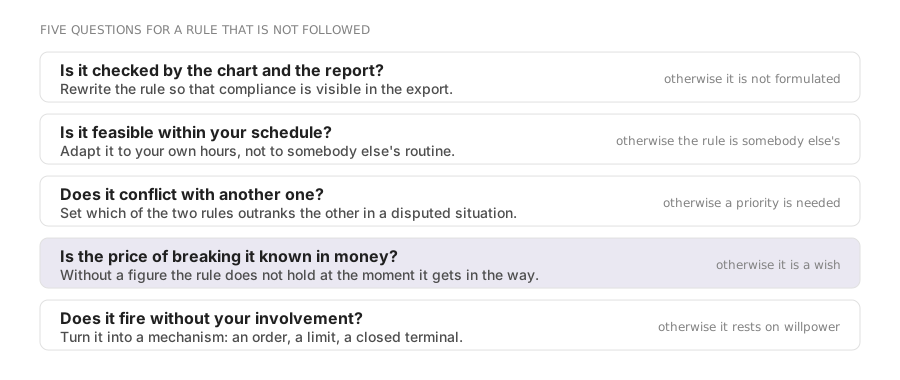
cured by measurementHow to check your rule in two minutes
| Question | If the answer is «no» |
|---|---|
| Can compliance be checked from the chart and the statement? | The rule is not formulated — rewrite it in verifiable form |
| Is it workable within your real schedule? | The rule is somebody else's — adapt it to your own time |
| Does it conflict with another rule? | Set a priority: which of the two comes first |
| Do you know the price of breaking it in money? | Calculate it — without a figure a rule remains a wish |
| Does it fire without your participation? | Turn it into a mechanism: an order, a limit, a closed terminal |
Five «yes» answers in a row mean the rule is workable and the issue really is execution. In practice fewer than half of rules reach the fifth question.
Why motivation has almost nothing to do with it
Motivation is a resource with a daily cycle: high in the morning and after inspiring material, low in the evening and after a loss. Building rule-following on it is the same as planning a budget on the income of your best month.
it is more reliable to increase ease and reduce resistance than to raise the first term
What this means in practice
- Reduce the number of decisions
- The stop as an order, size by formula, the entry as a pending order. Every decision removed is one less point of failure.
- Reduce the effort required
- A journal of five fields instead of fifteen. A checklist of seven points instead of twenty.
- Increase the effort required to break it
- Logging out of the terminal, the password in a manager, the laptop in a bag. Thirty seconds of barrier remove most of the impulse.
- Make the price visible
- One figure next to the monitor: what this habit cost last month. Calculated from the journal.
How to rewrite an unworkable rule: six examples
The most common case is a rule that cannot be broken because it cannot be checked. Below are six «before and after» wordings; rewriting takes an evening and closes half the questions about discipline.
| Was | Why it does not work | Became |
|---|---|---|
| «I only trade quality setups» | Quality is judged at the moment of entry, that is, under the influence of a state | «Enter when all four conditions from the list are met» |
| «Risk is reasonable» | There is no number — size is chosen by a feeling of sufficiency | «Risk 1 % of equity, size = risk ÷ (stop × point value)» |
| «I do not trade when tired» | Fatigue is not recognised from the inside precisely when it is present | «I do not trade on less than 6 hours' sleep or after 3 hours at the chart» |
| «I do not chase losses» | Describes an intention rather than an action, and so cannot be checked | «After two stops in a row the terminal is closed until tomorrow» |
| «I exit when the move has run out of steam» | There is no exit condition, so the exit will be by emotion | «Half at 1R, stop to the entry point, the rest to level N» |
| «I keep a journal» | There is neither a volume, nor a deadline, nor a criterion of completeness | «Nine columns, filled in on the day of the trade, reviewed on Saturdays» |
it can be checked from the statement · it can be broken · it requires no judgement at the moment of the trade
What to do when the rule is right but there is no execution
One case in six is left: the wording is checkable, the rule is yours, there are no conflicts, the price is known — and it still is not followed. Here what works is not motivation but a change in the effort required.
The stop as an order, size by formula, the entry as a pending order. Every decision removed is one less point of failure.
the strongestA journal of nine columns instead of twenty, a checklist of eight points instead of thirty. A short one gets done, a long one does not.
strongLogging out of the terminal, the password in a manager, the laptop in a bag. A thirty-second barrier removes most of the impulse.
strongOne figure next to the monitor: what this habit cost last month. Calculated from the journal.
mediumA weekly report to another person. It works for months, so it is suitable for establishing a habit rather than as a permanent mechanism.
mediumTwo pairs instead of ten, one setup instead of four, one window instead of the whole day. Less input data means fewer occasions to interpret it in your own favour.
structuralThe order in the list is by descending reliability, not by popularity. The first three ask nothing of you at the moment of the trade, and that is exactly why they work on the evening when everything else has already stopped working.
Frequently asked questions
Why do I break the rules even though I understand the point of them?
Because understanding and execution are provided by different things. Understanding is knowledge; execution is the resource available in the moment plus the ease of the action. That is exactly why reading another book about discipline does not change behaviour, while a placed order changes it at once.
Maybe trading is simply not for me?
The question is premature until the six reasons above have been checked. If after rewriting the rules and introducing mechanisms the rule-following share does not grow for three months — then it is a reasonable question, and the answer may be anything.
Does telling someone about your rules help?
It helps as an external barrier: an obligation to another person is met better than one to yourself. But the effect lasts months rather than years, and it is worth using to establish a habit rather than as a permanent mechanism.
Read next
