 APTF
APTFCognitive biases on forex
Cognitive biases on forex are neither stupidity nor inattention. They are stable ways of processing information that save effort in ordinary life and systematically cost money on the currency market. Knowing a bias does not cancel it, which is why each one here comes not with «remember this» but with a specific action.
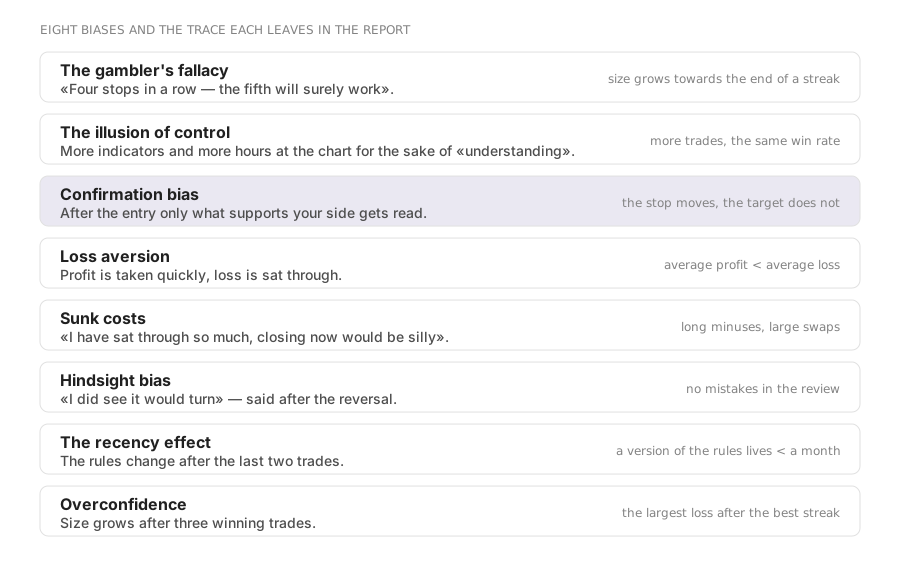
Eight biases visible in the trade statement
Selected are the ones that leave traces in the statistics: they can be found in your own trade log rather than merely recognised in a description.
| Bias | What it looks like at the terminal | Its trace in the statistics |
|---|---|---|
| The gambler's fallacy | «Four stops in a row — the fifth will surely work» | Size grows towards the end of a losing streak |
| The illusion of control | More indicators and more time at the chart for the sake of «understanding» | The number of trades grows, the win rate does not |
| Confirmation bias | After entering you read only the analyses that back your side | The stop moves, the take-profit does not |
| Loss aversion | Profit is taken quickly, a loss is sat through | The average win is smaller than the average loss |
| The sunk cost fallacy | «I have sat through so much already, closing now would be silly» | Long losing positions, large swaps |
| Hindsight bias | «I did see it would reverse» — after the reversal | There are no mistakes in the trade review, only «bad luck» |
| The recency effect | The rules change after the last two trades | A version of the strategy lives less than a month |
| Systematic overconfidence | Size grows after three winning trades | The largest loss comes right after the best run |
The gambler's fallacy on forex: why a run is not «due» to end
The brain looks for a pattern where there is none. After four losses in a row it feels as though the fifth trade is obliged to be a winner — «by probability theory». Probability theory says exactly the opposite: if trades are independent, the probability of the next one does not depend on the previous ones at all.
after 1 loss — 45 %, after 4 losses in a row — the same 45 %
What does change is your estimate of the probability of a long run. At a 45 % win rate five losses in a row over a hundred trades occur with a probability of 92 %: that is the norm, not a failure. The gambler's fallacy is dangerous not in itself but because it almost always comes paired with revenge trading — it is not only confidence that grows but size as well.
The illusion of control: why more analysis does not give more money
The more effort is put into preparation, the stronger the feeling that the outcome depends on you. On the currency market that feeling is false: price movement is determined by order flow, not by the quality of your mark-up. The mark-up affects only whether you enter situations with an edge.
Confirmation bias and what is done about it
After a position is opened perception changes instantly: arguments for your side seem weighty, those against seem contrived. This is not weakness of character, it is a basic property of attention, and it works in everyone.
There is one working technique and it is mechanical: the exit condition is written down before the entry. Not «I will see how it goes» but a specific level and a specific event. A condition written before the entry belongs to yesterday's you — the one who had no open position and therefore no bias.
A check on yourself. Take the last ten trades and find the ones where the stop was moved further from the entry. Then find the ones where the take-profit was moved further towards profit. For the overwhelming majority the first group is noticeably larger — and that is confirmation bias in its pure form, measured with your own hands.
Why knowing a bias does not cancel it
Biases work faster than conscious control: the decision forms before its explanation appears. That is why the only reliable method is to move the decision outside the moment.
The entry conditions, the stop, the take-profit and the maximum size are fixed in the trading plan before the terminal is opened. At the moment of the trade no decisions are left.
against all eightA daily loss limit and a trade limit cut off a series of decisions taken in one and the same distorted state.
against the gambler's fallacyA trade journal with a «state before entry» field deprives hindsight bias of its material: the record was made before the outcome was known.
against hindsight biasTwo pairs, one timeframe, two or three mark-up tools. The less input data, the smaller the surface for the illusion of control.
against the illusion of controlThe sunk cost fallacy and the recency effect: two expensive pairs
These two biases work in opposite directions in time and so are rarely recognised together. The first holds you inside a past decision, the second makes you rewrite the rules to fit the last three trades.
What each one does
neither the swap, nor the time in position, nor the commission paid enters this function — they are already spent whatever the outcome
The technique against the first works mechanically: the exit condition is set as an order at entry, and the position closes without your participation. Against the second there is the calendar review: the rules change on the first Saturday of the month and only with a sample of no fewer than thirty trades. Both techniques remove the decision from the moment when the bias is active.
A check on your own export: what to look for in the statement
A bias cannot be seen in yourself directly — it works faster than awareness. Its traces, however, remain in the numbers. Below is exactly what to calculate from a terminal export of the last hundred trades.
| What to calculate | How | The sign of a bias |
|---|---|---|
| Risk in money by date | The «loss at the stop» column in trade order | A step up after a run of stops — the gambler's fallacy and revenge trading |
| Number of stop moves | Compare the first and last stop level in a trade | There are moves against the position and almost none towards profit |
| Average trade duration | Separately for winners and losers | Losers are held longer — sunk costs and the disposition effect |
| Number of rule versions per quarter | By the dates of edits in the journal | More than three — the recency effect |
| Number of instruments | Unique symbols in the export | More than five with a system on two pairs — the illusion of control |
| Result by hour of the day | The sum of results broken down by hour of entry | A slump at the end of the session — fatigue, not a bias |
Frequently asked questions
How does a cognitive bias differ from an emotion?
An emotion is a state, a bias is a way of processing information. Fear makes you not press the button; confirmation bias makes you read the chart differently. In practice they go together: the bias selects the arguments that the emotion wants.
Can you train yourself not to fall for biases?
Entirely, no, and the attempts are useless. The frequency does fall noticeably: if the decision is taken in advance and written down, the bias has nothing to distort. That is precisely why the whole discipline section is built around mechanisms rather than self-control.
Are there biases that help?
There are — optimism during learning: without it nobody would survive the first year. But it has the same price as the rest: it is also what stops you admitting in time that a strategy has no edge. Its usefulness depends on where it is applied.
How do I work out which bias is mine?
By the traces in the journal: the «trace in the statistics» column in the table above lists exactly the verifiable signs. A quick self-check by behaviour is in the map of your breakdowns.
Read next
