 APTF
APTFA forex trader's psychological test
A forex trader's psychological test of twenty statements about what you did at the terminal over the past month. Not «how do you feel» but what happened with specific trades. Tick the ones that describe you — below there will be a breakdown across five scenarios and the leading one among them.
Tick what happened over the past month
This trader test is answered by facts, not by intentions: an item counts if it happened at least twice. The ticks are stored in your browser and are not sent anywhere.
Result
The result is counted by groups rather than by the overall total: four ticks in one group is a settled habit, whereas the same four spread across different groups more often mean that you simply have no written rules.
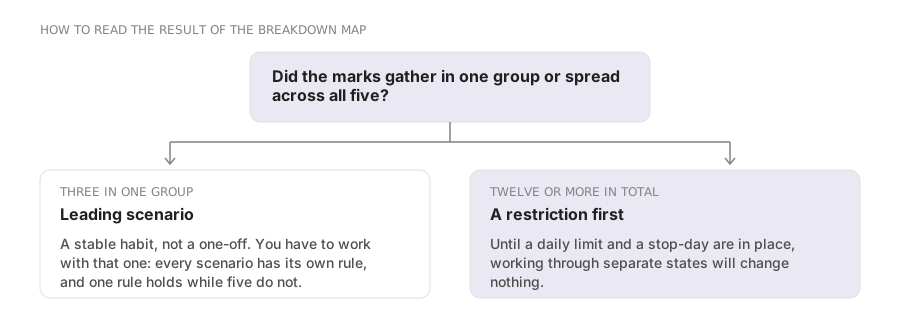
Type of forex trader: how to read the test result
The leading scenario. This is what you have to work on, rather than «emotions in general»: each scenario has its own rule, and one rule can be kept up while five cannot.
the point of applicationA separate case: until a restriction has been introduced, going through the scenarios is pointless. First the daily limit and the stop-day, then everything else.
gateUsually this means not five problems at once but the absence of a trading plan: there is nothing to breach, so everything is breached a little.
no rulesEither your execution really is in order, or the questions were answered by intention. Checked against a month of the journal — it does not remember good intentions.
checkWhat to do with each of the five scenarios
The test result is useful exactly to the extent that the next action is clear. Below is one first step for each scenario; they are chosen so that they can be done today.
| Leading scenario | First step | How to check it a month later |
|---|---|---|
| Fear | Halve your size and record missed entries | The number of misses due to fear falls, the share of execution grows |
| Greed and FOMO | Calculate size by formula; a rule cancelling the entry by distance from the level | The spread of risk in money between trades is below 1.2 |
| Revenge trading | A stop-day after two stops in a row, risk unchanged for a month | Average risk after a loss equals average risk after a profit |
| Overtrading | A limit on trades per day and a list of two or three pairs | The actual number of trades is close to the planned one |
| Breaking the rules | Rewrite one unworkable rule in checkable form | The share of trades by the rules grows rather than staying put |
Note that in all five rows the first step is a mechanism, not work on your state. The order is exactly that: while there is no restriction, any amount of self-understanding loses to a pressed button. Working with the emotion itself makes sense after the mechanism has held for a month.
The limits of the test: what it does not show
Twenty statements are structured self-observation, not a measurement. It is useful to understand where exactly it goes wrong.
The exact version of the same answer. A month of the journal with a «state before entry» column gives the distribution of the result across states — that is, the same conclusion, but from facts and with the price of each scenario in R. The test exists so that you do not have to wait that month before the first action.
Why three ticks in one group is a signal
The threshold is not invented: it comes from a simple comparison with an even distribution. Twenty statements are laid out across five groups equally — four to a group.
| Ticked in total | Expected per group | Three in one group is | How to read it |
|---|---|---|---|
| 5 | 1.0 | three times the expected | a settled habit |
| 8 | 1.6 | almost twice as high | a habit is likely |
| 12 | 2.4 | slightly higher | there is no leading group |
| 16 | 3.2 | at background level | the problem is not one emotion |
In shares it is clearer: three ticks out of five in one group is 60 % of all matches against an expected 20 %, that is, three times the background. The same three out of twelve ticked is 25 % against the same 20 %, and that is noise rather than a signal.
Hence the rule for reading it: with a small number of ticks you look at concentration, with a large one at the overall total. Twelve or more mean not five problems at once but the absence of written rules; in that case you start with the daily limit rather than with work on a particular emotion.
Frequently asked questions
How accurate is this test?
It is not a diagnostic instrument and not a psychometric method. It structures self-observation: it turns the feeling «I have problems with psychology» into a specific scenario you can work with. Only a month of the journal gives an exact answer.
Why are there no questions about emotions?
Because judging your own emotions after the fact is unreliable: memory adjusts that judgement to the known result. Actions are remembered more accurately and can be checked against the terminal report.
What if there are two leading scenarios?
Start with the more expensive one. Usually that is revenge trading: it is the only one that multiplies the loss. The second is taken up a month later, once the first has been closed off by a mechanism.
Are the answers saved?
Only in your browser, so that you can come back to the list later. Nothing is sent to a server, and we do not see your answers.
Read next
