 APTF
APTFForex trader psychology
Forex trader psychology is not character and not «strength of spirit». It is the set of decisions you take after the strategy has had its say: enter or wait, where to close, whether to add size, whether to trade at all today. We examine where exactly the line between system and state runs and what of it can be corrected.
Where the strategy ends and psychology begins
A strategy answers the question «what counts as a signal». Trading psychology answers the question «what will you do when the signal appears at an inconvenient moment». These are different questions, and the second is not solved where the first is.
| Decision | Who takes it | Where it is fixed |
|---|---|---|
| What counts as an entry | Strategy | The setup rules |
| What size to take | A calculation from risk | The position size formula |
| Where to put the stop | The mark-up | A level, not a sum |
| Whether to enter now | State | The pre-trade checklist |
| Whether to move the stop | State | The rule: do not move it against the position |
| Whether to trade today | State | The daily limit and the stop-day |
| Whether to increase risk after a loss | State | Constant risk per trade |
Hence a working definition: the psychology of a successful trader is not a special cast of character but the habit of moving the lower four decisions outside the moment when price is already running.
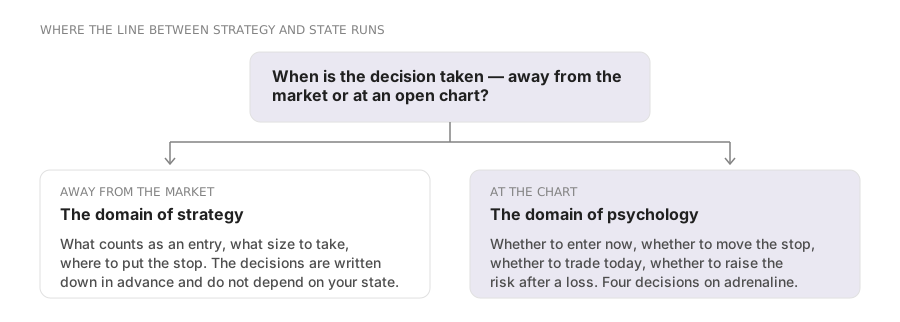
The top three rows are the domain of strategy, the bottom four the domain of psychology. Note that it is precisely the lower four decisions that are taken at the moment when price is already running and the adrenaline has already risen. Hence the main conclusion of the section: those decisions have to be taken in advance and written down, because at the moment of taking them the quality of thinking is lower than at any other moment of life.
A trader's mindset on forex: four shifts
Everyday common sense works against a person on the market: it is tuned to an environment where effort produces a result and a mistake is fixable. On the currency market neither is true.
What gets fixed first and what does not get fixed at all
It is useful to separate three layers. The first changes in a week, the second over months, the third does not change, and it is worked around.
Constant risk per trade, a daily limit, a stop-day, a stop placed in advance. All of this is switched on by one act of will and then works without your participation.
a weekKeeping a journal, reviewing trades on Saturdays, giving up the terminal after the second stop. Here only repetition works, one change at a time.
two or three monthsA quickened pulse at the sight of a minus, the urge to get your own back, boredom in the absence of trades. This is physiology; it is not «defeated». It is worked around: by reducing the number of decisions that have to be taken in that state.
a workaround, not a fixA practical consequence. Any programme of work on yourself that begins with the layer of reactions («stop being afraid», «become calm») fails — it demands changing what does not change. The working order is the reverse: first mechanisms, then habits, while reactions stay as they are and simply lose access to the button.
What it costs in money
Psychology becomes manageable exactly when it acquires a price. As long as «I increased size a little» is about feelings, there are no arguments against it. As soon as it is $900 a year on a $5,000 deposit, the conversation changes.
Where to go next through the sections
- Where to start if I have been trading less than six months
- With the daily limit and the journal. Work on emotions before those two things exist produces no effect.
- If the problem is a specific feeling
- The emotions section: fear, greed, FOMO, tilt, gambling urges and euphoria are examined separately, each with its own sign and its own price.
- If the problem is that there is a plan but no execution
- The discipline section and separately the examination of why you fail to follow your system.
- If you would rather understand the mechanics of the mistakes first
- Cognitive biases and loss aversion explain why a normal person systematically does the same thing.
How to measure your state rather than guess at it
A conversation about psychology stalls where there is no measurement: «I have become calmer» can neither be confirmed nor refuted. Below are four quantities calculated from a month's terminal export that change from your actions rather than from the market.
| Quantity | How it is calculated | Working level | What growth in it means |
|---|---|---|---|
| Share of trades by the rules | trades without violations ÷ all trades | from 90 % | Execution is growing — the one quantity under your control |
| Spread of risk in money | max risk ÷ min risk across trades | up to 1.2 | Position size wanders — it is calculated by eye rather than by formula |
| Average winner ÷ average loser | across the month's closed trades | above the planned R | Below plan — the disposition effect is at work on the exits |
| Share of trades outside the trading window | trades outside your hours ÷ all | up to 5 % | The schedule is not holding, and that is visible before the result falls |
The practical value of the second row often turns out to be unexpected. A trader certain that «my risk is always one percent» finds on checking a spread of three or four times: here the stop is closer and the lot the same, there «the setup was better». Formally the rule was not broken once — in fact position size is living a life of its own.
0.20 × 25 × 10 = $50 and 0.20 × 60 × 10 = $120 — the same lot, the risk differs by a factor of 2.4
Six questions that separate a state from the system
If the month's result is unsatisfactory, the first thing to work out is where to look for the cause. The questions below are checked from an export in an hour and almost always give an unambiguous answer.
Split the trades into two groups and calculate them separately. A plus in the first group means the strategy does not need touching at all.
system or executionIf it is more than half, the issue is position size in those trades rather than the quality of the entries. Check whether there was a stop in them.
size or frequencyPlot risk in money in date order. A rising step after a run of stops is revenge trading, and it is visible without any psychology.
reaction to a lossThe same curve, but after a good run. Here euphoria is at work, and the largest loss usually stands at the end of such a stretch.
reaction to successIf it is more than a tenth, the question is not about emotions but about the entry conditions being described vaguely and admitting interpretation.
quality of the rulesBreak the result down by hour. A slump at the end of the session is fatigue; a slump in the first minutes after news is an attempt to keep up.
time and fatigueThe order of the answers matters more than their content. The first two questions separate strategy from execution, the next two separate the reaction to a loss from the reaction to success, the last two separate the quality of the rules from physical condition. Work on «psychology in general» without that separation usually improves what was working anyway.
Frequently asked questions
Is a trader's psychology innate?
Partly, yes: the speed of reaction to threat, the inclination to risk and tolerance of monotony differ from person to person. But the result is determined not by that but by the number of decisions you leave to a live market. A person with a «bad» temperament and a hard set of rules trades more steadily than a calm person with no rules.
Is it true that psychology matters more than strategy?
The wording is wrong by construction: they have different tasks. Strategy creates the edge, psychology lets you live to see it. A strategy with negative expectancy is not saved by any amount of discipline, and a strategy with an edge is lost in a dozen violations — both claims can be checked in the risk-of-ruin calculation.
How do I know the problem is psychology and not the system?
From the journal. If you split the trades into «by the rules» and «not by the rules» and calculate the result separately, the answer is immediately visible. A plus on the first and a minus on the second is a question of discipline. A minus on both groups is a question of edge, and it is solved on the strategy side.
How long does this work take?
Mechanisms switch on in a week, a stable habit of keeping a journal builds over two or three months, and most people begin to distinguish their state before an entry after a hundred recorded trades. There are no quick timelines here, but it does not drag on «for years» either.
Read next
