 APTF
APTFForex market psychology
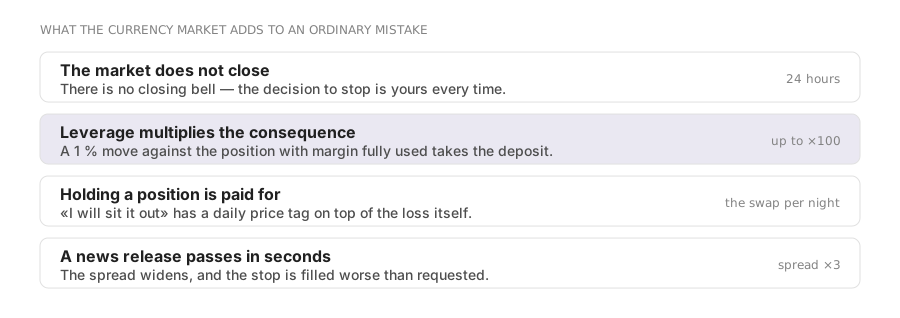
Forex market psychology differs from trading shares not in the set of emotions — that is the same everywhere — but in the conditions under which those emotions get access to money. Four properties of the currency market multiply the price of exactly the same mistake.
How the psychology of forex trading differs from exchange trading
The psychology of exchange trading in shares works the same way, but shares trade in fixed hours, the available leverage is lower and holding a position costs nothing. Below are four differences, and each multiplies the price of one and the same mistake.
Leverage: the same mistake, a different scale
Margin trading does not make you more inclined to risk. It multiplies the consequence of a decision already taken. The difference between «bought with everything» on an unleveraged account and the same purchase at 1:100 is not psychological but a matter of what a one percent move against you costs.
| Move against the position | Without leverage | Leverage 1:10 | Leverage 1:100 |
|---|---|---|---|
| 0.5 % | −0.5 % | −5 % | −50 % |
| 1 % | −1 % | −10 % | total loss |
| 2 % | −2 % | −20 % | loss + debt |
The calculation is for a position using the whole available size: loss = move × leverage. On the currency market the daily range of the major pairs usually fits within 0.5–1.0 %, so the third column is not an exotic case but a typical week.
The practical conclusion is not «leverage is evil» but something else: position size has to be calculated from the sum you are prepared to risk and from the distance to the stop. Then leverage becomes a technical parameter of the account and stops taking part in the decision at all.
A round-the-clock market: there is no closing bell
On an equity exchange the trading day ends by itself. On forex the quote runs from Sunday evening to Friday evening, and the decision to stop is yours every time. That creates two characteristic scenarios.
What round-the-clock trading gives you
The replacement for the missing bell is a stop-day: a number of trades or a loss amount set in advance, after which the terminal closes regardless of what is happening on the chart. More on sessions and your own schedule is in the material on routine and trading sessions.
The swap: holding a loss costs money
Carrying a position past midnight server time credits or debits a swap — the interest rate differential of the currency pair. For psychology that matters more than it seems: on forex «I will sit it out, it will come back» has a daily price tag, and on a losing position it is usually negative.
0.5 lots × (−$3) × 10 nights = −$15 — on top of the price move itself
The sum looks small right up to the moment a position is held for months. But it is not only about money: a paid delay adds one more argument to loss aversion — «closing now would be an especially great shame, I have already paid». That is the classic sunk cost trap, and it works the more strongly the longer the position hangs.
News: there is no time to take a decision
US employment releases, rate decisions and speeches by central bank heads produce moves of dozens of points in seconds on the currency market. Three things happen at once, and each breaks the usual logic of action.
The difference between buying and selling increases several times over at the moment data is released. A position opens straight away at a bigger loss than in an ordinary minute.
the cost growsOn a gap in the quote an order fills at the nearest available price. A risk set at one percent can turn into one and a half.
slippageThe move passes faster than a person can assess the situation. Everything not decided in advance is decided at that moment by impulse.
decide before, not duringHence a simple rule worth writing into the trading plan as a separate line: what you do with open positions fifteen minutes before a release and whether you enter in the first minutes after. The answer may be anything — what matters is that it is given in advance and not revised at the moment the data comes out.
What follows from this for the rules
- Position size is calculated from risk, not from leverage
- There is one formula: size = acceptable loss ÷ (distance to the stop × point value). Leverage does not appear in it.
- Stopping is set by a number, not by how you feel
- Two stops in a row or minus 3 % for the day are workable thresholds. Any threshold is better than none.
- The holding period is planned in advance
- If a position was designed for a day and hangs for a week, that is not patience but a violation, and its price grows with the swap.
- The news calendar is open before the session starts
- Not in order to trade the news but to know when not to hold an open position.
Four properties of forex in one table
A comparison with the equity market is useful because it shows that the set of emotions is the same while the price of a mistake differs. The numbers in the right-hand column describe not the market but the consequence of one and the same decision.
| Property | Shares, an ordinary account | Forex, leverage 1:100 | What it changes in behaviour |
|---|---|---|---|
| Trading hours | 6–8 hours, a closing bell | 24 hours five days a week | You have to stop by yourself — there is no external signal |
| Leverage | none or 1:2–1:5 | up to 1:100 and above | A 1 % move against the position changes the account by 1 % or by 100 % |
| Cost of holding | no | a swap for every night | «I will sit it out» acquires a daily price tag |
| Speed of reaction to news | a gap at the open | dozens of points in seconds | The decision cannot be taken as you go — only in advance |
From the table follows a practical conclusion that is often stated the other way round. Forex is not «psychologically harder» — it is less forgiving. A mistake of the same nature arrives at its result here faster and in a larger size, so there is no margin for «I will work it out as I go».
How to calculate your risk: a formula instead of a feeling
Half the conversations about psychology on the currency market are closed by one formula. As long as size is chosen «by a feeling of sufficiency», any state gets direct access to the size of the loss.
(5,000 × 1 %) ÷ (25 × 10) = 50 ÷ 250 = 0.20 lots
the same account, stop 60 points: (5,000 × 1 %) ÷ (60 × 10) = 0.08 lots
Note that leverage does not appear in the formula at all. It determines only the maximum available size and the margin requirements, not the size of your loss. Hence the answer to the frequent question «what leverage should I choose»: with a calculated size there is no difference between 1:30 and 1:500. The difference appears for someone who does not calculate size.
| Distance to the stop | Size at 1 % risk and a $5,000 account | Loss if it is hit | Swap for 3 nights |
|---|---|---|---|
| 15 pts | 0.33 lots | $50 | −$3.0 |
| 25 pts | 0.20 lots | $50 | −$1.8 |
| 60 pts | 0.08 lots | $50 | −$0.7 |
| 120 pts | 0.04 lots | $50 | −$0.4 |
What to do about news: a rule rather than a judgement of importance
Releases from the economic calendar are the only moment on the currency market when you can rely neither on the execution price nor on your own speed. A workable rule is therefore worded as a condition rather than as «assess the situation».
The rule is written into the trading plan as a separate line and verified by a point of the checklist. The calendar itself needs opening once before the session starts — inside it, it is no longer needed.
Frequently asked questions
Is forex psychologically harder than shares?
It is harder for two reasons: the available leverage here is higher and there are fewer natural pauses. But forex adds no specific emotions — fear, greed and the urge to win it back are the same on any market. What differs is the price of a mistake and the speed at which it arrives.
Does reducing leverage help?
It does, but not in the way people usually think. Leverage by itself does not affect the result if size is calculated from risk: at 1 % risk per trade there is no difference between 1:30 and 1:500. Reducing leverage helps those who do not calculate size — it physically caps the maximum mistake.
Why is forex so often called «a casino»?
Because when trading without rules the distribution of results really does resemble a game: a short distance, high frequency, instant feedback. The difference appears where there is positive mathematical expectancy and a constant size of risk — more in the examination of myths about trading.
What to do about night trading if I have a day job?
Choose one session and trade only that one, rather than «as much as works out». The Asian session is calmer and suits level-based setups; the London open gives movement but requires being in shape. The worst option is «I will start in the evening and see how it goes» — that is exactly what produces trading until three in the morning.
Read next
