 APTF
APTFMoving from demo to a live forex account
Moving from demo to a live forex account produces a complaint so common that it is worth taking apart: «it works on demo, it does not on live». There are exactly three reasons, and only one of them is psychological. The other two are technical, and they usually go unnoticed while everything is blamed on nerves.
Three reasons for the divergence
On a demo account an order is filled at the requested price almost always. On a live one there is slippage, a widening spread on news and latency. On short targets that eats a visible share of the result — sometimes all of it.
technicalSome demo accounts do not charge swap and commission, or charge them at showcase values. A strategy with frequent trades is profitable on demo and not on live.
technicalThe only psychological reason, but the most visible one. On demo there is no loss aversion: the numbers are not tied to your money, so the stop does not get moved and the profit is held to target.
psychologicalThe order of the review has to be exactly this. Before explaining the divergence by psychology, it is worth checking the first two points: compare spread, commission and swaps on the demo and on a live account with the same broker. Often half the gap is explained right here.
A forex demo account and psychology: what it really tests
Limits of applicability
How to make the transition soft
The task of the transition is not «to start earning» but to keep the share of rule-following intact once real risk appears. That is measurable, and it is what to look at for the first months.
One at which a stop does not change your evening. Often that is 0.01 lots, and that is fine: the point of the first trades is not the money.
1 monthThe share of trades by the rules is counted. While it is below 90 %, size is not increased whatever the result.
1–2 monthsAfter thirty trades with a rule-following share of 90 % or above. If the share falls — back to the previous step.
as it happensA drawdown of a set depth returns size one step back automatically, with no discussion.
continuouslyHow to set up a demo so that it tests something
A demo account is useless not in itself but in its default settings. Five parameters bring it as close to reality as is possible at all.
Spread, commission and swap must match. A demo with a different broker tests somebody else's execution conditions.
costsA $100,000 demo against a live account of $500 trains nothing: sizes, risk and drawdown tolerance will all be different.
scaleCalculated by the same formula from the same risk percentage. Otherwise the statistics on setups are gathered on a different sample.
sizeWith all the columns, including your state before entry. Demo records are later compared with live ones — the difference is the subject of the review.
measurementThree or four weeks. Beyond that a habit of painless losses forms, and it gets in the way on a live account.
durationAt least one session with an important release. On demo there is almost no slippage — and that is exactly what you need to see for yourself so as not to be surprised on live.
executionthe first two are measured by comparing statements, the third by comparing journals
What to compare in the two journals
The most useful procedure of the transition is comparing the demo statistics with the first thirty live trades. It shows what exactly changed instead of a general feeling that «everything is different on live».
| Indicator | If it dropped on live | What it means |
|---|---|---|
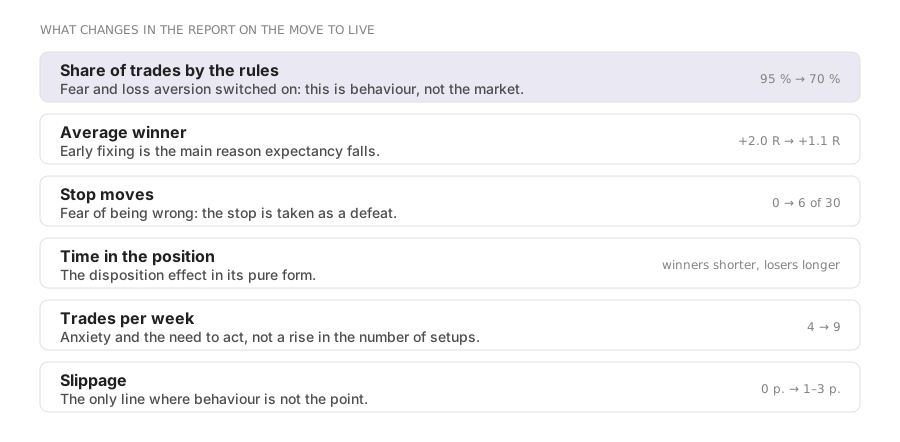
| Share of trades by the rules | from 95 % to 70 % | Behaviour: fear and loss aversion have switched on |
| Average time in position | winners shorter, losers longer | The disposition effect — we cut profits and sit through losses |
| Average winner in R | from +2.0 to +1.1 | Early exits: the main reason expectancy falls |
| Number of stop moves | from 0 to 6 out of 30 | Fear of being wrong — the stop is felt as a defeat |
| Slippage | 0 pts on demo, 1–3 pts on live | A technical difference, nothing to do with behaviour |
| Number of trades per week | from 4 to 9 | Anxiety and a need to act, not a rise in the number of setups |
The separation matters because these are treated by different means. Slippage is solved by the choice of trading time and order type, a falling rule-following share by reducing size, and a rising number of trades by a limit. The general advice to «get used to it» helps in none of the three cases.
Frequently asked questions
How long should you trade on demo?
Long enough to work out the technique and confirm that the setups occur — usually a few weeks. After that a demo stops giving anything new: behaviour under risk is not trained on it, while a habit of painless losses forms quickly and gets in the way.
Why does it work on demo and not on live?
First check costs and execution — often the gap is explained by them. What remains falls on behaviour: on a live account loss aversion and fear switch on, and they were not there on demo.
Does going back to demo after a failure help?
It helps restore the technique but does not settle the behaviour question. A short check of the rules on demo and a return to minimum live size is more sensible — there the risk exists, but it is painless.
Is it worth opening a live account at the broker's minimum?
The size of the account is chosen not by the broker's minimum but by your tolerance: it is a sum whose loss changes nothing in your life. If the minimum deposit is above that sum, the broker is not suitable for a first account.
Read next
