 APTF
APTFIntuition on forex
Intuitive trading on forex is the subject of an argument in which both sides are wrong in general terms: one considers instinct the main thing, the other calls it self-deception. Intuition has measured working conditions, and the question comes down to whether they hold on the currency market.
Two conditions under which intuition works
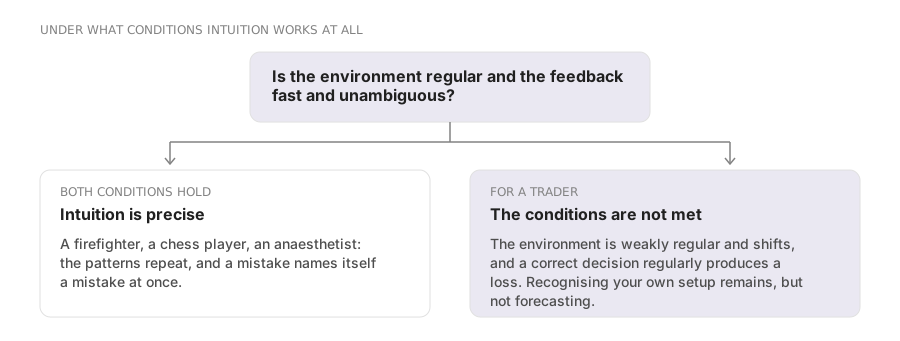
Research on expert judgement converges on two requirements for the environment. If even one is not met, the specialist's confidence grows while accuracy does not.
It contains stable patterns that can be picked up. A firefighter and a doctor work in such an environment: the same causes produce the same effects.
condition 1An error is visible at once and is clearly tied to the decision. A chess player learns of a miscalculation within a few moves and understands exactly which one.
condition 2Now apply this to forex. Regularity exists there, but it is weak and shifting. Feedback is fast but ambiguous: a correct decision regularly produces a loss, while breaking the rules produces a profit. The second condition is systematically violated, and that is the main reason experience accumulates more slowly on the market than in other professions.
Intuitive trading on forex: what stands behind «instinct»
How to test your intuition in a month
Intuition is a hypothesis, and a hypothesis gets tested. The method is simple and requires nothing but a journal.
after 30 trades compare the result across the three groups
There are three possible outcomes and each is useful. If the «intuition for» group is noticeably better than the rest, you have working recognition and it is worth trying to formalise it into a rule. If it is worse, intuition systematically pushes you towards violations, and its signals should be used as a reason to re-check the checklist. If there is no difference, the feeling carries no information and you can stop spending attention on it.
An important condition of the test. The note is made before the entry, otherwise memory will fit the feeling to the result — that is hindsight bias, and it leaves no chance of an honest review.
How to formalise what genuinely works
If the test showed that the «intuition for» group is consistently better, the next step is to turn the feeling into a rule. Otherwise it stays unreproducible and disappears along with your form.
All entries where you noted «intuition for» over the last three months. No fewer than twenty are needed.
half an hourOpen the charts and look for what was the same: time of day, the behaviour of a neighbouring pair, the character of the previous candle, volume.
an eveningA verifiable statement of the kind «enter only if the previous hour closed above the level». Without the words «strong» and «clear».
one lineFind thirty cases in past data and calculate the result. This is where most «intuitive» rules get filtered out.
two eveningsWith its own risk and its own statistics. While the sample is small, its risk is kept below the main one.
at the reviewOnly after that is the setup given equal standing with the rest. Until then it remains a hypothesis rather than a system.
1–2 monthsWhat happens most often. At the fourth step it turns out that there was a common feature, but it coincides with a setup you had already described — you simply noticed it faster than you could put it into words. That is a good result: it means intuition was working as an accelerator of recognition rather than as a separate source of information.
What the experience of other professions says
Intuition has been studied not on traders but on professions where its accuracy can be measured. The comparison is useful because it shows which conditions the currency market lacks.
| Profession | Regularity of the environment | Feedback | Does intuition work |
|---|---|---|---|
| Firefighter | High: fire behaves by the laws of physics | Immediate and unambiguous | Yes, and very accurately |
| Chess player | Complete: the rules are fixed | After a few moves, but unambiguous | Yes |
| Anaesthetist | High: physiology is predictable | Fast and tied to the decision | Yes |
| Exchange trader | Weak and shifting | Fast but ambiguous: a correct decision produces a loss | Only for recognising a setup, not for forecasting |
It is the fourth row that explains why experience accumulates more slowly on the market than in other occupations, and why years of service by themselves correlate poorly with results. Ten years of trading without a journal give ten years of ambiguous feedback — that is, conditions in which expert intuition does not form.
a journal with a «what you expected» field is the only way to raise the second factor on the market
Frequently asked questions
Can you trade on intuition alone?
You can, but the result of such trading cannot be assessed and therefore cannot be improved: no rules means no split of trades into «by the rules» and «not». In practice intuitive trading almost always means the absence of fixed risk, and that is the main factor in losing an account.
Is it true that experienced traders trade «by feel»?
They often describe it that way, but the description is imprecise. Behind a fast decision stands the recognition of a configuration seen thousands of times, plus hard rules on risk that are not broken while it happens. The second part is usually left out of the telling because it seems to go without saying.
What if intuition says to close a winning trade?
Check whether it is the fear of losing the profit — the most common disguise. The sign: the feeling appears when you are in profit and almost never when you are in loss. The breakdown is in the material on loss aversion.
Can intuition be developed?
Recognition can be developed — through the volume of situations reviewed and, more importantly, through review with feedback. Simply «trading a lot» is not enough: without a journal the feedback stays ambiguous, and experience does not turn into skill.
Read next
