 APTF
APTFDiscipline on forex
Discipline on forex is usually discussed as a character trait: either you have it or it must be «cultivated». That view is useless because it gives neither a measurement nor an action. The working definition is different: discipline is the share of trades made according to written rules. A number, calculated from the journal over a month.
How to measure your discipline
You will need a trade journal with one extra field: «by the rules — yes/no». A rule counts as broken if at least one parameter deviated: an entry outside the setup, size above the calculated one, a stop not placed or moved, a trade after the daily limit was used up.
27 of 34 = 79 % — a workable level for the second month, but not for a year
Next comes the most useful part: calculate the result separately for the two groups. It is exactly this split that answers the question of where the problem is — in the system or in the execution.
Discipline in forex trading: rules instead of willpower
They have one thing in common: they fire without your consent at the moment of firing. That is the only practical difference between a mechanism and an intention.
Answers written down before the session: what counts as an entry, where the stop goes, what size, when there is no trading. The decision was taken in advance — which means it was taken in a calm state.
removes decisionsFive to seven points gone through before every entry. It works as a delay: a procedure appears between the impulse and the button.
adds a pauseThe amount of loss or the number of stops after which trading ceases. The only mechanism that stops tilt before it becomes expensive.
sets a boundaryA record with a field for your state before entry. It does not prevent violations but makes them visible — without it discipline cannot be measured.
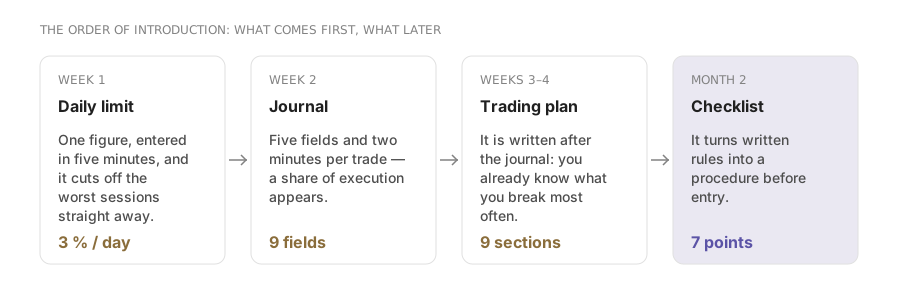
provides measurementThe order of adoption
All four at once do not hold: within a week everything is abandoned. The working order is one at a time, with verification.
One number, entered in five minutes, and it immediately cuts off the worst sessions. This is where to start: it is the cheapest to follow.
week 1Five fields, two minutes per trade. By the end of the second week the first statistics on the rule-following share appear.
week 2Written after the journal, not before: by that point you already know what you break most often, and the plan turns out to be about you rather than about an abstract trader.
weeks 3–4Last, derived from the plan. It adds no new rules but turns the written ones into a procedure before entry.
month 2One change at a time, based on statistics rather than feelings. Five changes at once make it impossible to tell what worked.
month 3Everything that can be handed to software is handed to it: size calculation, placing the stop, controlling the number of trades. The human is left with the decision to enter, and only that.
continuously from hereWhat does not work and why
Two ways to hold a rule
A separate breakdown of the reasons rules get broken even by motivated people is on the page why you cannot follow your system.
Discipline in numbers: a quarter taken apart
The quantity becomes useful when you can see it over time. Below are three months on one account: the rule-following share grows, the result on «by the rules» trades is stable, and the entire minus is created by the violations.
| Month | Trades | By the rules | Share | Result by the rules | Result by the violations |
|---|---|---|---|---|---|
| January | 38 | 21 | 55 % | +6.2 R | −9.8 R |
| February | 34 | 26 | 76 % | +7.0 R | −4.1 R |
| March | 31 | 29 | 94 % | +6.4 R | −0.6 R |
The table reads like this. The strategy produced about six R a month in all three months — it is stable and it works. The January result, however, is minus 3.6 R, February plus 2.9 R, March plus 5.8 R. No changes to the strategy took place over the quarter; what changed was the rule-following share, from 55 % to 94 %.
January: +6.2 − 9.8 = −3.6 R · March: +6.4 − 0.6 = +5.8 R
a difference of 9.4 R created by execution, not by the market
Hence the practical answer to «what to improve first». While the violations column is comparable to the rules column, any improvement to the strategy falls straight into it. Improving the strategy makes sense after the rule-following share is steadily above ninety percent.
Six typical violations and how to count them
For the rule-following share to be honest, a closed list of violations is needed. Otherwise «almost by the rules» gradually eats the whole statistic.
At least one entry condition is not fully met. The wording «almost» means «no»: lists of conditions are lists for a reason.
count as a violationRisk in money differs from the planned one by more than 10 %. Check by division: loss at the stop ÷ (equity × planned risk).
count as a violationA stop «in your head» or placed after the entry. Even if the trade closed in profit.
count as a violationAny move away from the entry point. A move towards profit under a written rule is not a violation.
count as a violationThe number of trades or the day's loss amount has been exceeded. The result of the trade is irrelevant.
count as a violationAn entry earlier or later than the hours written in the plan. Trades on days declared days off belong here too.
count as a violationThe list is closed: if an action falls under none of the points, the trade counts as made by the rules. New points may be added only at a planned review — otherwise everything that ended in a loss gets declared a violation after the fact.
Frequently asked questions
How can a trader build discipline if there is none at all?
Start with one mechanism, not with a decision «to become disciplined». A daily loss limit is the cheapest entry: it requires one decision away from the market and then works by itself. When it has held for two weeks, add the journal, and only then the rest.
What percentage of trades by the rules is normal?
At the start 50–70 % is typical, and that is not a verdict. A steady working level is from 90 %. What matters is not the absolute number but the direction: if the share does not grow for three months running, the rules were written for somebody else and need rewriting for you.
Do expert advisors and automation help?
They help in the part where execution can be handed to software: placing the stop, calculating size, switching the terminal off at the limit. They do not help where the decision stays with the human — for example, switching the advisor back on after it has stopped.
Is discipline more important than strategy?
Neither replaces the other. You can check which one is missing in a single evening: split the trades into «by the rules» and «not by the rules» and calculate the result separately. The answer will be in numbers, not in opinions.
Read next
