 APTF
APTFMartingale on forex and the price of revenge trading
Martingale on forex and spontaneous revenge trading are one and the same action: raising risk after a loss. The calculator works it out step by step and compares it with constant risk over the same run of stops. The difference usually turns out larger than expected.
| Stop | Risk | Loss | Balance with revenge trading | Balance at constant risk |
|---|
Risk is calculated from current equity — the same way the terminal calculates it. You cannot put more than the deposit into one trade, so the calculated risk is capped at one hundred percent.
Doubling the lot after a loss: the step-by-step formula
balance after step n = balancen−1 × (1 − risk at step n)
2 % → 4 % → 8 % → 16 % → 32 % at a multiplier of 2.0
The key feature: losses multiply rather than add. That is why the total differs from the naive sum «2 + 4 + 8 + 16 + 32 = 62 %»: at each step the percentage is taken from a reduced account, and the actual drawdown comes to 50.6 %. Less than the sum — but still five times more than at constant risk.
How much capital martingale requires
The promise that «the run will break sooner or later» is true. The question is whether the deposit lasts long enough to see it.
| Length of the run | Capital required at a base of 2 % | Probability of such a run over 100 trades at a 45 % win rate |
|---|---|---|
| 4 stops | 30 % of the deposit | 99.4 % |
| 6 stops | 126 % of the deposit | 72.9 % |
| 8 stops | 510 % of the deposit | 30.7 % |
| 10 stops | 2,046 % of the deposit | 10.6 % |
2 % × (2⁸ − 1) = 2 % × 255 = 510 % of the deposit
Eight stops in a row at a 45 % win rate occur in roughly every third hundred trades. That is not a black swan but an ordinary event, and no reasonable deposit has the capital for it. The probabilities are examined in the losing-streak calculation.
Why a multiplier of 1.0 is the only workable one
Soft versions of martingale: why they do not save you
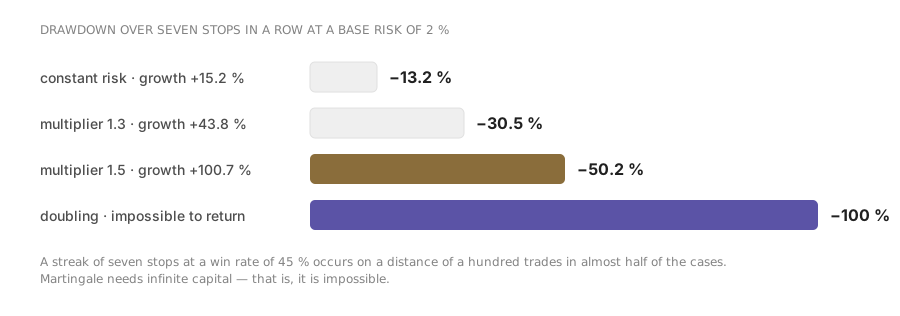
Most people consider full doubling an extreme, but the arithmetic works at any multiplier above one. All that differs is the number of steps in which the account reaches a critical drawdown.
| Multiplier | Drawdown over 5 stops | Over 7 stops | Growth needed after 7 |
|---|---|---|---|
| 1.0 — constant risk | −9.6 % | −13.2 % | +15.2 % |
| 1.3 | −16.9 % | −30.5 % | +43.8 % |
| 1.5 | −23.9 % | −50.2 % | +100.7 % |
| 2.0 | −50.6 % | −100 % | impossible |
The row with a multiplier of 1.3 is the most useful in the table. A thirty percent addition to risk after a loss does not look like martingale and is usually not even recognised as a rule. Yet it turns seven stops in a row from thirteen percent of drawdown into thirty and a half, and the growth needed to recover from fifteen percent into forty-four.
at m = 1.3 and a base of 2 %: 2.0 → 2.6 → 3.4 → 4.4 → 5.7 %
no single step looks like a violation on its own
How to catch yourself with rising risk
Martingale can be told from planned trading in five minutes from an export. The check requires neither memory nor honesty with yourself.
The terminal statement into a spreadsheet: date, size, distance to the stop, result.
5 minutesSize × distance to the stop × point value. A separate column both in money and as a share of that day's equity.
10 minutesNot by result: what matters is the sequence, not the size.
1 minuteA separate column «previous trade was a loss: yes/no».
5 minutesAfter a loss and after a profit. A difference of more than ten percent means you have a multiplier, even if you never set one.
1 minute«The average risk after a loss is higher by X %». That is your actual multiplier — the one to put into the calculator.
1 minuteWhat usually turns up. The multiplier is rarely exactly 2.0 — more often 1.2–1.5, and it is not conscious. That is precisely why the check is more useful than introspection: asking yourself «do I increase risk after a loss» and calculating the average across two groups are two different questions with different answers.
Anti-martingale: raising risk after a profit
The mirror scheme is discussed less often and works on a fundamentally different principle: risk grows on a winning run and falls on a losing one. That does not make it automatically safe, but it changes the distribution of losses.
| Martingale | Anti-martingale | |
|---|---|---|
| When risk grows | after a loss | after a profit |
| What the growth is paid for with | the remaining deposit | profit already received |
| What happens during a losing streak | risk grows, the drawdown accelerates | risk falls, the drawdown slows |
| Worst case | the account ends during a losing run | one large loss takes away the whole run of profits |
| What is essential | infinite capital — that is, impossible | a risk ceiling and a rollback rule |
| Outcome without limits | ruin at any multiplier > 1 | a return to zero profit, but not the loss of the account |
In practice anti-martingale is the same planned scaling, only with a fast step. To stop it turning into euphoria the same three limits are needed: a risk ceiling, a fixed step and an automatic rollback on a drawdown of a set depth. Without them the scheme differs from spontaneous growth in size only by its name.
step ≤ 25 %, review once a month, rollback at a 10 % drawdown
Frequently asked questions
Does martingale not work at all?
It works under two conditions: infinite capital and no limit on the size of the stake. Neither holds on the currency market — the deposit is finite and size is capped by margin. So the question is not «will it work» but «on which run will the account end».
What if I double the size rather than the risk, keeping the same stop?
That is the same thing: risk = size × distance to the stop × point value. Doubling the size with the stop unchanged doubles the risk.
How does averaging down differ from martingale?
Averaging adds size within one position, martingale in the next trade. The outcome is the same: total risk grows after a move against you. The examination of averaging is on a separate page.
Can risk be increased after a profit rather than after a loss?
That is a different scheme and it is safer: the stake grows on a winning run rather than a losing one. But it too needs a ceiling and a rollback rule, otherwise one large loss takes the whole run — see euphoria.
Read next
