 APTF
APTFWhat one trade costs on forex
What one trade costs on forex is seen not in the result but in the costs: every trade starts at a loss equal to them. Individually that is a trifle; over the distance it is a visible expense item, and with overtrading it doubles along with the number of trades. The calculator works out the costs of one trade and the overpayment for the extra ones.
The swap is entered as a positive number and subtracted: on a losing position it is most often negative. A carry through Wednesday is charged at triple rate by most brokers — allow for that in the number of nights.
Formula
0.2 × (1.2 × 10 + 7) + 0.2 × 3 × 1 = 3.80 + 0.60 = $4.40
break-even threshold = costs ÷ (size × point value) = 2.2 points
The break-even threshold is the most useful quantity in this calculation. It shows how many points price has to travel simply for the trade to reach zero. With short targets that figure eats a substantial share of the expected result: if the take-profit sits at ten points, 2.2 points of costs is 22 % of the target.
How costs change the required win rate
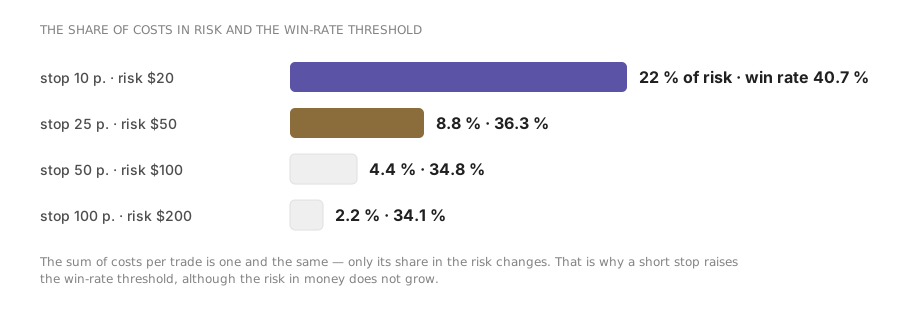
It is convenient to express costs as a share of risk: then their influence is visible directly in the break-even threshold.
| Distance to the stop | Risk at 0.2 lots | Costs as a share of risk | Break-even win rate at 1:2 |
|---|---|---|---|
| 10 pts | $20 | 22 % | 40.7 % |
| 25 pts | $50 | 8.8 % | 36.3 % |
| 50 pts | $100 | 4.4 % | 34.8 % |
| 100 pts | $200 | 2.2 % | 34.1 % |
The costs in both columns are the same $4.40 per trade. Only the distance to the stop changes, and with it their share of the risk. Hence the general rule: the closer the stop, the more sensitive the strategy is to spread and commission.
This also explains why scalping on the currency market requires a noticeably higher win rate than the risk/reward ratio suggests: the threshold is calculated with costs included, and with a short stop they add several percentage points to it.
Spread, commission and swap on forex: what costs are made of
There are three components, and each behaves in its own way. Understanding the difference matters, because they are reduced by different means.
The difference between buying and selling. It is paid on every entry, grows at moments of news releases and on a thin market — in the Asian session it is noticeably wider on European pairs.
depends on timeA fixed amount per lot, usually for a round turn. It does not depend on time or on the market, it depends on the account type.
depends on the accountA charge for carrying past midnight server time. It depends on the rate differential of the pair and on the direction of the trade; a carry through Wednesday is charged at triple rate by most brokers.
depends on the holding periodentry and exit: the spread is paid once, the commission per round turn, the swap for every night
A practical conclusion from the different nature of the three terms: costs can be cut in three independent ways. Fewer trades means less spread and commission. Trading in the hours of a tight spread reduces the first term. Refusing to carry positions overnight removes the third. The first method is the most effective and the only one that depends solely on you.
Costs over a year: three trading profiles
The absolute sum is more impressive than the share of risk, but decisions have to be taken on the second figure. Both are given below.
| Profile | Trades per month | Costs per month | Per year | Against a $5,000 deposit |
|---|---|---|---|---|
| Position, 0.2 lots | 6 | $26 | $317 | 6.3 % |
| Daily, 0.2 lots | 20 | $88 | $1,056 | 21.1 % |
| Daily with overtrading, 0.2 lots | 35 | $154 | $1,848 | 37.0 % |
| Intraday, 0.1 lots | 60 | $132 | $1,584 | 31.7 % |
The third row differs from the second only in the number of trades — the setups, instruments and size are the same. Fifteen extra trades a month cost $792 a year, that is almost sixteen percent of the deposit, and that is before allowing for the fact that their win rate is lower.
4.40 × 15 × 12 = $792 = 15.8 % of a $5,000 deposit
How to reduce costs without changing anything in the strategy
Three directions, and they are independent: their effects add up. The first depends only on you, the second on your schedule, the third on the account type.
The most effective direction and the only one entirely under your control. Fifteen extra trades a month is $792 a year at 0.2 lots, that is almost sixteen percent of a $5,000 deposit.
up to −45 % of costsOn European pairs the spread is wider in the Asian session and at moments of data releases. Moving the trading window to the London–New York overlap reduces the first term of the formula.
up to −30 % of spreadAn account with a commission and a tight spread is better for frequent trading; one without commission and with a wide spread is better for infrequent trading. It is worked out by putting your own numbers into the formula above.
depends on frequencyspread 1.2 pts + commission $7: 0.2 × (12 + 7) = $3.80
spread 2.0 pts with no commission: 0.2 × 20 = $4.00
the difference is small on one trade and visible over three hundred a year
Note that moving the trading window affects more than the spread. In the hours of low activity the setups themselves work out worse: moves are shorter and there are more false breakouts. The session breakdown is on the page about routine and trading sessions, where there is also a widget with the windows in your time.
Frequently asked questions
What is the point value of my pair?
For a standard lot (100,000 units of the base currency) on pairs quoted in dollars it is about $10 per point. For other pairs it depends on the quote currency and the current rate — the exact value is shown by the terminal in the instrument specification. That is exactly why it is put on a slider here: an exchange rate must not be hard-wired into a model, it goes out of date.
Should I count the swap if I do not carry positions?
No, set nights to zero. But check that against your actual holding time: in many «intraday» strategies some trades regularly hang past midnight server time.
Why do I have no commission?
That means the broker earns on the spread, and yours is wider. Enter zero in the commission field and your account's real spread — the total will come out comparable.
How do I reduce costs?
Three workable directions: fewer trades, a greater distance to the stop and trading in the hours of a tight spread. The first depends only on you — the breakdown is in the material on overtrading.
Read next
