 APTF
APTFLoss aversion on forex
Loss aversion on forex is the asymmetry described by Kahneman and Tversky in prospect theory: a loss is experienced more strongly than a gain of the same size. On the currency market it is the most expensive of all the biases, because it strikes both sides of a trade at once — the losses and the profits alike.
Asymmetry: the same sum weighs differently
In prospect theory experiments the subjective weight of a loss turns out to be about twice the joy of an equal gain. The exact coefficient depends on the design of the experiment and on the person, but the sign and the order of magnitude are stable.
hence: to accept the risk of losing $100 a person needs a chance of winning noticeably more than $100
That is exactly why a 1:1 risk/reward ratio is psychologically unbearable although it can be arithmetically profitable. And it is why a trader whose plan says 1:3 closes the trade at 1:1: a bird in the hand weighs more than the calculation prescribes.
The disposition effect on forex: profits are cut, losses are sat through
A direct consequence of the asymmetry, recorded in studies of real brokerage accounts: winning positions are closed noticeably earlier than losing ones. The mechanics are simple — in profit a person fears losing what he already has, in loss he does not want to turn a paper loss into a real one.
| Situation | What the feeling suggests | What the plan does |
|---|---|---|
| A position 0.7R in profit | Close it before it is taken away | Hold to target or to the exit signal |
| A position 0.9R in loss | Wait, it will come back | The stop fires by itself, there is no decision |
| Price came back to the entry point | Close at breakeven, «got away with it» | The exit condition has not occurred — hold |
| A position in profit, news released | Take at least something | The news rule is set in advance |
The trace in the statistics is always the same: the average winning trade is smaller than the average losing one, with an outwardly decent win rate. That combination is the calling card of the disposition effect, and it is easy to check from a terminal statement.
What it costs: the arithmetic on a sample
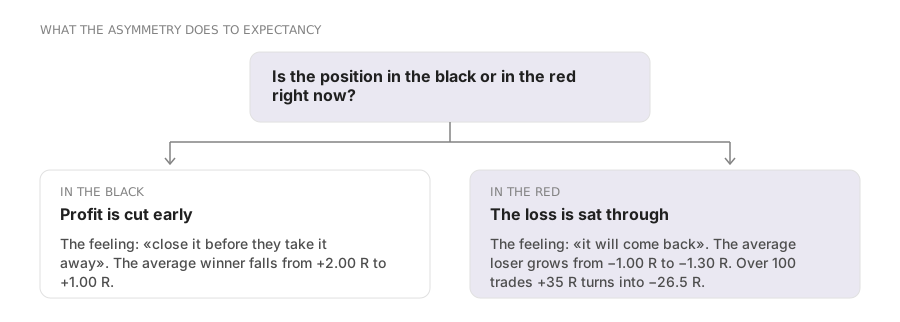
Take a system with an edge: a win rate of 45 % and a planned risk/reward ratio of 1:2. Now add the disposition effect — profit is cut to 1:1, the loss is sat through to 1.3 of the risk.
| Indicator | By plan | With the disposition effect |
|---|---|---|
| Average winning trade | +2.00 R | +1.00 R |
| Average losing trade | −1.00 R | −1.30 R |
| Expectancy per trade | +0.35 R | −0.265 R |
| Result over 100 trades at 1 % risk | +35 R | −26.5 R |
by plan: 0.45 × 2.00 − 0.55 × 1.00 = +0.35 R
with disposition: 0.45 × 1.00 − 0.55 × 1.30 = −0.265 R
The strategy did not change. The entry rules are the same, the win rate is the same. All that changed is the behaviour at the exit — and the sign of the expectancy. This is the main argument against the notion that «psychology is secondary»: it is capable of flipping the sign of a system that has an edge.
What is done about it
The stop and take-profit are placed as orders at the moment the position is opened. As long as the exit remains a decision, it will be taken under the influence of the asymmetry.
against both halves«Minus one R» is a planned cost. «Minus 87 dollars» is money you worked for. The unit of measurement noticeably changes how bearable it is.
against sitting throughIf holding the full target does not work, close half the size at 1R and manage the rest by plan. It is a compromise, but it preserves part of the edge.
against early exitsOnce a month compare the average winner with the average loser. If the first is smaller, the disposition effect is at work, regardless of what you think about yourself.
measurementWhere the asymmetry shows up most sharply on forex
The mechanism is universal, but the currency market gives it three additional supports that do not exist on an unleveraged account.
Every night in a losing position adds a fixed sum to the loss. Formally that is an argument to close; in fact it is an argument to stay: «I have already paid, so now it would be an even greater shame».
sunk costsThe asymmetry works from the absolute sum, not from the percentage. At a size where the stop is worth twenty dollars, the reluctance to take it is noticeably weaker than at two hundred.
position sizeOn an equity exchange a position is closed by the bell; here it can hang for weeks. The longer the window for a decision, the greater the chance the asymmetry takes it.
no external deadlineThe ability to enter with 0.01 lots makes averaging down accessible and innocent-looking, although the total risk grows linearly.
a low barrier to entryThere are no pauses during which a position «settles». Every tick is a fresh occasion to reassess the decision.
constant reassessmentAn unrealised loss is visible in the account currency every second. That is exactly the presentation format that strengthens loss aversion most.
presentation of informationWhat to do: four techniques and their price
The asymmetry cannot be abolished, but it can be denied access to the decision. The techniques below are listed in descending order of reliability, not of popularity.
| Technique | What it does | What you pay with |
|---|---|---|
| Stop and take-profit as orders at entry | Removes the decision from the moment when the asymmetry is active | Nothing: this is a pure improvement |
| A partial exit of half at 1R | Relieves the tension and leaves part of the position to target | Part of the expectancy on long moves |
| A closed terminal after the orders are placed | Removes the constant reassessment of the floating result | You cannot react to a force majeure by hand |
| Recording results in R rather than in currency | Reduces the weight of the absolute sum in perception | Requires discipline in keeping the journal |
What not to do. The most common advice — «just do not look at the floating result» — demands effort exactly when there is none. What works is not refraining from looking but the absence of a button: a closed terminal and placed orders give the same effect without spending self-control.
Frequently asked questions
Is loss aversion the same as fear?
No. Fear stops you opening a position; loss aversion stops you closing it correctly. These are different points in the process: fear works before the entry, the asymmetry after it. Fear is examined separately in the material on fear in trading.
Why does moving the stop to breakeven look so attractive?
Because it removes the possibility of a loss, and that is what weighs double. The price of the decision is not zero, though: a trade closed at zero on a pullback deprives you of the part of the sample for which a 1:3 ratio exists at all. The technique works, but it has to be part of the plan with a specific condition rather than a reaction to nerves.
Is the swap counted when sitting through a loss?
Yes, and on forex it is a separate item: holding a losing position for weeks adds a negative swap to the loss itself. It can be calculated in the costs calculator.
Are there people without this asymmetry?
The coefficient varies; complete absence is not found in the research. The practical conclusion does not change: an exit rule set in advance works even for those whose asymmetry is weaker.
Read next
