 APTF
APTFTrader mistakes on forex
Lists of «trader mistakes on forex» usually consist of platitudes: there is nothing to check in them and nothing to do with them. Here the approach is different: only actions visible in the terminal statement, and each with a price calculated by a formula. Why traders lose money is best seen not from advice but from arithmetic.
Eight actions and their price
Sorted by cost over the distance rather than by frequency. The first three are capable of flipping the sign of a system with an edge; the rest eat the result gradually.
| Action | The sign in the statement | Model price |
|---|---|---|
| Raising risk after a loss | Size grows towards the end of a run of stops | −50.6 % over five stops instead of −9.6 % |
| Trading without a stop | There are trades where the loss is a multiple of the average | One trade eats the result of months |
| Averaging down a losing position | Several entries in one direction at a worsening price | The risk on the position is not known in advance |
| Size above the calculated one | Different risk in dollars at the same stop | 18 % of the deposit a year with one breakdown a month |
| Taking profit early | The average winner is smaller than the average loser | Expectancy from +0.35 R to −0.265 R |
| Overtrading | Twice as many trades as planned | 15.8 % of the deposit a year in costs alone |
| Entering after most of the move | The stop is noticeably further away than usual | A required win rate of 71 % instead of 25 % |
| Trading without records | Some trades are missing from the journal | It cannot be measured and therefore cannot be fixed |
The prices are models obtained with specific sets of inputs, which are given on the corresponding pages. The point is not the exact value but the order of magnitude: almost all of them are larger than what improving the strategy yields over the same period.
How one loss turns into a lost month
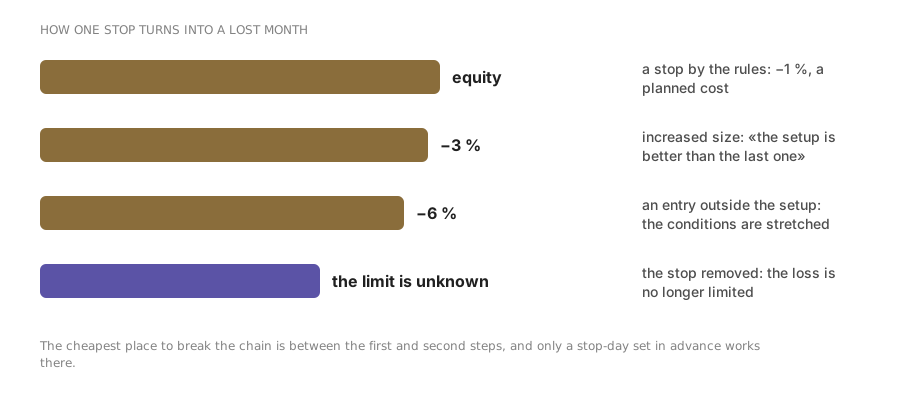
Mistakes rarely come singly. The usual sequence looks like this, and every step in it is logical from the inside.
An ordinary event: minus 1 % of equity. At this step nothing has happened yet — it is a planned cost.
−1 %The thought «I will win it back before the end of the day» appears. That is where revenge trading begins — the decision has not been taken yet, but the frame has already changed.
the motiveThe next trade goes in at two or three times the lot. There is almost always a justification: «the setup is better than the last one».
−3 %After the second stop the entry conditions stretch: «almost like it» becomes sufficient grounds.
−6 %The stop is taken off or moved to «give the trade a chance». From that moment the loss stops being limited.
the limit is unknownThe last step, which takes the episode beyond one evening. The state has not changed and the rules have not changed — only the balance has, and the cycle starts again.
the next dayWhere the chain breaks. It is cheapest between the first and second step, and there is no mechanism there other than a rule set in advance. That is exactly why a stop-day is introduced first: it is the only one that works once the chain has already started.
Beginners' mistakes on forex and the mistakes of the experienced
The set of actions is the same, the causes differ — and they are treated differently.
One action, two causes
Where to start reviewing your own mistakes
- Find the most expensive one, not the most frequent
- Export your trades, sort by loss and look at the top five. Usually they all belong to one scenario.
- Calculate the price of that scenario over a month
- The sum across all the trades in the scenario. That is the budget you can return to yourself without changing anything in the strategy.
- Introduce one rule against it
- One, not five. Five rules at once do not hold, and within two weeks none is left.
- Check after thirty trades
- A smaller sample shows nothing. If the frequency of the scenario has not fallen, the rule is unworkable and has to be rewritten.
How to tell a mistake from a routine loss
Half the work on mistakes is wasted because an ordinary stop is taken for a mistake. There is one criterion here and it is not about the result.
Two questions for any losing trade
not «a trade that ended in a loss»
a winning trade outside the rules is also a mistake, and a more expensive one
The last line of the formula matters more than the rest. A winning trade made outside the rules reinforces the violation itself — and in the most persistent mode known to behavioural psychology. That is why in the journal such trades are marked on a par with losing violations rather than celebrated.
What each mistake costs: a summary table for a year
The numbers below are models, but each was obtained with specific inputs given on the corresponding page. The point of the summary is not precision but the order of magnitude: almost any of the rows is larger than what improving the strategy yields over the same year.
| Mistake | Inputs of the calculation | Price | Where to calculate it |
|---|---|---|---|
| Size above the calculated one once a month | deposit $5,000, risk 1 %, multiplier 2.5 | −$900 / year | the home page widget |
| Revenge trading: doubling after a loss | deposit $10,000, risk 2 %, a run of 5 stops | −$4,095 in one evening | the cost of revenge trading |
| Overtrading: +15 trades a month | 0.2 lots, spread 1.2 pts, commission $7, swap $3 | −$792 / year | the cost of overtrading |
| Taking profit early | plan 1:2, actual 1:1, win rate 45 % | expectancy from +0.35 R to −0.10 R | break-even win rate |
| Risk of 3 % instead of 1 % | win rate 45 %, 1:2, 200 trades, threshold 30 % | risk of ruin from 0.1 % to 28.5 % | risk of ruin |
| Entries missed out of fear | 6 setups a month, expectancy 0.35 R, risk $50 | −$1,260 / year forgone | fear in trading |
Note the last row: what fear forgoes is comparable to what greed overpays, although it is discussed an order of magnitude less often. The reason is simple — a missed trade leaves no trace in the account history, and without a separate journal entry its price cannot be seen at all.
Frequently asked questions
Why do traders lose money if everyone knows the rules?
Because knowing a rule and following it are provided by different things. The rules are known, but they are followed in a state where there is no resource for following them. Hence the only direction that works — not learning the rules again but reducing the number of decisions that have to be taken at the chart.
Is it true that 90 % of traders blow up?
The figure circulates online without a source and in different versions: 70, 80, 90, 95 %. There are no public verifiable statistics for the whole market, and individual broker disclosures measure different things over different periods. An examination of what is wrong with that figure is in myths about trading.
Which mistake is the most expensive?
Raising risk after a loss. It is the only one that multiplies the loss rather than adding to it: five stops in a row with doubling cost half the deposit instead of a tenth. The calculation is in the cost of revenge trading.
Can you learn from other people's mistakes?
Partly: a list of mistakes helps you recognise them and write a rule in advance. But somebody else's experience does not replace living through a loss, which is why the first months for almost everyone go on repeating what has already been described. The only way to reduce the price of that stage is position size.
Read next
