A portfolio of several strategies on one account: each is given a share of capital and its own copying rules. The decisions about size and about what gets copied at all are taken in advance and by a setting rather than at the moment of a drawdown.
Software for a forex trader
Software for a forex trader is divided not by price and not by the number of features but by the moment at which it intervenes. Some show the past, others let you repeat it without money, a third kind stops you pressing the button right now. Those are three different tasks, and substituting one for another is pointless: a journal will not stop revenge trading, and a limiter will not show why it happened.
Software for a forex trader: six tools and what each one does
The list is deliberately short. Reviews of software for a forex trader usually have twenty entries, seventeen of which are the same thing with different logos. Here there is one representative per class plus one where the class matters more than the brand. Services for analysing forex trades stand in the catalogue next to the limiter deliberately: these are different answers to different questions, and confusing them is expensive.
Tools shown: 6 of 6. The filters are off by default: the list is short and worth reading in full before narrowing it.
The only one of the mainstream journals where a trader's state is not a field for a note but a measurable field on a par with the entry price. It calculates statistics broken down by tags: what the trades marked as impulsive cost.
A desktop simulator: history plays back candle by candle at a controllable speed, trades are opened by hand. A tool for collecting a sample of execution faster than real time does.
A set of free tools around MetaTrader: an account statistics breakdown on the website and a manual trading simulator on history inside the terminal itself. It is forex-specific: it counts in points and lots, not in shares.
A web journal with tags and notes on trades. Its strong side is review through somebody else's eyes: the journal can be opened to a mentor or a colleague with a link, without sending exports or collecting screenshots.
An expert advisor in the terminal that closes positions and forbids trading once the daily limit is used up. The only tool in the section that does not show but obstructs: it intervenes at the moment of the breakdown.
Four moments of intervention — four classes of tool
It is useful to keep the time axis in mind: a tool works either before a trade, or during it, or after it — and one class works even before the first trade exists. Mixing up the classes is the main cause of disappointment: people expect discipline from a journal, and it only measures it.
They show what has already happened and turn the feeling «it was a bad week» into a number. They prevent nothing, but without them it is unclear what exactly to fix: a trade journal answers the question «what does this habit cost me».
Edgewonk, Tradervue, FX BlueIt lets you repeat the execution of a plan many times without money. It speeds up not the learning of a strategy but the collecting of a sample: a hundred trades by the rules in an evening instead of a quarter of real time.
Forex Tester, FX BlueIt closes positions and blocks the terminal once the daily limit is reached. It intervenes at exactly the moment when the decision is being made by a state rather than by the system.
An expert advisor in MT4/MT5The earliest possible moment of intervention. The decision about how much capital each strategy gets and what will be copied at all is taken once by a setting — and is not then revised during a drawdown.
AllocationWhat software for a trader really changes
Below is an honest division. On the left is what a tool does better than a human, on the right what is loaded onto it in vain.
How to choose a tool for your task
The order is the reverse of the usual one: first the problem is named in figures, and only then a class of tool is sought. The reverse order produces a subscription that goes unused from the second week.
«A third of trades are off plan» or «after a stop the average size is twice as high» is a task. «I want to be more disciplined» is not a task; you cannot choose a tool for it.
a journal reviewThe problem is visible after the trade — you need a journal. The problem is in execution — a simulator. The problem is at the moment of the breakdown — a limiter.
one minuteThe «journal» and «account analytics» classes have free options, including a spreadsheet you set up yourself. It is worth paying for what a spreadsheet does not have.
a monthA tool is justified if after a month the share of trades by the rules has grown. If it has not, the software is not the issue.
a monthWhat is not in this section and why
Where to start if you have no tools yet
The order of adoption matters more than the choice of brand. It is the same regardless of what you trade and for how long.
The one metric a tool is judged by
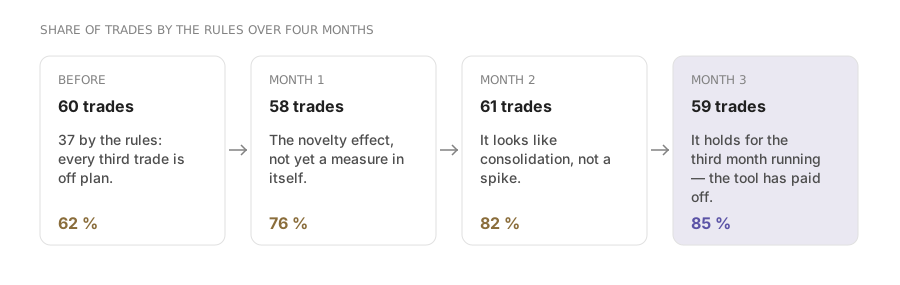
Not profit: it depends on the market and on the period. The share of trades made by written rules depends on you, and it is that which a tool has to move. Calculated from the journal over a month.
| Month | Trades in total | Of them by the rules | Share | What it means |
|---|---|---|---|---|
| Before the tool | 60 | 37 | 62 % | Every third trade is off plan |
| First month | 58 | 44 | 76 % | A novelty effect, not yet an indicator |
| Second month | 61 | 50 | 82 % | Looks like consolidation |
| Third month | 59 | 50 | 85 % | The tool is justified |
The difference between 62 % and 85 % is 13 trades a month that used to be opened off plan. What one such trade costs is computed by the cost-of-a-trade calculator; at costs of $4.40 and an average loss on an impulsive entry of even a quarter of the risk, that is a noticeable sum over a year. If after three months the share has not grown, the software is not the issue — and the money for it was spent in vain.
Frequently asked questions
Which software for a trader is the most necessary?
The one that closes your task in figures. If the share of off-plan trades is above a quarter — a limiter. If it is unclear where the money is going — a journal. There is no universal answer, and «top 10 programs» lists do not provide one.
Can you do without software altogether?
Yes, and the first month is better done exactly that way: a spreadsheet and written rules. Software saves time on calculations but creates neither the rules nor the habit of following them.
How does account analytics differ from a journal?
Analytics calculates from the trades in the terminal: price, size, result. A journal adds what the terminal does not have — the state before the entry and the reason for the decision. The first answers what happened, the second why.
Do these tools work with brokers in my country?
Everything that imports MT4/MT5 statements works with any broker that provides those terminals. Services with a direct connection to the account depend on the broker — that is checked before paying.
Is it worth publishing your account statistics?
Public statistics are disciplining, but they add a new emotion — trading for an audience. If you decide to publish, agree with yourself in advance that you will not change behaviour for the sake of a pretty curve.
Will a simulator replace a live account?
No. A simulator practises execution, not your relationship with money: on history there is neither a real loss nor real fear. That difference is examined on the page about moving from demo to live.