 APTF
APTFALAllocationA portfolio of strategies and risk rules
Tool reviewSoftware
FX Blue: forex account analytics and a simulator in the terminal
FX Blue is the only tool in the section that counts the forex way by default: in points, in lots, with the overnight swap included. It is a set of free tools around MetaTrader, and two of them are useful for our subject: the account statistics breakdown and the manual trading simulator on history.
Forex account analytics online and a simulator: the two parts of the suite
They are often confused, and one gets installed for the sake of the other without the second being noticed. Their tasks are opposite in time: the first looks back, the second lets you repeat the future without money.
01Account analytics
An MT4/MT5 account is connected and the service calculates the statistics: result by instrument, by time of day, by day of the week, the distribution of trade durations. Everything that takes half a day to assemble by hand from a statement.
looks back02A simulator in the terminal
The plugin plays history back inside MetaTrader itself: the chart advances candle by candle, trades are opened with the mouse, the speed is adjustable. Practising execution without real money and without waiting.
repeats the pastWhy forex specificity matters here
General-purpose journals count in the account currency. For the currency market that is not enough: half the decisions are taken in points, and half the costs are invisible in the trade result.
| What is counted | A general-purpose journal | A forex-specific tool |
|---|---|---|
| Trade result | In the account currency | In the account currency and in points |
| Position size | In units or contracts | In lots, allowing for the contract type |
| Overnight swap | A line in the statement, if the broker provided it | A separate item, with the accumulation visible |
| Spread | Dissolved in the entry price | Counted separately from the result |
| Trade time | By the service's time zone | By the trading sessions of the currency market |
| Instrument pair | A ticker as a string | A currency pair with a base and a quote |
FX Blue: short answers
- What it costs
- The tools in the suite are distributed free of charge.
- Where it works
- A website for the analytics plus a plugin for MT4/MT5.
- How an account is connected
- Through the terminal; the statistics go to the service.
- Are the statistics public
- Configurable. That decision is worth taking deliberately.
- Are there state tags
- No. This is trade analytics, not a journal.
- What to check before connecting
- What data goes to the service and what the default publication mode is.
The contents of the suite and its terms change — check on the developer's site.
FX Blue Trading Simulator for MT4: a sample of execution in one evening
The value of a simulator is not in testing a strategy — the terminal's tester exists for that. The value is that it lets you repeat your own behaviour many times over and see where it breaks.
01Write the entry rule in one sentence
The simulator tests execution, not the idea. If the rule cannot be put in one sentence, there is nothing to test.
10 minutes02Play through a hundred trades in a row
The speed is chosen so that a decision is taken in seconds: slow playback turns into curve-fitting.
an evening03Calculate the rule-following share
Not profit. The share of trades made by the written rule is the one number all of this was done for.
15 minutes04Compare with the live account
The gap between the rule-following share on history and on live is the price of emotions. It is usually measured in tens of percent.
at the end of the monthLimits: what a history simulator will not show
The most common mistake is treating the simulator's result as a forecast. It is not one under any settings.
noReal fearOn history it is not your money being lost. The fear of loss, the very thing this was started for, is absent from a simulator entirely.
noReal executionSlippage, the widening of the spread on news and latency are modelled approximately or not modelled at all.
cautionLooking aheadOn a familiar stretch of history you remember what came next. Practising on a studied segment means nothing.
yesThe mechanics of executionHow many times the hand reaches to enter before the signal and to move the stop is visible, and that is exactly what people come here for.
What an account review shows that the terminal does not
A MetaTrader statement is a list of trades. Analytics turns the list into distributions, and almost always the very first of them changes the schedule more than a month of work on yourself.
01Result by hour of the day
The most expensive distribution of all. Most accounts have two or three hours that are negative in total — usually the end of the evening and the time after news. Narrowing the window requires neither willpower nor a new strategy.
changes the schedule02Result by day of the week
Monday and Friday behave differently from midweek on the currency market: on Monday the market plays out the weekend, on Friday weekly positions are closed. If your statistics confirm it, those days are simply excluded.
changes the calendar03Trade duration
A histogram of time in position catches what is otherwise invisible: winning trades are closed twice as fast as losing ones. That is the signature of the disposition effect, not of a trading style.
catches the disposition effect04Swap accumulation
A separate line for carried positions over a period. In medium-term trading a quarter's swap is comparable to one full-sized trade, and usually nobody counts it.
forex specificsTwo hours of the evening: what an invisible window costs
A breakdown by hour almost always finds a window that works at a loss. An example over a quarter: 180 trades, a $10,000 account, 1 % risk.
| Trading window | Trades | Result for the quarter | Per trade |
|---|---|---|---|
| 09:00–18:00 | 146 | +8.8 % ($880) | +0.06R |
| After 22:00 | 34 | −2.1 % ($210) | −0.06R |
| Total | 180 | +6.7 % ($670) | +0.037R |
Excluding the late window raises the quarter's result from 6.7 % to 8.8 % — without a single edit to the strategy and without any work on yourself. That is the typical finding of account analytics: not a new idea but the subtraction of what was getting in the way. Why the late hours cost more is examined in routine and sessions.
Frequently asked questions
Is FX Blue really free?
The tools in the suite are distributed free of charge. We do not state the terms more precisely because they change — the current position is checked on the developer's site before connecting an account.
How does it differ from the strategy tester in MetaTrader?
The built-in tester tests an expert advisor — automated logic. The FX Blue simulator lets you trade by hand, that is, it tests you rather than an algorithm. These are fundamentally different tasks.
Does my data go outside?
Connecting an account sends the statistics to the service. The publication mode is configurable, but the decision that the data goes there at all is taken once and deliberately.
Does it replace a journal?
No. Analytics counts what is in the terminal statement. The state before entry is not there and cannot be — only a trade journal adds that.
How many trades in a simulator are needed to understand anything?
For assessing execution a hundred is enough. For assessing a strategy even a thousand on one stretch of history is not: these are different questions.
Can it be used together with Forex Tester?
Yes, they do not conflict. Forex Tester gives more serious work with history and data quality, FX Blue is a quick way in without paying.
Other tools in this section
EWEdgewonkA journal that analyses your state
Tool reviewFTForex TesterA history simulator for manual practice
Tool reviewTVTradervueAn online journal with review
Tool reviewEALimiter expert advisorA class of tools, not a brand
Tool review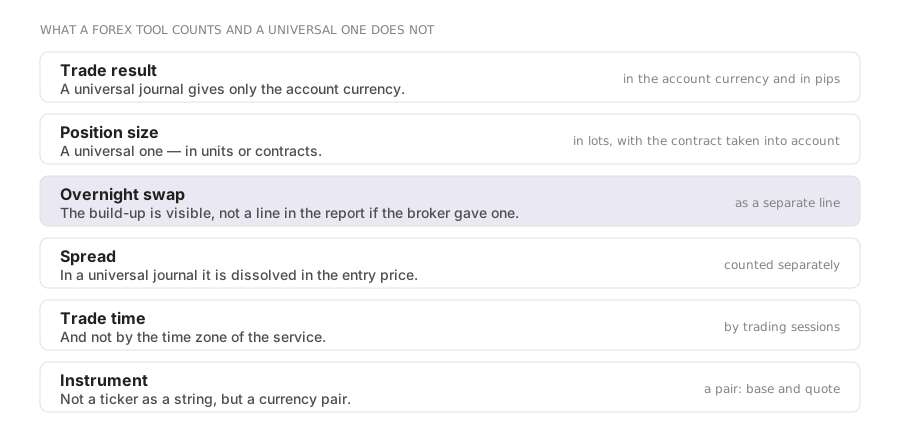
Read next
