 APTF
APTFALAllocationA portfolio of strategies and risk rules
Tool reviewSoftware
Forex Tester: a hundred trades by the rules in one evening
Forex Tester solves an arithmetic problem: collecting a sample. To find out whether you follow your own rules you need one and a half to two hundred trades. On a live account that is a quarter of a year and real money; in a simulator it is a few evenings and nothing. Everything else written about it is secondary.
Forex strategy tester: what it is and what it is not
A desktop program: a local quote database, the chart advances candle by candle at a controllable speed, trades are opened by hand. A forex strategy tester in this sense is not about the strategy but about the hands.
+It compresses timeA year of history plays through in an evening. For collecting a sample of execution that is the only available method.
+It lets you repeat a mistakeThe same situation can be gone through ten times to see at which moment the hand reaches to enter before the signal.
+It works with data qualityLocal history and its accuracy are the strong side of the class. Gaps in the quotes spoil the conclusions more than one would think.
+It costs less than experienceA one-off licence against a lost deposit — the comparison does not favour learning with real money.
−It does not give real fearThe main limitation. On history it is not your money being lost, and half the problems of psychology simply do not arise.
−It provokes curve-fittingOn a familiar stretch you remember what came next. A result on studied history means nothing.
−It does not model execution preciselySlippage and the widening of the spread on news are approximate. Scalping cannot be tested with it.
−Does not replace the reviewThe simulator collects data. Calculating the rule-following share from it and drawing conclusions is still up to you.
How to calculate the rule-following share — the one number worth sitting down for
Profit in a simulator means nothing: it depends on the stretch of history. What matters is the share of trades made by the written rule — and that is what to calculate.
| Indicator | How it is calculated | What it tells you |
|---|---|---|
| Share of entries by the rule | Entries on signal ÷ all entries | Below 80 % — the rule does not work or is not formulated |
| Share of stops left in place | Trades without a stop move ÷ all trades | Below 90 % — the real risk per trade is unknown |
| Average size after a loss | Average lot after a stop ÷ the usual lot | Above 1.0 — spontaneous revenge trading is already present |
| Number of trades per session | Total trades ÷ number of sessions | Above plan — overtrading carries over to live as well |
| Share of trades outside the window | Trades outside the schedule ÷ all trades | Shows whether the routine holds without external control |
| The gap against the live account | Rule-following share on history − on live | That is the price of emotions: usually tens of percent |
Forex Tester: short answers
- Class of tool
- A desktop simulator for manual trading on history.
- Is it paid
- Yes, a licence. The exact terms are on the developer's site.
- Where the quotes come from
- Local history databases, with an import of your own data available.
- Does it test expert advisors
- For automation there is MetaTrader's own tester.
- Is it suitable for scalping
- Poorly: execution on minute targets is modelled approximately.
- Is there a free alternative
- Yes — the simulator in the FX Blue suite, simpler and inside MT4/MT5.
Versions and licence contents change; figures are deliberately not given here.
An evening protocol that produces a result
Without a protocol the simulator turns into a game: restarting the stretch until the curve looks nice. Below is an order that prevents this.
01Choose an unfamiliar stretch
History you have not studied. A familiar segment tests memory, not the rule.
5 minutes02Write down the rule and the limit
The entry rule in one sentence and a daily limit in trades. The limit is observed in the simulator too, otherwise you are training the breakdown.
10 minutes03Go through a hundred trades without restarting
Restarting the stretch after a losing streak trains exactly the thing you are treating.
2–3 evenings04Calculate the rule-following share and compare
The number from the simulator is compared with the same number from the live account journal. The gap is the price of emotions.
20 minutesWho needs a simulator and who is harmed by one
neededThose with few tradesOne or two trades a week is forty a year. Execution cannot be assessed on such a sample, and here a simulator is the only way out.
neededBefore changing the rulesA new rule is tested on history before it is tested with money. That is an order of magnitude cheaper.
harmfulThose looking for confirmationRestarting the stretch until the result is the one you want trains confirmation bias, examined in cognitive biases.
debatableThose whose problem is tiltThe simulator does not reproduce the state you came for. What works here is a limiter, not practice.
Three mistakes in working with history that devalue everything
A simulator turns easily into a trainer of self-deception. The mistakes are known, and all three are made for one reason — you want to see confirmation rather than fact.
mistake 1A run through a familiar stretchA segment you have already studied tests memory. The result on it is always inflated and carries over nowhere. Take a stretch you have not seen.
mistake 2Restarting after a losing streakPrecisely the habit the simulator is supposed to treat. A restart zeroes the sample and trains the belief that a bad run can be cancelled.
mistake 3Judging by profit rather than by executionProfit on a historical stretch depends on the stretch. The share of trades by the rule does not, and it carries over to a live account.
how it should be doneAn unfamiliar stretch, a hundred trades, one numberA three-evening protocol that yields a single quantity — the rule-following share. Everything else in a simulator is secondary.
Frequently asked questions
Does a simulator help with emotions?
Indirectly. It does not create fear and therefore does not train tolerance of it. What it does show is what share of your violations has nothing to do with emotions at all and comes from an unclear rule.
How is it better than a demo account?
Speed. A demo runs in real time, a simulator hundreds of times faster. The other differences are examined on the page about moving from demo to live.
Are a forex strategy tester and a simulator the same thing?
No. A tester runs an expert advisor automatically, a simulator lets you trade by hand. The first tests an algorithm, the second tests a person.
How many trades do you need to go through?
To assess the rule-following share, one to two hundred. For conclusions about a strategy's profitability even a thousand on one stretch of history is not enough.
Can you get by with a free one?
Yes, the FX Blue simulator closes the same task inside MetaTrader. Paying makes sense for the quality of the history and for convenience, once you have established that you will actually use it.
Does the result carry over to a live account?
The rule-following share carries over partly and always for the worse. Profit does not carry over at all: those are different conditions and different money.
Other tools in this section
EWEdgewonkA journal that analyses your state
Tool reviewFBFX BlueFree account analytics and a simulator
Tool reviewTVTradervueAn online journal with review
Tool reviewEALimiter expert advisorA class of tools, not a brand
Tool review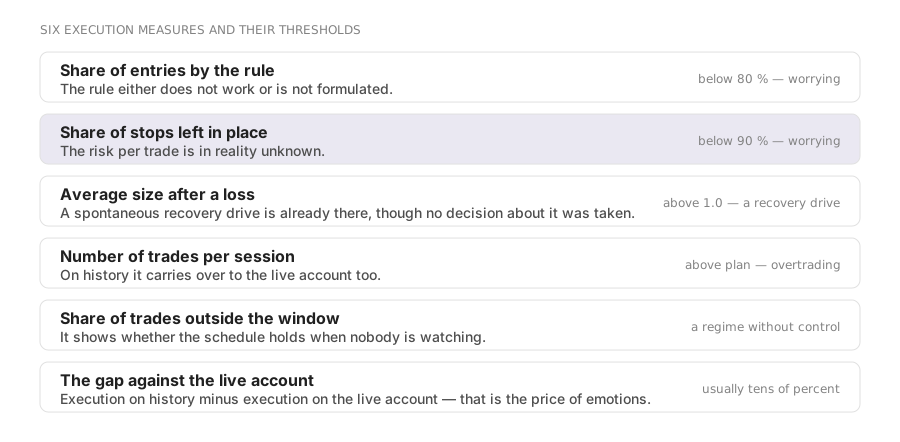
Read next
