 APTF
APTFStress from forex trading
Stress from forex trading arises not from losses as such but from the combination of three conditions: the result is unpredictable, the money is your own, and the feedback comes immediately. These conditions cannot be removed. What can be removed is the fourth one that amplifies them — a position size that does not match your tolerance.
Four sources of tension
Stress in trading rarely has a single source: usually there are four, and they add up. Taking them apart one at a time is cheaper than fighting the combined feeling.
The main source and almost always an underestimated one. If a one-percent move against the position spoils your evening, the size was chosen by desire rather than by calculation.
treated by halving the lotWhen it has not been decided in advance where the exit is, every candle becomes an occasion for a decision. The tension is created not by the market but by the need to choose with no criterion.
treated by a planTrading on borrowed money, on savings set aside for housing, or on your last funds is guaranteed tension regardless of technique.
not treated by techniquesThe goal of «reaching an income in three months» when the learning takes years creates a constant background of failure.
treated by revising the timescaleHow stress changes decisions
Stress does not make a person stupider — it narrows the horizon. Attention shifts to the nearest result, and the ability to hold the distance in mind falls. Hence specific mistakes.
| What happens | How it looks in the trades |
|---|---|
| The planning horizon narrows | The goal changes from «a profit for the quarter» to «a profit today» |
| Sensitivity to loss grows | Profit is taken earlier, a loss is sat out longer |
| Inhibition falls | Entries appear that would have been rejected in the morning |
| Attention narrows | Points of the checklist are skipped, especially the last ones |
| The need for release grows | A trade becomes a way to relieve tension rather than to make money |
How to trade forex without stress: what lowers the tension
Works and does not work
When it is worth taking a break
A break is not a sign of weakness but a planned action. It is useful to agree with yourself in advance on the specific conditions under which it happens automatically.
How to measure your own level of tension
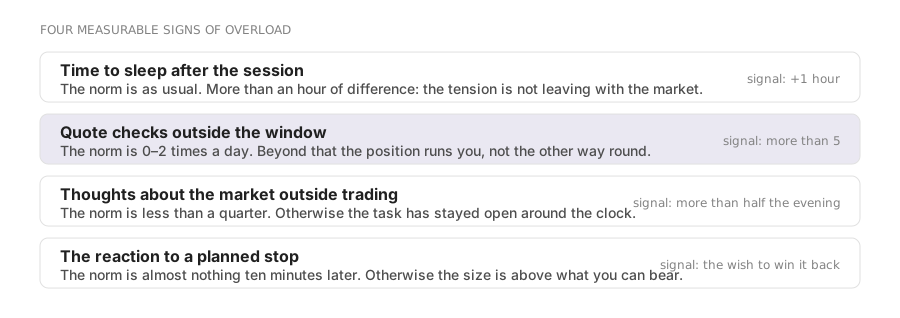
«I feel anxious» is not a quantity. Below are four observable indicators that can be counted without instruments and that change earlier than the account result does.
| Indicator | How to measure it | Normal | Signal |
|---|---|---|---|
| Time to sleep after the session | From closing the terminal to falling asleep | as usual | More than an hour's difference — the tension is not leaving with the market |
| Number of quote checks outside the window | How many times a day you opened the terminal or the app | 0–2 | More than five — the position is running you, not the other way round |
| Talking about the market outside trading | The share of the evening taken up by thoughts about positions | less than a quarter | More than half — the task has stayed open around the clock |
| The reaction to a planned stop | What you feel ten minutes after it is hit | almost nothing | Irritation and a wish to get it back — the size is beyond what you can bear |
The last row is the most accurate. The reaction to a planned stop is directly proportional to position size: at a risk you genuinely tolerate, a stop being hit is not remembered ten minutes later. If it is remembered in the evening, the size was not chosen by calculation.
for most people that is noticeably less than «one percent of the deposit» at the start — and that is normal
Six techniques that lower the background, and what they cost
The list is sorted by reliability. The first three always work; the last three are auxiliary and do not replace the first ones.
The quickest remedy: it takes away most of the background in a single day. The price is a smaller result in absolute terms during the adjustment.
always worksThe position is run without you, and there are no occasions for reappraisal. The price is that you cannot step in manually in a force majeure.
always worksThe start and the end are set by the clock, not by the result. Your brain stops holding the task open around the clock.
always worksAffects resilience more than any concentration technique: inhibition is restored only by sleep.
background, not a techniqueLower the general level of arousal. They do not replace rules: a calm person with no stop loses just as much as an agitated one.
auxiliaryTakes away the sense that the problem is unique. It gives no footing — only your own statistics do that.
auxiliaryWhat is deliberately absent from the list. The advice «do not look at the floating result» is not here, because it demands effort at the very moment when no effort is left. A closed terminal gives the same effect — but without spending self-control.
Frequently asked questions
How do I trade without stress?
Entirely without stress there is no way, and that is normal: the uncertainty of the result creates tension by itself. The manageable part is the level: it falls almost linearly with position size and with the number of decisions you have to take while a trade is open.
Does meditation help?
As a way to lower the general level of arousal, yes. As a replacement for rules, no. The practical order: first reduce size and place the orders, then everything else.
Why is it easier after closing a position, even at a loss?
Because the uncertainty ends, and it is uncertainty that creates the bulk of the tension. This, incidentally, is where early profit-taking grows from: closing relieves the tension regardless of the result.
Is stress always bad?
Moderate arousal before a trade is normal and does not interfere with execution. The problem begins where tension persists outside trading: it gets in the way of sleep, spoils the weekend, does not pass after the positions are closed.
Read next
