 APTF
APTFEWEdgewonkA journal that analyses your state
Tool reviewSoftware
Allocation on forex: a portfolio of strategies instead of a single bet
Allocation on forex is a web platform that connects to your MT4 or MT5 account and assembles separate strategies into a portfolio: each is given a share of capital, its own copying rules and its own risk ceiling. For our subject this is the earliest possible point of intervention — the decision is made by a setting before the first trade, not by hand during a drawdown. One disclosure straight away, so you do not have to look for it: the platform is built by the same team that makes this site.
A portfolio of forex trading strategies: what problem it solves
A single strategy is a single bet, and its drawdown feels like the failure of everything. That is exactly where the decisions the rest of this site is devoted to come from: double the size, switch the system off at the bottom, jump to a «more workable» one. A portfolio does not remove the drawdown, it removes its emotional weight: when there are six strategies, a minus on one of them is a line in a report, not a catastrophe of the evening.
+A drawdown stops being personalOne strategy in the red against five that are working does not demand an immediate decision. It is precisely the need to decide immediately that produces most of the expensive mistakes.
+Position size is set in advanceEach strategy receives a share of equity and works only within it. Increasing the lot «because the signal is good» is technically impossible — and that is the most common form of greed.
+The rules live in the interface, not in your headSizes, instruments, hours and days are configured once. A setting does not get tired and does not argue with you after three stops in a row.
+The capital stays with youThe account is yours, the money is on it, the platform connects to it and executes your rules. No transfer of funds into someone else's management takes place.
−Does not remove riskA portfolio distributes risk between strategies, it does not cancel it. A combined drawdown is possible and will happen — the question is its depth, not whether it occurs.
−Does not replace understandingOnly someone who understands what they are configuring can set shares and filters. The tool gives you levers, not answers.
−Does not cancel correlationSix strategies on the same pairs in the same market regime fall together. Diversification is calculated, not declared.
−Gives no guaranteesNo figure in the platform is a promise of income. Historical statistics describe the past.
Three mechanisms that work directly on psychology
The platform does more, but for our subject exactly three things matter. All three are about a decision being made in advance and executed without willpower.
01Capital shares: position size cannot be inflated
Each strategy is allotted its own part of equity, the rest stays as a free reserve. A strategy physically cannot go beyond its share, and the question «take a bit more, the signal is clear» simply does not arise. This is the same mechanism as a daily limit, only at portfolio level.
against greed02Drawdown entry threshold: the moment of the start is set by a number
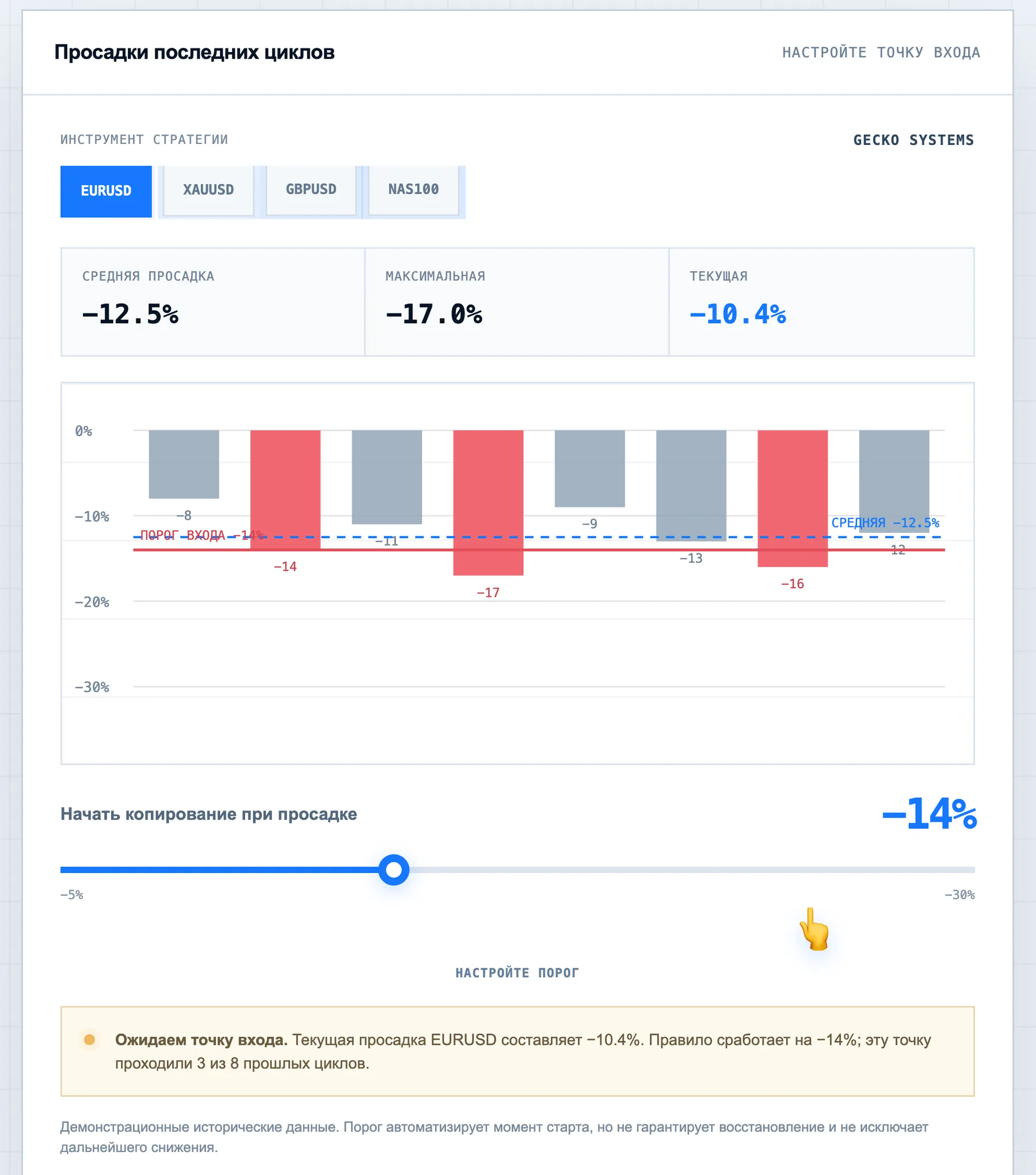
Connecting to a strategy can be made conditional: start copying when its drawdown reaches a set depth. The decision «enter now or wait» stops being taken on emotion and turns into a rule compared against the average historical drawdown.
against FOMO03Filters by segment: the weak part is switched off rather than endured
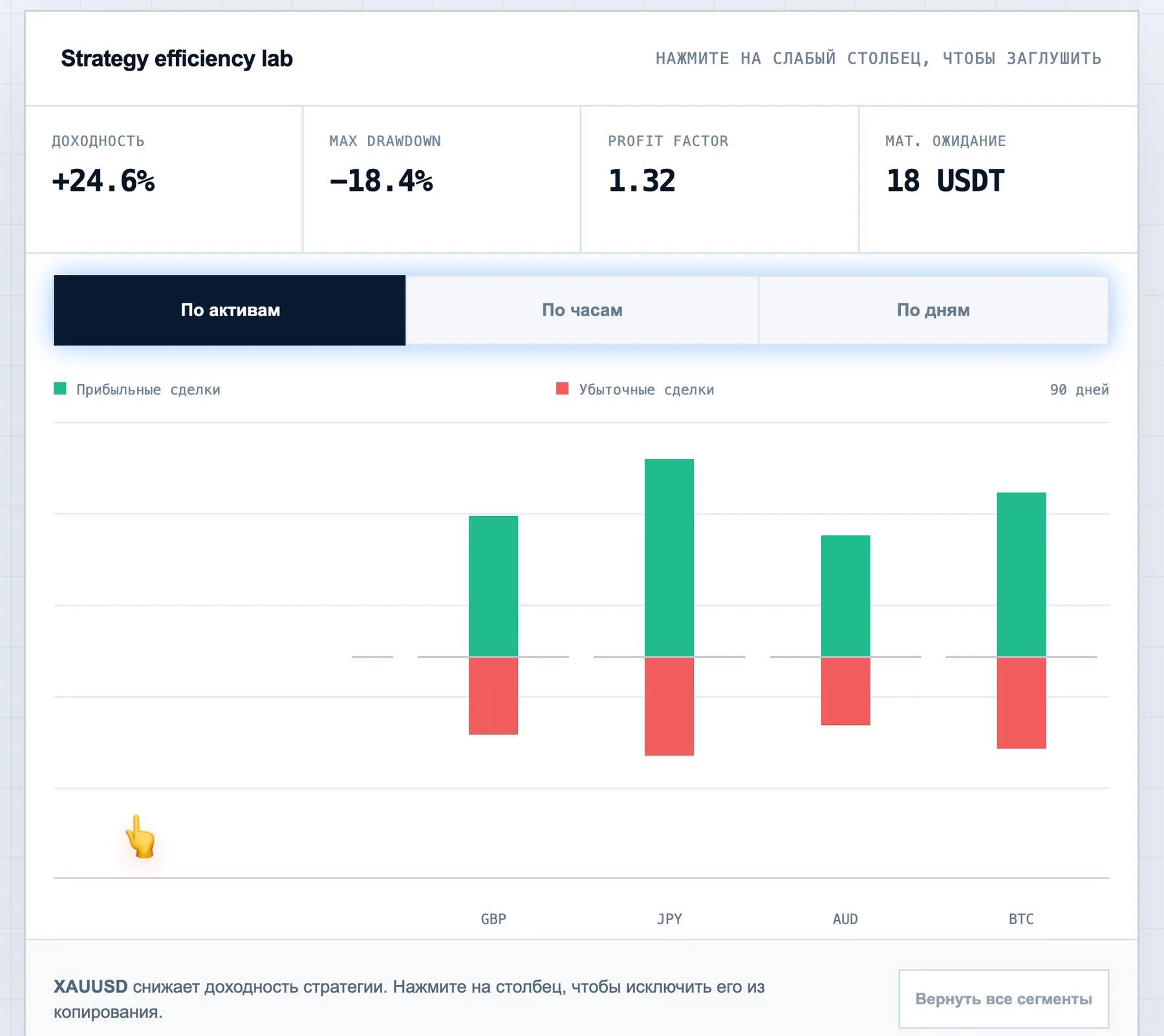
A strategy's result is broken down by instrument, hour and day, and the weak segment is switched off from copying. This is exactly the review we recommend doing with a trade journal — but applied with one button rather than with willpower.
against self-deception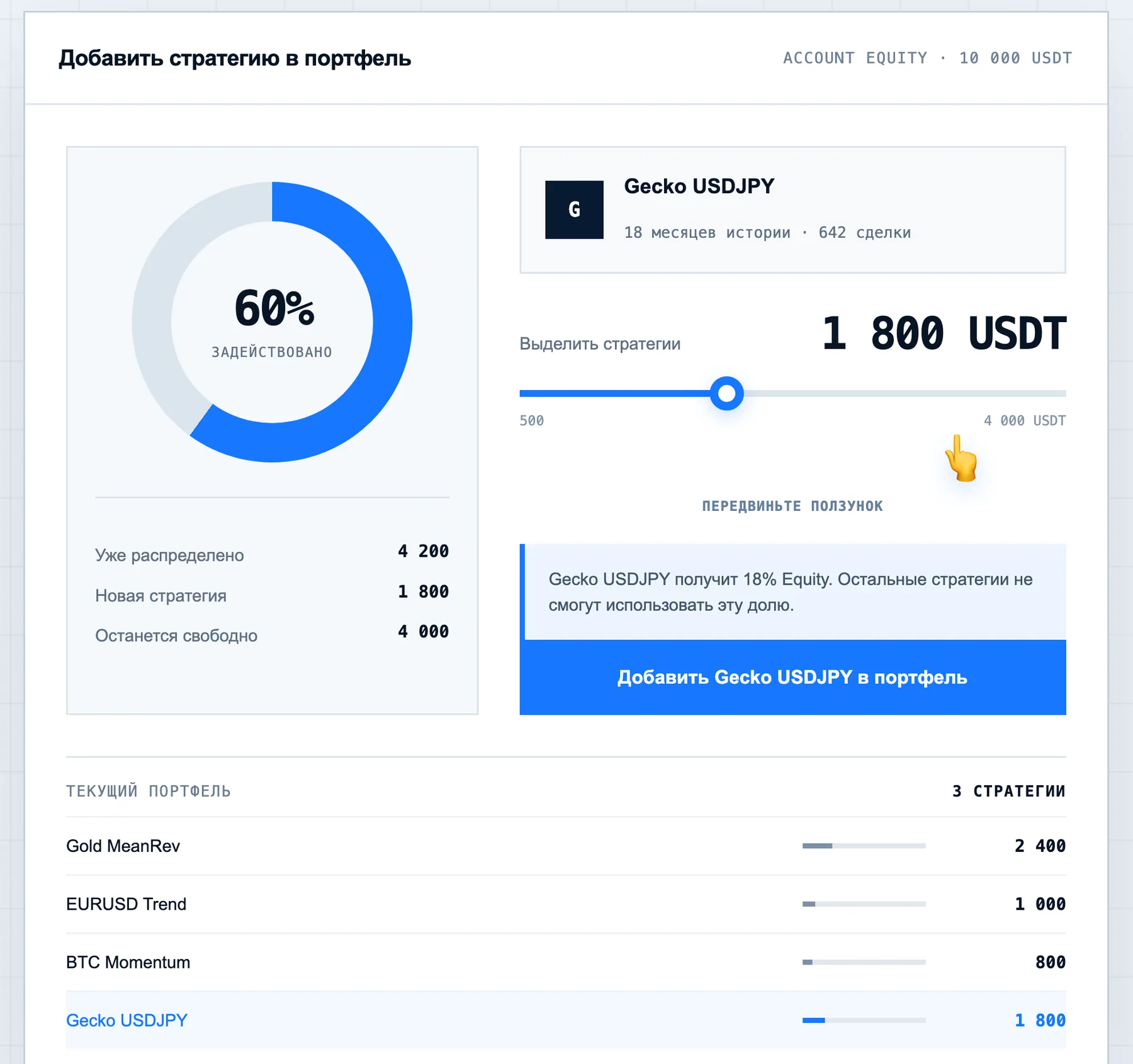
The product interface is in Russian
The product interface is in Russian
The product interface is in Russian
A farm of trading robots step by step: from account to portfolio
The route is short and needs no new infrastructure: the account stays with your broker and the terminal is the familiar one.
01Connect an MT4 or MT5 account
An existing account is linked to the web platform. Capital is not transferred anywhere: the platform reads the account and executes your rules on it.
once02Assemble a farm of trading robots from the catalogue
Strategies are chosen from the available list — algorithms and signals with a track record. The point is not to find the best one but to collect dissimilar ones.
an evening03Hand out shares and limits
A percentage of equity and a risk ceiling for each strategy. This is exactly the decision that must not be taken during a drawdown, and here it is taken in advance.
half an hour04Configure the copying rules
Size, instruments, hours, days, maximum positions. Everything that has to be held in your attention on an ordinary account is moved into a setting.
an hour05Work with statistics, not with the chart
From here the task changes: not to guess the move, but once a week to look at the segments and remove what drags the portfolio down.
hours per week06Review the shares on a schedule
Once a quarter, not after a bad week. A calendar review is the only kind that does not turn into the same impulse, merely slower.
once a quarterAllocation: short answers
- Where the money stays
- On your trading account with your broker.
- What gets connected
- An MT4 or MT5 account; the work is done from a browser.
- Is this a signal service?
- No. This is management of a portfolio, of copying and of risk; signals are only one of the sources inside it.
- Do you have to sit at the terminal
- No: copying runs automatically.
- Is income guaranteed
- No, and claiming otherwise would be a lie. The tool lets you manage risk by data, it does not remove risk.
- Who builds the platform
- The same team that makes this site. Stated in the first paragraph so that it is not discovered after the fact.
The list of strategies, the set of features and the access terms are updated regularly. Check them in the platform itself: no review, this one included, keeps up with the product.
Who it suits and who it does not
An honest breakdown matters more than persuasion: a tool bought for the wrong task is abandoned within a month, and that is bad for both sides.
suitableThose who already copy and are tired of choosingIf you change trader or robot after every drawdown, the problem is not the choice but the absence of a portfolio. Shares and rules close exactly that gap.
suitableAn algo trader with several systemsComparing robots against each other, finding weak segments and assembling a portfolio out of them is the platform's direct job.
not suitableThose looking for guaranteed incomeNo such tool exists. If the expectation is phrased as «I want a percent a month», disappointment is guaranteed in advance — in money and in time.
debatableA complete beginnerThe settings require understanding what you are configuring. It makes sense first to take the breakdown-map test and start a journal: without them the portfolio is assembled blind.
What to look at before deciding
A sensible order is to see the interface on your own scenario first and count money second. Thirty minutes of a demonstration is usually enough to tell whether this is your logic or not.
01
The platform on the product siteThe portfolio sections, the share allocation and the statistics are shown directly on allo.trading — interactively, before any registration.02
A demonstration on your scenarioA walk-through from connecting the account to the portfolio rules. Useful even as an outside view of your current setup.03
Your own numbers to handBring to the conversation your share of off-plan trades and the depth of the worst drawdown of the year. With them the conversation is concrete; without them it is generic.04
Correlation as a separate questionThe main technical question for any portfolio of strategies: how dissimilar they are. Ask that one first.See the platform at allo.tradingExternal product site. The developer is the same team that makes this reference.
What allocation gives you: the arithmetic of one drawdown
The main effect of a portfolio is calculated in one line and requires no faith in diversification. A strategy in a 20 % drawdown costs the account exactly as much as the share of capital you gave it.
| Strategies in the portfolio | Share of each | A 20 % drawdown on one costs the account | Needs to be recovered |
|---|---|---|---|
| 1 | 100 % | 20.0 % | +25.0 % |
| 2 | 50 % | 10.0 % | +11.1 % |
| 3 | 33 % | 6.7 % | +7.2 % |
| 6 | 17 % | 3.3 % | +3.4 % |
The top and bottom rows differ not in return but in the decision a drawdown ends with. Minus 20 % on the account forces you to do something the same day; minus 3.3 % is a line in a report. How much has to be recovered after any depth is calculated by the drawdown calculator.
The caveat without which the table lies: the rows hold with equal shares and unrelated strategies. Six systems on the same pairs in the same market regime fall together, and then the portfolio behaves like a single strategy. That is why correlation is the first question worth asking.
Frequently asked questions
How is this different from ordinary copy trading?
Ordinary copying repeats trades one for one: you connect and watch. Here a layer of rules stands between the strategy and your account — a share of capital, a risk limit, filters by instrument and by time. The difference is the one between «I backed a trader» and «I manage a portfolio».
Does the money have to be transferred to someone?
No. The account stays yours with your broker, the platform connects to it. This is a matter of principle: any scheme that hands funds over to someone else's management is a different story with different risks.
How much time does it take per week?
Copying runs by itself; your part is reviewing the statistics and adjusting the settings. In practice that is a few hours a week, and they go into numbers rather than into watching a chart.
Will this solve my discipline problems?
Partly, and only those that can be moved into a setting: position size, moment of entry, the set of instruments. The urge to intervene by hand will not disappear — but it will have fewer occasions and fewer levers.
Why is the review on your own site?
Because hiding the connection is worse than naming it: the platform is built by the same team, and that is stated in the very first paragraph. Checking us is easy — the review follows the same template as the other five, with the same «what the tool does not do» block and without a single figure of return. Comparing it with Edgewonk takes a minute.
Is there any point if I have one working strategy?
The point appears with the second one. With a single strategy the portfolio mechanisms degrade into an ordinary risk limiter — an expert advisor is enough for that.
Other tools in this section
FTForex TesterA history simulator for manual practice
Tool reviewFBFX BlueFree account analytics and a simulator
Tool reviewTVTradervueAn online journal with review
Tool reviewEALimiter expert advisorA class of tools, not a brand
Tool review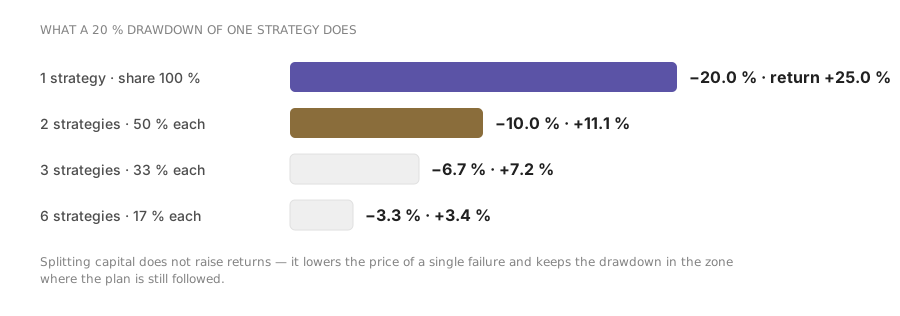
Read next
